Artificial intelligence increasingly contributes to decisions that shape access, opportunity, services, evaluation, and institutional treatment. Although explainability is widely treated as a foundation of trustworthy AI, an explanation does not by itself enable an affected person to question a decision, introduce corrective evidence, request reconsideration, or obtain an appropriate response. This article develops a conceptual Human Contestability Framework for connecting explanation to actionable decision challenge. The framework treats contestability as a socio-technical requirement involving affected-person access, reason-giving, explanation quality, procedural accessibility, evidence submission, meaningful human review, override capacity, escalation, appeal, redress, correction, organizational accountability, documentation, auditability, monitoring, and feedback updating. It distinguishes interpretability and transparency from contestability, and separates human review from meaningful reconsideration, appeal from recourse, and correction from broader redress. The framework proposes that contestable decision design should begin with decision-context and stakeholder mapping, define explanation and evidence requirements, establish challenge and review pathways, assign organizational responsibilities, preserve traceable records, and use contestation outcomes to identify recurring system or governance failures. Its contribution is not a validated procedure or universal institutional model, but an integrated structure for analyzing whether people can move from receiving an AI-supported decision to questioning its basis and seeking a reasoned institutional response. Contestability may strengthen trustworthy-AI planning, but it does not independently establish fairness, legality, ethical sufficiency, accountability, operational safety, or deployment readiness. Domain-specific validation, accessible procedures, competent human review, organizational governance, and continuing evaluation remain necessary.
Explainable artificial intelligence encompasses diverse technical methods, explanation purposes, audiences, and interpretive assumptions. Human explanation research further shows that useful explanations are often selective, contrastive, socially situated, and responsive to the questions people actually ask, while technical surveys demonstrate that explanation methods differ substantially in scope, fidelity, and output [1-3]. These differences matter when AI contributes to consequential decisions because a technically available explanation may still be inaccessible, incomplete, unresponsive, or disconnected from any process through which its reasoning can be challenged.
Trustworthy-AI discourse commonly connects transparency with fairness, responsibility, accountability, and human control, yet high-level principles do not automatically become usable procedures for people affected by algorithmic decisions [4]. A person may receive a feature-attribution display, confidence score, or generic description of model logic without knowing which evidence was used, which uncertainties mattered, who owns the decision, how to submit corrective information, or whether a reviewer can reconsider the outcome. Explanation therefore provides only one component of a wider contestability architecture.
Human contestability concerns the practical capacity to question a decision, dispute its factual or normative basis, provide relevant evidence, request meaningful reconsideration, escalate unresolved concerns, and receive a reasoned response. Depending on context, it may also include override, appeal, correction, recourse, or redress. These functions are related but not interchangeable. Questioning may clarify a decision without changing it; reconsideration reopens its substance; override interrupts or replaces an output; appeal introduces a further review level; correction repairs an identified error; and redress addresses relevant consequences where institutionally supported.
This article proposes a Human Contestability Framework that links explanation, decision challenge, human review, appeal, correction, accountability, and organizational learning. The framework is intended to clarify conceptual relationships, required inputs, responsible functions, procedural dependencies, evidence infrastructures, and residual risks. It does not prescribe a universal appeals mechanism, establish legal or procedural sufficiency, or imply that every AI-supported decision should use the same form of review. Its contribution is a structured basis for designing and evaluating challengeable, overrideable, appealable, and correctable decision processes without treating any single safeguard as sufficient.
Contestability extends trustworthy-AI design beyond disclosure by connecting system explanations to affected-person participation, institutional answerability, and pathways for corrective action. Contestable-AI scholarship frames contestability as a lifecycle property rather than a post-decision interface; normative analysis emphasizes that decision subjects may be owed opportunities for participation and challenge beyond transparency; and accountability scholarship links reason-giving to identifiable relationships of answerability and consequence [5-7]. Contestability is therefore best understood as a socio-technical capacity distributed across interfaces, reviewers, organizational roles, records, and governance arrangements.
At minimum, a contestable process requires notice of the decision, access to decision-relevant information, an understandable challenge route, an opportunity to submit evidence, a responsible reviewing function, and a reasoned response. Human involvement alone cannot satisfy these conditions. Human-oversight policies may fail when reviewers lack time, competence, authority, independence, institutional support, or realistic opportunities to depart from automated recommendations [8]. Meaningful contestability must consequently evaluate what humans can actually examine and change rather than merely confirm that a human is formally present.
Procedural accessibility is central because a challenge mechanism that cannot be discovered, understood, afforded, or completed is only nominally available. Affected-person access requires clear communication about who may raise concerns, what elements can be questioned, which evidence may be submitted, how the case will progress, and when a response should be expected. Decision-subject access additionally requires information specific to the individual decision rather than only general model documentation. Escalation should be possible when an initial reviewer lacks authority, competence, independence, or capacity to resolve the disputed issue.
Contestability should nevertheless not be treated as a guarantee of trustworthy outcomes. A procedurally accessible challenge can still operate within a defective decision system, reproduce institutional power imbalances, or offer remedies too limited to address material harm. Explanation may support contestability but cannot establish it alone; contestability may support accountability but cannot certify it; and a completed review pathway does not prove fairness, compliance, safety, or deployment readiness. The framework therefore incorporates explicit no-sufficiency and no-guarantee boundaries alongside its positive procedural requirements.
Explanations intended for contestability must be evaluated according to the task they are meant to support. Explanation quality may involve fidelity, correctness, relevance, completeness, stability, and comprehensibility, while usefulness concerns whether the explanation helps a person identify a disputed input, assumption, rule, uncertainty, or decision boundary. Existing XAI evaluation approaches remain heterogeneous, making it unsafe to infer that an explanation is useful merely because it is available or positively received [9]. Contestability consequently requires purpose-specific evaluation tied to questioning, evidence submission, and reconsideration.
Static disclosure may also be insufficient when the affected person cannot ask follow-up questions. Conversational and layered explanation models suggest that people may need progressively deeper information, including why an outcome occurred, why an alternative did not occur, what evidence mattered, and how contextual assumptions affected the decision [10]. Such interaction should not be confused with persuasion. Its contestability value lies in helping a person identify what can be questioned, which information may be missing, and whether a formal review route is appropriate.
Explanation accessibility depends on language, format, cognitive load, technical literacy, domain knowledge, disability access, and the person’s uncertainty about the system or decision. Empirical evidence indicates that explanation demand varies with users’ epistemic uncertainty and that additional explanation is not uniformly beneficial [11]. A contestable system should therefore permit layered detail and supportive interpretation without assuming that personalization automatically produces understanding. User confidence, readability, or satisfaction cannot substitute for direct assessment of comprehension and challenge performance.
Decision rationales should identify the material grounds for the outcome, while evidence-basis explanations should describe the relevant data, records, assumptions, provenance, and limitations. Feature contributions may help identify influential inputs where technically appropriate, but they should not be presented as complete causal reasons. Counterfactual and contrastive explanations can clarify decision boundaries, yet algorithmic-recourse research shows that apparent actionability may be infeasible, causally invalid, discriminatory, unstable, or unfairly burden-shifting [12]. Institutional correction and redress must therefore remain distinct from recommendations that a person alter their circumstances.
Actionable explanation should primarily clarify what may be questioned, corrected, supplemented, or escalated within the decision process. Domain experts may be needed to interpret specialized evidence, while affected persons require a form that remains procedurally and cognitively accessible. Explanation design should disclose uncertainty and limitations, connect technical information to decision-specific reasons, and identify available next steps without implying guaranteed reversal or remedy. Table 1 summarises explanation requirements for contestable AI decisions, linking reason-giving, evidence basis, accessibility, uncertainty, actionability, and challenge pathways.
Table 1. Explanation Requirements for Human Contestability in AI Decisions: Reason-Giving, Explanation Quality, Explanation Usefulness, Accessibility, Completeness, Uncertainty, Evidence Basis, Counterfactual and Contrastive Support, Actionability, Cognitive Accessibility, Decision Challenge, and Explanation-Sufficiency Boundaries
Explanation or contestability requirement | Core challenge question | Required explanation feature | Contestability function | Potential output | Failure or misinterpretation risk | Human interpretation or governance need | Framework role |
Explanation quality | Is the explanation accurate, faithful, relevant, and sufficiently stable? | Method-appropriate fidelity, correctness, and relevance checks | Determines whether the explanation can support scrutiny | Evaluated explanation artifact | Persuasive but unfaithful narrative | Technical and human-centered validation | Explanation quality gate |
Explanation usefulness | Does the information help identify a challengeable issue? | Task-specific and decision-relevant content | Connects understanding to questioning | Identified challenge ground | Equating satisfaction with usefulness | Challenge-task evaluation | Functional explanation condition |
Accessibility and cognitive accessibility | Can the affected person perceive and understand the explanation? | Plain language, accessible formats, layering, and support | Enables practical use | Accessible explanation package | Technical disclosure that transfers burden to the person | Inclusive comprehension testing | Human access condition |
Completeness and uncertainty | Are material reasons, limitations, omissions, and uncertainties disclosed? | Decision-relevant coverage and calibrated uncertainty | Reveals disputed assumptions and evidence gaps | Completeness and uncertainty statement | Information overload, omission, or false precision | Layered communication and risk interpretation | Evidence-sufficiency condition |
Reason-giving and decision rationale | Why was the decision reached? | Decision-specific reasons, criteria, and contextual judgment | Supports direct questioning | Reason statement | Post-hoc rationalization | Fidelity and domain review | Core explanation function |
Evidence basis | What data and records materially supported the decision? | Sources, provenance, material evidence, and limitations | Enables factual dispute and correction | Evidence summary | Unverifiable evidence or privacy exposure | Data-governance and access controls | Factual challenge layer |
Feature contribution where supported | Which inputs influenced the model output? | Valid local or global attribution with limitations | Identifies potentially disputed inputs | Contribution display | Treating association as causation or full rationale | Statistical and domain interpretation | Optional technical layer |
Counterfactual explanation where supported | What change might have altered the output? | Feasible, stable, and causally cautious alternatives | Clarifies decision boundaries | Counterfactual scenario | Impossible or burden-shifting recommendation | Feasibility and causal assessment | Optional boundary layer |
Contrastive explanation where supported | Why this outcome rather than a relevant alternative? | Explicit comparison outcome and distinguishing reasons | Supports targeted questioning | Contrastive reason | Manipulative or irrelevant comparison | User-sensitive selection of the comparison | Interactive explanation layer |
Actionable explanation | What can be questioned, corrected, or supplemented? | Clear distinction between procedural actions and behavioural recommendations | Links reasons to challenge and correction pathways | Challenge options | Confusing recourse with institutional remedy | Procedural guidance and governance review | Explanation-to-action link |
User and domain expertise | What level of detail is required for meaningful interpretation? | Adjustable depth and access to qualified expertise | Supports both personal and specialist scrutiny | Expertise-appropriate explanation | Incorrect expertise assumptions or inaccessible technical review | User control and competent reviewer access | Interpretation condition |
Decision challenge pathway | How can the explanation be used to initiate review? | Visible route for questioning, evidence submission, status, and escalation | Converts explanation into contestability | Registered challenge | Disclosure without usable procedure | End-to-end pathway testing | Procedural bridge |
No explanation-sufficiency boundary | Is explanation connected to review and correction? | Challenge, reconsideration, response, escalation, and correction options | Prevents explanation-only governance | Explicit pathway linkage | Claiming clarity itself establishes contestability | Framework-integrity assessment | Conceptual boundary |
No human-understanding guarantee boundary | Has understanding been assessed rather than presumed? | Direct comprehension and task-performance evidence | Limits unsupported claims | Comprehension evidence with limitations | Treating readability or confidence as understanding | Human-centered evaluation | Evaluation boundary |
Human review should mean substantive examination of the disputed decision rather than ceremonial confirmation of an AI output. Effective oversight requires clarity about what is reviewed, when intervention can occur, who holds authority, and how responsibility is allocated [13]. The reviewer should have access to the original decision record, relevant explanations, submitted evidence, system limitations, and applicable decision criteria. Without these inputs, the reviewer may be unable to distinguish model error, data error, contextual omission, procedural failure, or a legitimate disagreement about judgment.
Meaningful human review additionally requires practical capacity to question and alter the outcome. Human intervention should not function as a formal step through which institutions disclaim responsibility while preserving automated conclusions [14]. Reviewers need sufficient competence, time, independence, organizational support, and authority to confirm, modify, reverse where supported, suspend, or escalate a decision. Their reasoning and use of evidence should be documented so that the review process itself remains open to later examination.
Human control should also be interpreted beyond the immediate operator. A society-in-the-loop perspective recognizes that consequential systems embody institutional objectives and value choices that may require collective or governance-level reconsideration, not only case-by-case intervention [15]. Individual review can correct a particular decision, while governance review may identify recurring explanation failures, inappropriate decision boundaries, systematic data problems, unsuitable escalation criteria, or institutional assumptions that cannot be resolved through frontline override alone.
Neither human-in-the-loop nor human-on-the-loop arrangements inherently provide superior or fairer decisions. Experimental evidence indicates that human decision makers are not automatically perceived as fairer than machine decision makers, reinforcing the need to evaluate the actual quality of review rather than relying on decision-maker identity [16]. Human reviewers may introduce automation bias, inconsistency, fatigue, unsupported discretion, or institutional defensiveness. Reviewer presence must therefore be assessed alongside independence, competence, authority, reasoning quality, workload, and the consequences of intervention.
Override capacity should be distinguished from meaningful control. A technically available override mechanism may be unusable when intervention is too late, risks are unclear, authority is ambiguous, or organizational incentives discourage departure from automated recommendations. Review documentation and review logs should record material evidence, questions, actions, reasoning, timing, and outcome without being treated as proof that review was adequate. Human review does not guarantee fairness, and override does not certify accountability, safety, or control; both require contextual evaluation, monitoring, and governance [8].
Appeal, redress, recourse, and correction address different dimensions of contestability. An appeal requests further review of an earlier determination, while recourse concerns feasible actions that may improve a person’s position. Correction repairs erroneous data, reasoning, procedure, or outcomes, whereas redress responds to relevant consequences where an institution has authority and capacity to do so. Fairness-perception research indicates that people evaluate algorithmic decisions through both outcome-related and procedural considerations, including transparency, voice, consistency, and the identity of the decision maker [17]. These perceptions are important for design evaluation but cannot independently establish substantive fairness.
A usable appeals pathway requires decision-specific access to information. Affected persons need sufficiently intelligible information about the logic, significance, evidence, and anticipated consequences of an automated decision before they can identify meaningful grounds for challenge [18]. Process notice should clarify available stages, relevant timelines, responsible functions, evidentiary opportunities, possible outcomes, and escalation routes. Access to general system documentation alone may be inadequate when the disputed issue concerns individualized evidence, contextual circumstances, or a particular combination of human and automated judgment.
A contestable pathway should connect explanation and questioning to evidence submission, human reconsideration, escalation, appeal, reasoned response, correction, and organizational learning. Procedural fairness may be supported when affected stakeholders can express concerns and when institutions use structured processes to identify and reason through competing values; nevertheless, participation does not prove fair outcomes, and no single deliberative structure is universally appropriate [19, 20]. Figure 1 illustrates the human contestability pathway, showing how an AI decision can move from explanation and challenge to human reconsideration, appeal, redress, correction, accountability, and feedback updating.
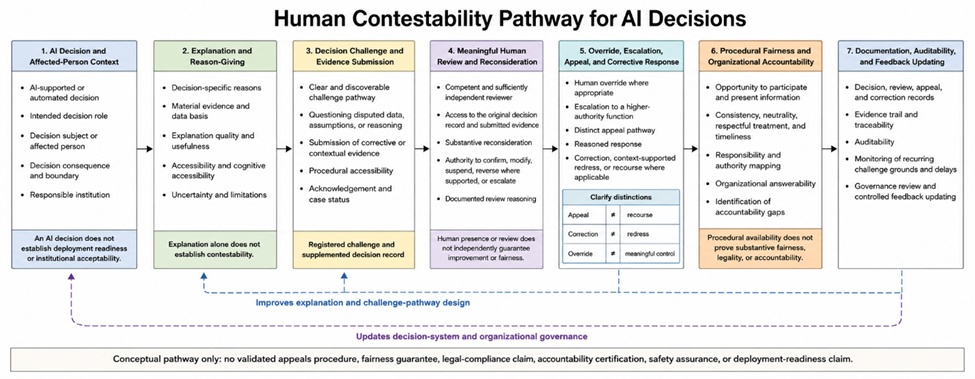
Figure 1. Human Contestability Pathway for AI Decisions
A conceptual pathway showing AI decision explanation, affected-person challenge, evidence submission, human review, reconsideration, override, appeal, redress, correction, accountability, documentation, and feedback updating.
Procedural fairness concerns the qualities of the process through which a decision is reached and reconsidered. Relevant considerations may include procedural accessibility, opportunity to present information, neutrality, consistency, respectful treatment, timeliness, and reason-giving. Procedural justice additionally directs attention to the legitimacy of institutional authority and the treatment of competing interests. Due-process terminology should be used only where conceptually and contextually supported; the framework does not infer legal entitlements or prescribe jurisdiction-specific hearing requirements.
A reasoned response should address the material questions raised, identify the evidence considered, explain the resulting determination, communicate uncertainties or limitations, and state any remaining options. Successful correction should extend beyond changing a displayed decision when the original error has propagated into data records, downstream systems, or organizational practices. Appeal and correction outcomes should therefore feed controlled monitoring and root-cause analysis. Appeals do not guarantee fairness, redress cannot eliminate every consequence, and procedural availability alone does not establish legal or ethical sufficiency.
Contestability depends on organizational governance because explanations, reviews, appeals, corrections, and monitoring require authority, resources, and coordinated ownership. Responsible-AI governance research indicates that organizations need linked structures, processes, roles, controls, and lifecycle mechanisms rather than isolated ethical principles [21]. Institutional accountability should identify which organization remains answerable for the decision, while organizational accountability should specify which units own explanation provision, review, correction, escalation, record preservation, and systemic learning.
AI governance is distributed across developers, deployers, data stewards, operators, decision makers, reviewers, suppliers, assurance functions, and affected stakeholders [22]. Responsibility mapping should distinguish these roles and reveal points at which authority or answerability may disappear. Accountability-gap analysis is particularly important where one actor develops the model, another supplies data, a third integrates the system, and a separate institution makes or communicates the decision. Shared responsibility should not be interpreted as the absence of responsibility.
Data governance supports contestability by preserving information about provenance, quality, transformations, access, ownership, and permitted use [23]. A reviewer cannot reliably examine a disputed decision when relevant data cannot be traced or when derived variables, supplier inputs, and processing histories are unavailable. Decision documentation should record material inputs, outputs, human contributions, uncertainty, and final status. Model and data documentation should provide context for technical scrutiny without being mistaken for individualized decision explanations.
High-level transparency principles must also be translated into explicit requirements that identify audiences, information needs, responsible actors, system components, and evaluation criteria [24]. Reviewer mandates should specify scope, authority, competence expectations, conflict rules, and access to specialized support. Decision, review, appeal, and correction logs should preserve relevant actions, evidence, reasoning, timing, versions, and implementation status. Auditability requires that authorized evaluators can inspect this evidence, whereas traceability concerns the ability to connect decisions, models, data, actors, and changes across the lifecycle.
Monitoring should examine recurring challenge grounds, procedural delays, inaccessible pathways, reversal or correction patterns, unresolved harms, and differential effects across relevant groups. Governance review can use these signals to determine whether problems arise from explanation design, data quality, model limitations, reviewer practice, institutional rules, or the decision context itself. Documentation and logs may support accountability, but they cannot certify it without answerability, authority, correction capacity, and consequential follow-through [7]. Table 2 maps human override, decision reconsideration, appeals, redress, procedural fairness, and organizational accountability requirements for contestable AI decision systems.
Table 2. Human Override, Decision Reconsideration, Appeals, Redress, Procedural Fairness, and Organizational Accountability Requirements for Contestable AI: Human Review, Override Capacity, Reviewer Independence, Appeal Pathways, Correction, Reasoned Response, Auditability, Traceability, Documentation, Review Logs, Appeal Logs, and Accountability Boundaries
Contestability or accountability requirement | Core procedural or governance question | Responsible actor or process | Required evidence or practice | Contestability or accountability function | Potential output | Failure or responsibility gap | Framework role |
Meaningful human review | Can a human substantively examine and alter the decision? | Competent, empowered reviewer | Decision record, explanation, evidence, time, authority, and review criteria | Reconsiders the decision | Confirmed, modified, reversed where supported, or escalated decision | Rubber-stamping or automation bias | Core review stage |
Human oversight | Is system operation monitored across the decision lifecycle? | Operator, supervisor, or governance function | Monitoring indicators, intervention criteria, logs, and escalation rules | Detects individual and systemic failures | Intervention or governance referral | Oversight without authority or resources | Lifecycle control |
Human override and override capacity | Can an authorized person stop or replace an AI output when justified? | Designated decision authority | Usable control, defined grounds, competence, authority, and fallback process | Enables immediate intervention | Overridden or suspended output | Technical control without practical ability to use it | Conditional control stage |
Decision reconsideration | Can the decision be reopened using disputed or new evidence? | Reviewer or reconsideration function | Original evidence, submitted evidence, reasons, and applicable criteria | Reassesses substantive judgment | Affirmation, modification, correction, or escalation | Repeating the original process without fresh consideration | Reconsideration stage |
Reviewer independence | Is the reviewer sufficiently separate from the original decision or error? | Review-management function | Conflict assessment, recusal rules, and reporting separation | Reduces defensive confirmation | Independent review assignment | Same actor defending the original decision | Review safeguard |
Reviewer competence | Can the reviewer interpret the domain, model, evidence, and procedure? | Reviewer-selection and training function | Competence criteria, training, specialist access, and support | Enables substantive evaluation | Competence-supported determination | Authority without expertise | Review safeguard |
Appeals pathway | Can an initial outcome receive further authorized review? | Appeal or escalation function | Entry criteria, timelines, record transfer, independence, and reasoned determination | Provides further reconsideration | Appeal determination | Appeal that replicates the same review | Formal escalation |
Complaint process | Can broader process or system concerns be recorded and routed? | Complaint-handling function | Accessible intake, classification, acknowledgement, investigation, and response | Captures issues beyond one decision outcome | Complaint record and assigned action | Collection without investigation | Issue-intake layer |
Redress and recourse | Can confirmed error or disadvantage receive an appropriate response? | Responsible institution | Harm assessment, feasibility, authority, and contextual response options | Addresses consequences or prospective position | Context-dependent redress or recourse | Burden shifting or symbolic response | Corrective-response layer |
Correction | Can erroneous data, reasoning, process, or outcomes be repaired? | Reviewer, data steward, decision owner, or system owner | Error verification, provenance, scope, propagation analysis, and authority | Repairs the decision and related records | Corrected decision or record | Local correction without downstream repair | Correction stage |
Reasoned response | Does the institution explain how the challenge was considered? | Reviewer or responsible decision function | Issues raised, evidence considered, reasoning, outcome, uncertainty, and next steps | Demonstrates answerability | Accessible response | Generic response that ignores material arguments | Response obligation |
Procedural fairness | Is the process accessible, participatory, consistent, impartial, and reasoned? | Review and governance functions | Voice, neutrality, respectful treatment, consistency, and timeliness | Evaluates procedural quality | Procedural assessment | Treating perceived fairness as substantive fairness | Evaluation layer |
Responsibility mapping | Who must explain, review, correct, escalate, and learn? | Organizational governance function | Role–task–authority map | Prevents responsibility diffusion | Responsibility allocation | Named roles without authority or resources | Governance architecture |
Decision, model, and data documentation | Can the decision and relevant technical context be reconstructed? | Decision owner, developer, and data steward | Inputs, outputs, versions, provenance, limitations, human actions, and changes | Supports scrutiny | Linked documentation package | Generic records disconnected from the decision | Evidence infrastructure |
Decision, review, appeal, and correction logs | Can procedural events and actions be traced? | System, records, review, and appeals functions | Actors, evidence, actions, reasoning, timing, outcome, and implementation | Supports monitoring and audit | Linked case history | Incomplete, formulaic, or inaccessible logs | Trace infrastructure |
Auditability and traceability | Can authorized evaluators inspect duties and reconstruct dependencies? | Assurance and governance functions | Evidence integrity, access controls, identifiers, lineage, and retention | Enables structured examination | Audit findings or trace reconstruction | Treating logs as proof of accountability | Assurance condition |
Monitoring and governance review | Are recurring failures identified and addressed institutionally? | Operational monitoring and governance functions | Trends, delays, outcomes, subgroup patterns, root causes, and action ownership | Supports systemic correction | Governance determination and controlled update | Individualizing structural problems | Lifecycle learning |
No accountability guarantee boundary | Do records and roles produce real answerability and corrective capacity? | Institutional governance | Evidence of authority, consequence, response, and implementation | Limits accountability overclaiming | Residual accountability-gap statement | Paper accountability without practical consequence | Explicit boundary |
The proposed framework begins with use-case and decision-context definition because contestability requirements depend on what decision is being made, how AI contributes to it, who exercises authority, and what consequences may follow. Ethics-to-practice scholarship shows that principles require lifecycle tools and methods, although the availability of such instruments does not itself establish responsible practice [25]. Decision-context definition should therefore identify the system’s role, human contribution, affected processes, foreseeable consequences, decision boundaries, and institutional ownership before a challenge mechanism is specified.
The second stage maps affected persons and stakeholders and assesses the potential severity, reversibility, scale, recurrence, uncertainty, and distribution of decision impacts. Responsible design should attend to socially significant objectives, relevant stakeholders, feasibility, and foreseeable harm rather than treating technical optimization as the sole design problem [26]. Impact classification is a contextual planning device, not a certification score. It helps determine the required depth of explanation, urgency of review, independence of reconsideration, and strength of documentation and monitoring.
The third and fourth stages define explanation requirements and connect them to challenge, evidence submission, review, and escalation. Contemporary XAI research emphasizes the need for interdisciplinary, interactive, context-sensitive, and rigorously evaluated explanations [27]. The framework therefore requires explanation purpose, audience, evidence basis, uncertainty, accessibility, and limitations to be specified before selecting an explanation method. Challenge interfaces should allow disputed facts, assumptions, data, or reasoning to be identified and should preserve submitted evidence for meaningful reconsideration.
The fifth stage integrates human review, override, appeal, redress, correction, and procedural-fairness evaluation. End-user XAI research indicates that explanation needs concern format, completeness, accuracy, and currency as well as technical content [28]. The review pathway should therefore distinguish clarification from reconsideration, and reconsideration from appeal. Override should remain conditional on authority and context; correction should include relevant downstream records; and redress should not be inferred merely because the original decision has been changed.
The final stages assign organizational responsibilities, design documentation and auditability, link decision, review, appeal, and correction logs, and establish monitoring and governance feedback. Human-centered AI treats automation and human control as dimensions that can be jointly designed rather than opposing endpoints [29]. The framework accordingly combines technical, procedural, human, and institutional controls while preserving explicit boundaries against explanation sufficiency, human-review sufficiency, override sufficiency, appeal-fairness guarantees, redress guarantees, accountability certification, compliance claims, and deployment-readiness claims. Table 3 presents the proposed human contestability framework linking decision context, affected-person access, explanations, challenge pathways, human review, override, appeal, redress, correction, accountability, auditability, monitoring, and feedback updating.
Table 3. Proposed Human Contestability Framework for AI Decisions: Decision Context, Affected-Person Mapping, Explanation Requirements, Reason-Giving, Evidence Basis, Challenge Pathways, Evidence Submission, Human Review, Reconsideration, Override, Appeal, Redress, Correction, Procedural Fairness, Organizational Accountability, Auditability, Monitoring, Feedback Updating, and Deployment Boundaries
Framework stage | Core purpose | Required input | Contestability function | Potential output | Validation or governance need | Failure risk | Feedback mechanism | Decision boundary |
Use-case and decision-context definition | Define what decision is made, by whom, and with what consequences | Purpose, workflow, system role, institutional authority, and downstream effects | Establishes the object of contestation | Decision-context statement | Domain and institutional review | Vague scope or concealed secondary use | Update after material system or process change | Does not establish acceptability of the use case |
Affected-person and stakeholder mapping | Identify people with contestability needs and actors with duties | Direct and indirect affected persons, users, operators, developers, reviewers, and governance actors | Defines access, participation, and responsibility | Stakeholder map | Participatory and impact-sensitive assessment | Exclusion of low-power or indirectly affected groups | Revise after complaints or newly identified impacts | Does not prove complete representation |
Decision-impact and risk classification | Match procedural depth to potential consequences | Severity, reversibility, scale, vulnerability, recurrence, and uncertainty | Informs explanation, review, and escalation intensity | Contextual impact classification | Periodic domain reassessment | Underclassification or false precision | Reclassify after incidents and appeal evidence | Not a legal or safety certification |
Explanation-requirement definition | Specify the information required for questioning | Stakeholder needs, decision logic, risk, expertise, and available methods | Defines explanation purpose and audience | Explanation specification | Human-centered evaluation | Generic transparency requirements | Revise using comprehension and challenge evidence | Explanation is not sufficient alone |
Reason-giving and evidence-basis design | Connect the outcome to material reasons and evidence | Rationale, data provenance, model contribution, human judgment, and uncertainty | Enables factual and reasoning challenge | Decision-specific reason package | Fidelity, privacy, completeness, and domain review | Plausible but unfaithful reasoning | Correct when evidence or rationale errors emerge | Does not establish correctness |
Challenge-pathway design | Define how a person initiates and follows a challenge | Entry point, grounds, stages, owners, timing, status, and escalation | Converts disagreement into a managed process | Registered challenge | Accessibility and end-to-end testing | Hidden or fragmented pathway | Analyse abandonment and delay patterns | Does not guarantee successful challenge |
Evidence-submission mechanism | Permit relevant corrective and contextual information | Accepted evidence, secure channel, provenance, relevance criteria, and acknowledgement | Supplements the decision record | Evidence-submission record | Privacy, security, and evidence-handling controls | Evidence gathered but not considered | Review decisive and rejected evidence patterns | Does not require acceptance of every submission |
Human review and reconsideration | Provide substantive reassessment | Original record, explanation, challenge, evidence, and criteria | Reopens the decision | Reasoned review outcome | Competence, independence, workload, and authority assessment | Rubber-stamping or automation bias | Monitor review quality and recurring issues | Human review does not guarantee improvement |
Override and escalation design | Enable urgent intervention or higher-authority review | Override grounds, authority, control point, fallback, and escalation criteria | Prevents automatic continuation or dead-end review | Override, suspension, or escalation record | Operational and governance evaluation | Unusable or arbitrary intervention | Analyse override and escalation consequences | Override does not certify meaningful control |
Appeal-pathway design | Provide a distinct further-review route | Eligibility, timelines, record transfer, authority, independence, and communication | Supports further reconsideration | Appeal determination | Accessibility, consistency, and implementation monitoring | Same reasoning repeated under a new label | Review appeal trends and implementation | Appeal does not guarantee fairness |
Redress and correction design | Address verified error and relevant consequences | Error, harm, authority, downstream effects, and contextual response options | Repairs records or supports an appropriate response | Correction or context-supported redress | Domain-specific authorization and verification | Symbolic response or incomplete propagation | Root-cause and downstream-impact analysis | Redress cannot eliminate every harm |
Procedural-fairness review | Evaluate process quality | Access, participation, neutrality, reasons, timing, outcomes, and subgroup evidence | Assesses whether the pathway operates fairly in procedure | Procedural findings | Independent human-centered evaluation | Confusing perceived and substantive fairness | Redesign processes based on findings | Does not prove fairness or legality |
Organizational-responsibility mapping | Assign explanation, review, correction, escalation, and learning duties | Workflow, roles, authority, suppliers, and governance structure | Prevents responsibility diffusion | Accountability map | Leadership authorization and gap analysis | Roles without authority or resources | Update after organizational change | Does not certify accountability |
Documentation and auditability design | Preserve evidence for reconstruction and scrutiny | Decision, model, data, process, version, and role requirements | Enables examination | Documentation architecture | Integrity, access, privacy, security, and retention controls | Excessive, missing, or inaccessible records | Audit findings inform documentation changes | Logs are evidence rather than proof |
Review, appeal, and correction logging | Record actions and outcomes | Actors, evidence, reasons, actions, timing, implementation, and status | Supports traceability and systemic analysis | Linked case history | Proportional access and integrity controls | Unstructured or privacy-invasive logging | Route recurring patterns to governance review | Logging does not validate procedural quality |
Monitoring and feedback updating | Identify recurring failures and support controlled improvement | Challenge grounds, delays, outcomes, disparities, corrections, and root causes | Converts contestation into lifecycle learning | Controlled organizational or system update | Change control and post-update evaluation | Learning from biased or manipulated feedback | Closed-loop monitoring | Updating does not prove improvement |
Governance review | Address systemic or high-impact issues | Aggregated evidence, stakeholder input, risk analysis, and authority | Moves from individual cases to institutional reconsideration | Governance decision and assigned action | Mandate, competence, transparency, and follow-through | Symbolic governance | Monitor implementation and residual risks | Does not establish universal legitimacy |
Explicit framework boundaries | Prevent conceptual overclaiming | Evidence on explanation, review, appeal, correction, accountability, compliance, and readiness | Preserves cautious interpretation | Boundary and residual-risk statement | Framework-integrity review | Treating framework completion as certification | Reassess boundaries as evidence develops | No fairness, compliance, accountability, safety, or deployment-readiness guarantee |
For AI developers and deployers, the framework suggests that technical explanation features should be designed together with procedural affordances. A feature-attribution display or counterfactual output becomes contestability-relevant only when users can identify disputed elements, communicate contextual information, and reach a responsible reviewing function. Challenge interfaces should therefore be evaluated for discoverability, accessibility, cognitive burden, evidence submission, status transparency, and escalation—not merely for aesthetic usability or explanation satisfaction [5].
For decision-support operators and human reviewers, future work should examine meaningful-review quality rather than human presence alone. Relevant dimensions include reviewer competence, independence, workload, authority, access to domain expertise, use of submitted evidence, reasoning quality, and ability to intervene before harm becomes difficult to reverse. Organizations should also study when automation bias, inconsistent discretion, or institutional incentives weaken reconsideration. These are empirical evaluation questions rather than assumptions resolved by assigning a human reviewer.
For governance bodies, assurance functions, and complaint handlers where supported, contestation records may provide evidence of recurring explanation failures, inaccessible processes, data-quality problems, unresolved responsibility gaps, and unequal procedural burdens. Responsible-AI governance research supports examining such evidence across organizational structures and lifecycle processes [21]. Auditability and traceability can support this examination, but audit findings should not be interpreted as automatic proof of fairness, accountability, compliance, or safety.
Research should investigate how affected persons and decision subjects understand explanations, discover challenge pathways, submit evidence, experience review, and evaluate reasoned responses across domains and populations. It should also assess appeal accessibility, correction propagation, residual harm, stakeholder participation, and lifecycle learning [27]. These implications offer research and design directions rather than legal advice, procurement guidance, audit instructions, model-selection recommendations, prescribed grievance structures, compliance assurance, safety certification, or deployment instruction.
Trustworthy AI decision design should connect explanation to action. The proposed Human Contestability Framework organizes the conditions through which affected people may question AI-supported decisions, submit evidence, obtain meaningful reconsideration, trigger override or escalation where appropriate, pursue appeal, seek correction or context-supported redress, and receive a reasoned response. It also connects individual contestation to responsibility mapping, documentation, auditability, monitoring, governance review, and feedback updating. The framework clarifies that explanation, human review, override, appeal, redress, and accountability mechanisms are mutually dependent but individually insufficient. It remains a conceptual structure requiring domain-specific evaluation, accessible institutional procedures, human-centered assessment, organizational capacity, and continuing governance; it does not establish fairness, legal compliance, ethical sufficiency, operational safety, certification, or deployment readiness.
None
None
None
None
Open Access The author(s) retain copyright. This article is licensed under the Creative Commons Attribution-NonCommercial-ShareAlike 4.0 International License. It may be shared and adapted for non-commercial purposes with appropriate attribution, an indication of changes, and distribution of adaptations under the same license. Third-party material may be subject to separate terms identified in its credit line. View the license at https://creativecommons.org/licenses/by-nc-sa/4.0/.
 Transparent Intelligence Publishing