Trustworthy artificial intelligence cannot be established permanently before deployment because deployed and adaptive systems operate within environments that continue to change. Data distributions, relationships between inputs and outcomes, user behaviour, organizational workflows, system dependencies, and decision consequences may diverge from the conditions represented during development. This article proposes a continuous trustworthiness lifecycle for organizing the evidence and governance activities needed after deployment. The approach begins with a versioned deployment context and risk baseline, followed by monitoring of data, concept, behavioural, performance, calibration, uncertainty, and explanation changes. It integrates technical monitoring with human interpretation, user and affected-person feedback, incident identification, corrective action, accountability review, model restriction, temporary suspension, retirement, and assurance updating. The framework distinguishes drift signals from confirmed degradation and treats explanation stability as a separate assurance concern rather than assuming that stable predictive performance preserves explanation quality. Incidents and complaints are positioned as lifecycle evidence that may trigger investigation, remediation, updating, rollback, restriction, suspension, or retirement review. These responses remain human-governed because monitoring indicators cannot independently determine safety, ethical acceptability, legal compliance, or appropriate end-of-life decisions. The main contribution is a conceptual lifecycle that connects post-deployment monitoring with decision records, responsibility allocation, residual-risk communication, and organizational learning. It supports structured reasoning about whether an adaptive AI system should continue operating unchanged, undergo correction, operate within a narrower scope, be suspended, or enter retirement review. The framework requires domain-specific evaluation and institutional governance and should not be interpreted as an implemented assurance process, certification model, or deployment-readiness determination.
Trustworthy AI is often evaluated through development-time evidence concerning predictive performance, robustness, fairness, transparency, explainability, and human oversight. Such evidence is indispensable, but it is temporally bounded: it describes a particular model version, dataset, task definition, technical environment, and intended-use context. Machine-learning assurance must therefore extend across operation, system change, maintenance, and eventual withdrawal rather than conclude when a model passes pre-deployment evaluation [1].
The persistence of trustworthiness is not only a technical monitoring problem. High-level ethical principles cannot independently determine how operational responsibilities should be allocated, how emerging failures should be investigated, or when continued use becomes unjustified [2]. Post-deployment assurance consequently requires institutional mechanisms that connect observed evidence with accountable decisions, documented interventions, stakeholder communication, and review of unresolved risk.
Trustworthy-AI scholarship identifies recurring principles such as transparency, accountability, fairness, non-maleficence, privacy, and human control, while also showing that trustworthiness is a multidimensional property involving technical performance, explainability, robustness, governance, and social context [3, 4]. These dimensions can change independently. A model may preserve aggregate accuracy while becoming poorly calibrated for a changing population, produce unstable explanations, generate unequal errors, or influence users in ways that were not represented during initial evaluation.
This article develops a conceptual continuous trustworthiness lifecycle for adaptive and deployed AI. The lifecycle connects deployment-risk baselines, drift detection, performance and explanation monitoring, uncertainty assessment, feedback, incident response, correction, accountability, restriction, suspension, retirement, and assurance updating. It does not treat continuous monitoring as certification. Instead, it organizes lifecycle evidence that may support qualified and human-governed decisions while maintaining explicit boundaries against claims of permanent trustworthiness, automatic safety determination, legal sufficiency, ethical completeness, or deployment readiness.
Adaptive AI includes systems whose effective behaviour may change through retraining, parameter updates, changing data pipelines, altered software dependencies, feedback loops, or evolving patterns of use. Even systems whose model parameters remain fixed can become functionally different when workflows, populations, interfaces, or decision contexts change. Real-world implementation therefore introduces generalizability, integration, safety, and maintenance problems that cannot be resolved by development performance alone [5].
Changing environments weaken the assumption that development data adequately represent future operation. Distribution shift may arise from new populations, collection practices, devices, institutions, incentives, or external conditions. Causal relationships can also change, meaning that apparently similar inputs no longer support the same conclusions. Deployment-time stability must therefore be investigated rather than inferred from historical validation [6].
Post-deployment evidence is required because performance may deteriorate gradually, episodically, or only within particular contexts. Continual quality monitoring can identify emerging discrepancies, while longitudinal evidence demonstrates that properties such as calibration may change after initial development [7, 8]. However, deterioration cannot always be attributed to a single source: data quality, prevalence, user behaviour, workflow change, software modification, feedback effects, or model updating may interact.
Pre-deployment evaluation is therefore necessary but not permanently sufficient. A continuous assurance approach should maintain versioned information about intended purpose, supported populations, decision context, known limitations, technical dependencies, monitoring coverage, and responsible actors. Material changes should trigger renewed review of whether existing evidence remains applicable. This framework supports that review process, but it does not determine whether a system is ready for deployment or whether its continued operation is legally, ethically, or operationally acceptable.
Concept drift concerns change in the relationship between observed inputs and the outcome or decision target. Such change can make previously learned patterns unreliable even when the incoming features appear familiar. Drift may be abrupt, gradual, incremental, recurring, or difficult to distinguish from noise, making continuing detection and adaptation important but inherently uncertain [9].
Data drift and broader distribution shift concern changes in operational data rather than necessarily in the underlying target relationship. Input values, correlations, missingness, coding practices, or population composition may change, while output and prediction distributions may also move. These signals can indicate new operating conditions, but drift and model degradation are not equivalent: a statistically detectable shift may be benign, while consequential performance loss may occur without a prominent distributional warning [10].
Recurring concept drift further complicates lifecycle assurance because earlier conditions can return. A model may encounter seasonal, institutional, or behavioural patterns that resemble previously observed states without being identical to them. Lifecycle learning should consequently retain information about earlier contexts, interventions, and model versions rather than assume that operational evolution follows a one-directional path [11].
Drift-detection methods also vary in their assumptions, evidential requirements, sensitivity, and compatibility with adaptation strategies. Their performance depends on the form of change, label availability, stream characteristics, evaluation design, and model behaviour [12]. False alerts may generate unnecessary intervention and alert fatigue, whereas missed alerts can delay recognition of degradation. Detector outputs must therefore be interpreted alongside performance, calibration, uncertainty, incident, contextual, and stakeholder evidence.
Behavioral drift extends the analysis beyond statistical distributions. Users may over-rely on outputs, develop workarounds, alter documentation, contest recommendations, or change their behaviour in response to the system. Feedback loops may then affect future observations, labels, opportunities, and outcomes. Context shift, environmental change, data-quality drift, model drift, population shift, calibration drift, and user-behaviour change should therefore be treated as related but distinct assurance signals. Table 1 summarises post-deployment drift and shift risks that can undermine trustworthiness after pre-deployment evaluation has been completed.
Table 1. Post-Deployment Drift and Shift Risks in Adaptive AI Systems: Data Drift, Concept Drift, Distribution Shift, Behavioral Drift, Model Drift, Data Quality Drift, Input Shift, Output Shift, Prediction Shift, Calibration Drift, Population Shift, Context Shift, Environmental Change, User Behavior Change, and Pre-Deployment Sufficiency Boundaries
Drift or shift type | Core monitoring question | How the change appears | Potential trustworthiness risk | Detection or evidence need | Failure or misinterpretation risk | Governance response need | Lifecycle role |
Data drift | Have operational feature distributions changed? | Changed ranges, frequencies, correlations, or missingness | Reduced transferability or uneven errors | Baseline comparison plus contextual evidence | Benign change may be treated as harmful | Investigate significance and affected scope | Early warning |
Concept drift | Has the input–outcome relationship changed? | Changed errors or conditional relationships | Learned decision rules become unreliable | Recent labels, calibration, and domain review | Noise or delayed labels may be misclassified | Escalated model and domain assessment | Reassessment trigger |
Distribution shift | Has the joint data-generating distribution changed? | Combined input, outcome, or relationship change | Development evidence may no longer transfer | Distribution and task-performance evidence | One distance measure may be treated as conclusive | Transferability review | Umbrella shift category |
Behavioral drift | Have model, user, or workflow behaviours changed? | Changed reliance, overrides, recommendations, or workarounds | New sociotechnical failure pathways | Interaction logs and qualitative evidence | Change may be attributed to the wrong component | Human-factors investigation | Sociotechnical monitoring |
Model drift | Has effective model behaviour changed? | Changed versions, preprocessing, outputs, or dependencies | Deployed system differs from evaluated system | Versioned model and pipeline evidence | Upstream causes may be overlooked | Change control and renewed evaluation | Model-change control |
Data quality drift | Have completeness, accuracy, timeliness, or provenance changed? | Missing, delayed, corrupted, or inconsistent inputs | Hidden degradation or inequitable errors | Quality and provenance checks | Stable distributions may conceal low quality | Data-governance intervention | Input-integrity assurance |
Input shift | Are new values, categories, devices, or combinations appearing? | Movement beyond development coverage | Unsupported extrapolation | Feature-level and multivariate comparison | Interactions may be missed | Intended-use review | Coverage boundary |
Output shift | Has the distribution of model outputs changed? | Changed score, class, ranking, or abstention rates | Altered allocation or intervention patterns | Output trends linked to context and outcomes | Legitimate prevalence change may be mistaken for defect | Decision-impact review | Downstream warning |
Prediction shift | Are predictions changing without an established justification? | Score movement or reordered classifications | Changed treatment of cases or groups | Cohort and version comparisons | Output change may reflect valid context change | Contextual investigation | Behavioural signal |
Calibration drift | Do predicted probabilities match observed frequencies? | Systematic overprediction or underprediction | Misleading confidence and threshold use | Recent outcome-linked calibration evidence | Discrimination metrics may conceal the problem | Recalibration or broader review | Performance assurance |
Label shift | Has outcome prevalence changed under the required assumptions? | Changed class proportions | Biased probabilities or decisions | Outcome prevalence and assumption checks | Shift may be claimed without verifying assumptions | Domain and performance review | Conditional diagnostic |
Covariate shift | Have inputs changed while the outcome mechanism is assumed stable? | New feature frequencies or regions | Poor transfer to operational cases | Input evidence and stability-assumption review | The assumption may be unverifiable | Transferability assessment | Conditional diagnostic |
Population shift | Has the composition of affected populations changed? | New demographic, geographic, clinical, or behavioural groups | Emerging disparity or exclusion | Representation and subgroup evidence | Population change may be reduced to one attribute | Fairness and scope review | Equity-sensitive monitoring |
Context shift | Have purpose, workflow, stakes, or institutional conditions changed? | Outputs acquire different meanings or consequences | Prior evidence becomes contextually invalid | Workflow and impact documentation | Identical data may be assumed to imply identical use | Governance and scope review | Sociotechnical reassessment |
Environmental change | Have external operating conditions changed? | New sites, devices, practices, threats, or constraints | Invalid assumptions or unexpected failure modes | Dependency and environmental evidence | External causes may be omitted | System-level investigation | External-change signal |
User behavior change | Have operators or affected users changed how they engage with the system? | Automation bias, avoidance, gaming, or workarounds | Overreliance, exclusion, or feedback distortion | Usage and qualitative evidence | Behavioural records may be treated as self-explanatory | Human-centered review | Feedback-loop monitoring |
Pre-deployment sufficiency boundary | Can initial evaluation permanently establish trustworthiness? | Evidence becomes stale as operation changes | False confidence in historical validation | Continuing lifecycle evidence | Approval may be treated as permanent | Scheduled and event-triggered reassessment | Foundational boundary |
Drift-detection guarantee boundary | Does an alert or absence of an alert determine trustworthiness? | Detector warning or silence | False reassurance or unnecessary action | Corroborating technical and human evidence | Imperfect signals become automated verdicts | Human-governed interpretation | Mandatory decision boundary |
Performance monitoring should examine more than whether aggregate accuracy remains close to an initial benchmark. Continuing assurance may require calibration, uncertainty, error severity, subgroup performance, decision utility, abstention behaviour, and the consequences of outputs in current workflows. Explanation monitoring adds a distinct question: whether the system continues to provide explanations that are faithful, sufficiently stable, contextually appropriate, and useful for the stakeholders expected to interpret them [13].
Explanation stability concerns whether similar cases or justified perturbations produce reasonably consistent explanatory accounts. Explanation consistency compares repeated runs or methods, while fidelity concerns whether an explanation accurately represents the model behaviour it claims to describe. Quantitative evaluation can examine fidelity, robustness, complexity, sensitivity, and related properties, but evaluation choices must remain aligned with the explanation method and intended purpose [14].
Explanation instability may arise from model updates, changes in data relationships, explanation-method sensitivity, or operation near decision boundaries. Feature-attribution rankings may shift, counterfactual suggestions may become inconsistent, and explanations may remain visually plausible despite weak fidelity. Current evaluation practices are fragmented, so no single stability, robustness, or uncertainty metric can establish that explanations remain adequate [15].
Human interpretation is equally important because explanation usefulness depends on the stakeholder, task, decision context, and reason for requesting an explanation [16]. Monitoring should therefore integrate performance signals, drift signals, explanation stability, uncertainty, user complaints, affected-person feedback, incidents, and evidence about how explanations influence reliance and contestation. Figure 1 illustrates the continuous monitoring logic for adaptive AI, showing how drift, performance change, explanation instability, uncertainty, and human feedback can trigger review, correction, restriction, or escalation.
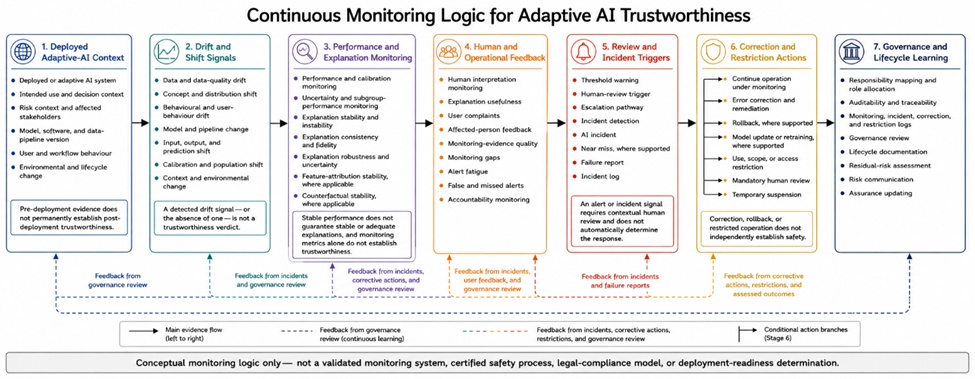
Figure 1. Continuous Monitoring Logic for Adaptive AI Trustworthiness
A conceptual monitoring pathway showing drift signals, performance changes, explanation instability, uncertainty changes, human feedback, incident signals, review triggers, correction, restriction, and governance review.
The monitoring process must itself be evaluated. Missing or delayed outcomes, incomplete subgroup information, unreported incidents, weak provenance, and inaccessible feedback channels can produce monitoring gaps. Excessive alerts may reduce reviewer attention, whereas false alerts and missed alerts can distort intervention. Continuous assurance must therefore assess the coverage, timeliness, representativeness, traceability, and decision relevance of monitoring evidence. Even well-designed monitoring cannot independently establish operational safety, accountability, legal compliance, ethical sufficiency, or deployment readiness.
Post-deployment assurance requires a clear distinction between an observed anomaly, a confirmed failure, an AI incident, and a near miss. An incident may involve technical malfunction, harmful output, inappropriate reliance, workflow disruption, unfair impact, or a failure of organizational controls. Responsibility should remain traceable across developers, deployers, operators, reviewers, and institutional decision-makers rather than being assigned exclusively to either the model or its immediate user [17].
Accountability begins before an incident occurs. System design, data selection, interface choices, deployment scope, monitoring coverage, and escalation arrangements all embody decisions for which organizational actors remain responsible [18]. Responsibility mapping should therefore identify who owns monitoring, investigation, communication, correction, restriction, suspension, and closure. Role allocation should also clarify decision authority so that shared responsibility does not become an accountability gap.
Transparency and explanation may support investigation, but they cannot restore accountability by themselves [19]. Useful incident evidence may include the relevant model and software versions, input provenance, outputs, explanations, uncertainty information, user actions, overrides, affected-person feedback, and decision records. Traceability connects these elements, while auditability enables structured review of whether the evidence, process, and response were adequate.
Incident pathways should accept signals from monitoring systems, failure reports, user complaints, affected-person feedback, audits, and human review. Translating ethical commitments into operational practice requires mechanisms for triage, escalation, remediation, communication, and documented follow-up [20]. Accessible complaint and contestation channels are particularly important because harms may be visible to affected persons before they appear in aggregate performance indicators.
Correction may include data repair, workflow modification, explanation redesign, rollback, model updating, or retraining where the evidence supports those actions. Every intervention should be recorded in a correction log and followed by reassessment because resolving an observed failure does not demonstrate that systemic causes or residual risks have disappeared. Auditing can support evidence review and institutional accountability, but its scope, independence, methods, and limitations must remain explicit [21]. Incident closure therefore represents a qualified governance decision rather than proof that the system has become safe or ethically sufficient.
When evidence no longer supports unchanged operation, a proportionate response may involve model restriction rather than immediate correction or complete withdrawal. Restriction can narrow permitted decisions, populations, locations, access rights, autonomy, or operating conditions. Responsible deployment requires safeguards that remain responsive to changing evidence, including mechanisms for reconsidering use when performance or contextual validity deteriorates [22].
Use restriction identifies tasks for which the model should no longer be applied, while scope restriction limits operation to supported populations or contexts. Access restriction can confine use to authorized personnel, and mandatory human review can apply to high-uncertainty or high-consequence outputs. Continued effectiveness should be demonstrated within the remaining scope rather than inferred from historical development results [23].
Temporary suspension is a stronger intervention that pauses all or substantial use while investigation, correction, or replacement review proceeds. A degraded mode may sometimes reduce model autonomy or functionality, but it should not be presumed safer without evaluation of the alternative workflow and its burdens. Operational lifecycle research indicates that conventional AI lifecycle models often underrepresent maintenance, organizational feedback, changing responsibilities, and end-of-life decisions [24].
Technical practices such as version control, observability, controlled release, rollback, and traceable dependencies can support restriction and suspension processes [25]. These mechanisms are enabling infrastructure rather than evidence of trustworthiness. A rollback may restore an earlier model version, for example, but that version may also be unsuitable for the current population or context. Post-restriction monitoring must consequently test whether the control is followed, whether it addresses the identified concern, and whether risk has shifted elsewhere.
Model retirement becomes relevant when the original purpose is obsolete, essential dependencies are unsupported, persistent failures cannot be adequately controlled, or continued operation is unjustified relative to replacement or non-use. Corrective updating can improve a drifting model in some settings, but an update creates a new candidate system requiring renewed evaluation [26]. Retirement and decommissioning therefore require human-governed review of alternatives, residual risk, affected parties, retained records, hidden integrations, and post-retirement consequences. Table 2 maps explanation stability monitoring, performance monitoring, incident response, correction, accountability, restriction, suspension, and retirement requirements for continuous AI assurance.
Table 2. Continuous Assurance Requirements for Explanation Stability, Performance Monitoring, Incident Response, Correction, Accountability, Model Restriction, Suspension, and Retirement: Monitoring Evidence, Drift Warnings, Explanation Drift, Human Review Triggers, Incident Logs, Correction Logs, Restriction Logs, Retirement Logs, Residual Risk, and Lifecycle Boundaries
Assurance requirement | Core lifecycle question | Required evidence or trigger | Assurance or risk-control function | Potential output | Failure or residual risk | Review, documentation, or governance need | Lifecycle role |
Performance monitoring | Does the model remain effective for current tasks, contexts, and groups? | Calibration, error, utility, subgroup, abstention, and outcome evidence | Identify meaningful degradation | Continue, investigate, correct, or restrict | Aggregate measures may conceal consequential failure | Versioned monitoring record and authorized review | Core monitoring |
Explanation stability | Are explanations appropriately stable, faithful, robust, and useful? | Longitudinal explanations, perturbation tests, fidelity checks, and stakeholder evidence | Detect explanation change or inadequacy | Investigation, redesign, warning, or withdrawal | Stable explanations may remain misleading | Explanation log and method-specific review | Interpretability assurance |
Monitoring evidence quality | Is evidence timely, representative, traceable, and decision-relevant? | Provenance, coverage, latency, completeness, and validation information | Qualify assurance inputs | Accepted evidence or documented evidence gap | Poor evidence may produce confident but invalid conclusions | Monitoring-quality review | Meta-monitoring |
Drift warning | Does a detected change warrant further investigation? | Data, concept, behavioural, model, calibration, or explanation signal | Initiate contextual assessment | Observe, investigate, or escalate | False alerts and missed alerts remain possible | Detector limitations and rationale log | Early warning |
Human review trigger | Does uncertainty, harm, contestation, or system change require human judgment? | Severe alert, incident, complaint, uncertainty, or unsupported context | Prevent automated resolution of contested risk | Reviewed continuation or escalation | Review may be superficial or under-resourced | Competence, authority, and workload controls | Human-governance boundary |
AI incident | Has AI operation caused or contributed to material harm or unacceptable risk? | Monitoring, outcome, complaint, audit, or operational evidence | Establish severity, scope, and contributing factors | Incident response and control decision | Narrow definitions may exclude sociotechnical harm | Incident log and multidisciplinary investigation | Response trigger |
Near miss | Was material harm narrowly avoided? | Override, abstention, manual interception, or report | Support preventive learning | Preventive correction or monitoring revision | Near misses may be normalized or unreported | Non-punitive reporting and trend review | Proactive learning |
User or affected-person feedback | What operational or impact problem has been experienced? | Complaint, appeal, contestation, survey, or interview | Reveal issues absent from telemetry | Investigation, support, correction, or scope review | Inaccessible channels can exclude highly affected groups | Traceable feedback and closure process | Human evidence |
Incident response | What immediate and longer-term action is proportionate? | Credible or confirmed incident | Contain risk and preserve evidence | Correction, restriction, suspension, or review | Premature closure can leave systemic causes | Escalation record and decision log | Corrective pathway |
Error correction | Can a verified error be addressed without introducing unsupported risk? | Root-cause analysis and correction options | Address specific failure | Data, model, explanation, or workflow correction | Local correction may not address structural causes | Correction log and follow-up review | Remediation |
Rollback | Is return to an earlier controlled state justified? | Failed release, harmful update, or severe degradation | Provide reversible containment | Restored prior version | Earlier version may also be unsuitable | Version provenance and authorization | Conditional control |
Model update or retraining | Is adaptive modification justified by evidence? | Drift, performance, incident, data, and alternative-response evidence | Develop a revised candidate system | Update, retraining, rejection, or non-model response | New bias, instability, or evidence invalidation | Change control and renewed evaluation | Lifecycle intervention |
Responsibility mapping | Who owns monitoring, response, communication, and approval? | System and organizational role analysis | Prevent accountability diffusion | Named responsibilities and decision rights | Shared roles may become unowned obligations | Periodic role review | Accountability infrastructure |
Auditability and traceability | Can evidence and decisions be independently reconstructed? | Logs, provenance, versions, tests, and role records | Enable review and learning | Audit findings and corrective recommendations | Records may be incomplete or ceremonial | Evidence-integrity and independence controls | Assurance verification |
Model restriction | Should permitted use be narrowed? | Context-specific degradation, incident, uncertainty, or evidence gap | Reduce exposure proportionately | Use, scope, access, or autonomy restriction | Remaining use may retain significant risk | Restriction log and post-restriction monitoring | Intermediate control |
Temporary suspension | Should operation pause while evidence is developed? | Severe or unresolved concern | Limit exposure during review | Suspension with reinstatement conditions | Suspension may shift risk to alternatives | Authorized decision and contingency review | Temporary containment |
Model retirement | Is continued operation no longer justified? | Persistent risk, obsolete purpose, invalidated evidence, or unsupported dependencies | End reliance on the system | Retirement and decommissioning | Hidden integrations and legacy effects may remain | Retirement log and post-retirement review | End-of-use decision |
Residual-risk communication | What unresolved uncertainty must be communicated, and to whom? | Integrated assurance and governance evidence | Support informed decision-making | Audience-specific risk statement | Generic warnings may obscure responsibility | Communication-quality and comprehension review | Cross-cutting obligation |
Restriction-safety boundary | Does restricted use establish safety? | Evidence concerning the remaining scope | Prevent overclaiming | Conditional restricted operation | Restricted contexts may remain unsafe or unsupported | Continuing assurance | Mandatory boundary |
Retirement-automation boundary | Can monitoring automatically determine retirement? | Alerts, incidents, alternatives, and impact evidence | Preserve contextual human judgment | Reasoned governance decision | Automated thresholds may ignore rights and dependencies | Multidisciplinary authorization | Mandatory decision boundary |
The proposed lifecycle begins with deployment-context and risk-baseline definition. This stage records the system version, intended purpose, supported population, operational environment, decision stakes, stakeholder roles, technical dependencies, known limitations, and available evidence. An end-to-end AI lifecycle should connect conception and development with production, monitoring, feedback, maintenance, and subsequent change [27]. The baseline is therefore a versioned reference point rather than a permanent declaration of trustworthiness.
The second stage develops a post-deployment monitoring plan covering data, concept, behavioural, model, performance, calibration, uncertainty, explanation, robustness, and fairness dimensions where relevant. Monitoring choices should reflect the harms, obligations, and affected interests associated with the system, not merely the signals that are easiest to measure. Ethical considerations such as non-maleficence, autonomy, justice, beneficence, and explicability provide broader interpretive obligations but require context-specific operationalization [28].
The third and fourth stages connect monitoring with human and organizational evidence. Drift warnings, performance changes, explanation instability, uncertainty, incidents, complaints, and affected-person feedback enter a review process that examines evidential quality, monitoring gaps, causal hypotheses, and affected contexts. Human-centered AI requires technical reliability to be combined with competent human oversight, organizational controls, and clearly allocated authority [29].
The fifth and sixth stages organize corrective and risk-control decisions. Correction, remediation, rollback, updating, and retraining are considered alongside continued monitoring, scope restriction, access restriction, mandatory human review, temporary suspension, replacement, or retirement. Fairness may change with populations, data, labels, and operational conditions, while post-market evidence can support renewed auditing and governance assessment [30, 31]. These signals inform but do not automate decisions because their interpretation depends on context, alternatives, residual risk, and the interests of affected parties.
The final stage updates lifecycle evidence through monitoring logs, incident logs, correction logs, restriction records, retirement documentation, governance decisions, and residual-risk communication. Every material intervention returns the system to a revised baseline and monitoring plan. Table 3 presents the proposed continuous trustworthiness lifecycle linking deployment context, monitoring, drift detection, explanation stability, incident response, correction, restriction, suspension, retirement, documentation, governance review, and assurance updating.
Table 3. Proposed Continuous Trustworthiness Lifecycle for Adaptive AI Systems: Deployment Context, Risk Baseline, Data Drift Monitoring, Concept Drift Monitoring, Behavioral Drift Monitoring, Performance Monitoring, Explanation Stability Monitoring, Incident Detection, Correction, Accountability, Model Restriction, Suspension, Retirement, Residual-Risk Communication, Documentation, Governance Review, and Assurance Updating
Lifecycle stage | Core purpose | Required input | Assurance function | Potential output | Validation or governance need | Failure risk | Feedback mechanism | Decision boundary |
Deployment context and risk baseline | Define the system, purpose, environment, stakeholders, and evidence scope | Intended use, version, population, dependencies, limitations, and risk record | Establish a reference state | Versioned baseline | Domain and institutional review | Vague baseline prevents meaningful comparison | Revision after material change | Baseline is not permanent assurance |
Monitoring plan | Specify signals, coverage, frequency, responsibility, and evidence limitations | Baseline, risk pathways, available outcomes, and stakeholder needs | Align observation with material questions | Monitoring and coverage plan | Monitoring-quality review | Easily measured indicators may crowd out important harms | Periodic gap review | Monitoring plan does not guarantee observability |
Data and quality monitoring | Detect material changes in inputs, collection, and provenance | Baseline and current feature and quality evidence | Generate qualified warnings | Continue or investigate | Context and outcome interpretation | Benign shift or missed harmful change | Detector review | Data drift is not a verdict |
Concept and behavioural monitoring | Assess changing relationships and sociotechnical behaviour | Labels, errors, interactions, reliance, and workflow evidence | Identify changed system conditions | Model or human-factors review | Domain and mixed-method assessment | Noise or behavioural ambiguity | User and outcome feedback | Detection does not select the response automatically |
Performance, calibration, and uncertainty monitoring | Determine whether outputs remain supported and useful | Outcomes, errors, utility, subgroup, calibration, and uncertainty evidence | Detect degradation and unsupported confidence | Continue, investigate, correct, or restrict | Domain-specific criteria | Aggregate metrics or weak labels mislead | Post-action monitoring | Performance alone does not establish trustworthiness |
Explanation stability monitoring | Evaluate fidelity, robustness, consistency, uncertainty, and usefulness | Versioned explanations, perturbations, predictions, and stakeholder evidence | Detect explanation-related change | Investigation, redesign, or warning | Method- and stakeholder-specific validation | Stable but misleading explanations | Human interpretation feedback | Explanation monitoring does not guarantee interpretability |
Incident and feedback review | Capture failures, near misses, complaints, and experienced impact | Monitoring, reports, appeals, audits, and affected-person evidence | Activate response and reveal blind spots | Incident record and escalation | Accessible reporting and multidisciplinary triage | Underreporting or narrow classification | Incident-pattern analysis | Absence of reports does not establish safety |
Correction and remediation | Address verified technical and organizational causes | Root-cause analysis, alternatives, and affected-party evidence | Reduce recurrence or impact | Correction, rollback, workflow change, or update | Post-correction evaluation | Local fixes leave systemic causes | Correction-effectiveness review | Response does not eliminate residual risk |
Accountability review | Allocate responsibility and preserve answerability | Roles, decisions, logs, evidence, and challenges | Ensure ownership and reviewability | Responsibility and decision record | Authority and independence review | Documentation without consequences | Periodic role reassessment | Auditability is not accountability completeness |
Restriction pathway | Narrow use while uncertainty or context-specific failure is addressed | Risk evidence, affected scope, alternatives, and residual risk | Reduce exposure | Use, scope, access, or autonomy restriction | Authorized and enforceable decision | Risk persists or moves elsewhere | Post-restriction monitoring | Restriction is not safety certification |
Suspension pathway | Pause operation during severe or unresolved concern | Severity, uncertainty, alternatives, and dependency evidence | Provide temporary containment | Suspension with review conditions | Contingency and reinstatement review | Alternative processes create new risk | Reinstatement evidence | Alerts cannot automatically determine suspension |
Retirement pathway | End use when continued operation is unjustified | Persistent risk, obsolescence, alternatives, dependencies, and impacts | Govern withdrawal | Retirement and decommissioning | Multidisciplinary authorization | Legacy outputs or hidden integrations remain | Post-retirement review | Retirement cannot be automated from monitoring alone |
Residual-risk communication | Communicate remaining uncertainty and obligations | Integrated lifecycle evidence | Support informed governance and use | Audience-specific statement | Comprehension and actionability review | Generic disclosure obscures responsibility | Stakeholder feedback | Communication does not transfer responsibility |
Documentation and auditability | Preserve reconstructable evidence across versions and decisions | Monitoring, incident, correction, restriction, and retirement records | Enable independent examination and learning | Lifecycle assurance record | Integrity, retention, and access controls | Incomplete or ceremonial documentation | Audit findings | Auditability does not prove correctness |
Governance review and assurance updating | Reassess whether current evidence supports the operating state | Integrated technical, human, impact, and contextual evidence | Produce a qualified lifecycle decision | Continue, correct, restrict, suspend, retire, or gather evidence | Legitimate multidisciplinary authority | Routine approval without meaningful challenge | Updated baseline and monitoring plan | No compliance or deployment-readiness claim |
Continuous assurance research should investigate how monitoring evidence remains linked to the precise system version, deployment context, population, and decision process to which it applies. Data-drift research should move beyond detector comparisons toward evaluation of whether warnings predict meaningful changes in performance, calibration, fairness, or impact. Concept-drift studies should address delayed labels, recurring contexts, causal ambiguity, and the possibility that adaptation itself creates new instability [9].
Behavioral-drift research requires combined technical, organizational, and human-centered methods. Interaction logs alone cannot explain changes in reliance, workarounds, contestation, or avoidance. Explanation-stability research similarly needs longitudinal evaluation of fidelity, robustness, uncertainty, counterfactual feasibility, attribution stability, and stakeholder usefulness in operational contexts rather than isolated demonstrations [14].
Incident-response and accountability research should examine reporting accessibility, near-miss recognition, escalation quality, response timeliness, role allocation, correction effectiveness, and recurrence. Greater attention is also needed to affected-person feedback because conventional monitoring may overlook burdens experienced outside the deploying organization. Auditing should be evaluated as one component of lifecycle governance rather than treated as an independent guarantee of trustworthy conduct [21].
Restriction, suspension, and retirement remain comparatively underdeveloped research domains. Studies should examine proportionality, enforcement, displaced risk, reinstatement, replacement, hidden dependencies, decommissioning, and post-retirement effects. These are conceptual and research implications, not legal advice, compliance guidance, procurement advice, audit instruction, MLOps instruction, tool-selection advice, threshold-selection advice, platform-selection advice, suspension or retirement advice, safety certification, or deployment instruction. Operational adoption requires separate domain-specific evaluation and legitimate institutional authority [24].
This article has proposed a continuous trustworthiness lifecycle for adaptive AI systems that links versioned deployment-risk baselines with data, concept, and behavioral drift detection; performance, calibration, uncertainty, and explanation monitoring; user and affected-person feedback; incident response; correction; accountability; model restriction; suspension; retirement; governance review; and assurance updating. Its central claim is that trustworthiness must survive deployment through continuing evidence and accountable lifecycle decisions rather than being assumed from pre-deployment evaluation, benchmark performance, initial explanations, or static governance commitments. Monitoring signals remain incomplete and fallible, corrective actions may introduce new risks, restrictions do not certify safety, and retirement decisions cannot be automated from thresholds alone. The framework therefore supports structured, cautious reasoning about post-deployment change while preserving the need for domain-specific validation, human-centered review, institutional governance, residual-risk management, and independent legal or safety assessment.
None
None
None
None
Open Access The author(s) retain copyright. This article is licensed under the Creative Commons Attribution-NonCommercial-ShareAlike 4.0 International License. It may be shared and adapted for non-commercial purposes with appropriate attribution, an indication of changes, and distribution of adaptations under the same license. Third-party material may be subject to separate terms identified in its credit line. View the license at https://creativecommons.org/licenses/by-nc-sa/4.0/.
 Transparent Intelligence Publishing