Trustworthy and explainable artificial intelligence is frequently evaluated through model-performance benchmarks, laboratory experiments, robustness tests, fairness measures, or explanation metrics. Although these forms of evidence can reveal important technical properties, they do not independently establish that an AI system is suitable for consequential decision use. This article proposes a conceptual benchmarking framework for assessing what may count as sufficient pre-deployment evidence when field experiments, operational-performance observations, and real-world user-outcome data are unavailable. The framework distinguishes benchmark validity and coverage from technical readiness, separates robustness evidence from operational safety, and treats explanation usefulness as different from explanation availability or plausibility. It further integrates evidence quality, relevance, completeness, uncertainty, traceability, failure testing, boundary-condition analysis, human evaluation, appropriate reliance, residual-risk documentation, and governance review. Non-empirical decision-readiness criteria are introduced to support structured reasoning about whether an AI system has been characterized sufficiently to proceed to further evaluation, rather than to certify deployment. The framework emphasizes that benchmark scores must be interpreted in relation to the intended use case, decision context, stakeholder context, and risk environment. It also requires explicit identification of evidence gaps, unsupported inferences, monitoring needs, and claims that remain dependent on field evaluation. The principal contribution is an evidence-to-decision structure that helps researchers and decision makers organize pre-deployment trustworthy-AI evidence without collapsing technical performance, human-centered evaluation, decision readiness, and deployment approval into a single score or conclusion.
Pre-deployment evaluation has become a central problem in trustworthy artificial intelligence because broad agreement on principles does not automatically determine what evidence is sufficient for a particular system, use case, or decision. International guidance repeatedly invokes transparency, fairness, accountability, privacy, safety, and human oversight, yet these concepts are operationalized unevenly across technical and organizational settings [1]. A related ethical framework identifies beneficence, non-maleficence, autonomy, justice, and explicability as distinct requirements, reinforcing that trustworthiness cannot be represented adequately by one benchmark score or undifferentiated readiness label [2].
Explainable AI adds another evidentiary challenge. Explanation methods vary in their purpose, technical assumptions, intended audience, and relationship to the underlying model. Some explanations are intended to support debugging, some to communicate influential features, and others to assist human decisions. Consequently, the existence of an explanation does not show that it is faithful, stable, understandable, relevant, or useful for the intended stakeholder. Explainability must therefore be evaluated as a multidimensional evidence domain rather than treated as a binary model property [3].
The problem is especially important where AI informs high-stakes decisions. Post-hoc explanations may appear persuasive while obscuring the behaviour of a complex model, creating a risk that explanatory presentation will be mistaken for genuine interpretability. In such settings, interpretable modelling and transparent decision logic may sometimes offer stronger evidentiary foundations than explanations attached to otherwise opaque systems [4]. Nevertheless, neither interpretable design nor explanation quality alone resolves questions of robustness, fairness, uncertainty, human reliance, organizational accountability, or field validity.
This article develops an original conceptual framework for benchmarking trustworthy and explainable AI before deployment and without field experiments. Its purpose is not to prescribe universal benchmarks, metrics, thresholds, or approval rules. Instead, it organizes pre-deployment reasoning around benchmark validity, evidence sufficiency, technical readiness, failure testing, robustness, boundary conditions, human evaluation, explanation usefulness, non-empirical decision-readiness criteria, residual risk, monitoring requirements, and future field-evaluation needs. The framework’s central boundary is that structured evidence assessment may support a decision to continue evaluation, but cannot independently establish operational safety, legal compliance, ethical sufficiency, or deployment readiness.
Benchmark validity can be undermined even when reported model performance appears strong. Data leakage, inappropriate separation between training and evaluation information, and analytical practices that unintentionally expose test information can produce optimistic results that are difficult to reproduce. Such failures are not minor procedural defects: they weaken the connection between the reported score and the capability the benchmark is assumed to measure [5]. A trustworthy-AI benchmarking process must therefore examine experimental separation, reproducibility, construct definition, and the evidentiary meaning of the selected task before interpreting comparative performance.
Benchmark coverage and representativeness depend substantially on the provenance, composition, collection process, intended use, and limitations of the evaluation data. Dataset documentation can make these assumptions visible by recording why data were created, which populations and variables are represented, how observations were collected, and which uses may be inappropriate [6]. Without this information, benchmark results may be transferred to populations, environments, decision workflows, or temporal conditions that were not represented during evaluation. Representativeness should therefore be treated as a contextual argument rather than a permanent characteristic of a dataset.
Benchmark bias also arises from the definitions used to operationalize fairness and harm. Machine-learning fairness includes multiple, sometimes incompatible, statistical and normative formulations, while bias may originate in sampling, measurement, labels, model design, evaluation, or institutional use [7]. A system may satisfy one fairness measure while failing another that is more relevant to the affected decision context. Fairness benchmarking must consequently state which disparity is being assessed, why the chosen formulation is appropriate, which groups are included, and what limitations remain.
Benchmark selection is only one component of a wider assurance problem. Evidence must be assembled across data management, model development, verification, validation, integration, human interaction, governance, and lifecycle change. Assurance scholarship therefore treats machine-learning dependability as a lifecycle concern rather than a result produced by one test or leaderboard [8]. This wider view exposes evaluation-context mismatch, use-case mismatch, risk-context mismatch, stakeholder mismatch, and the laboratory-to-field inference gap. It also establishes two essential boundaries: no benchmark is sufficient to prove overall trustworthiness, and no benchmark result alone establishes deployment readiness.
Evidence sufficiency concerns whether the available evidence is adequate for the claims being considered, not whether a predetermined number of evaluations has been completed. Operationalizing responsible-AI principles requires methods that translate abstract commitments into inspectable assessments, documentation practices, impact analyses, and governance processes [9]. A sufficient evidence set must therefore be claim-specific and context-sensitive. It should identify which properties have been assessed, how directly each assessment relates to the intended use, and which questions remain unresolved.
Evidence completeness must also be distinguished from the presence of an ethics checklist. Reviews of AI-ethics guidance show that principles can receive uneven attention and may omit implementation, enforcement, political, social, or accountability concerns [10]. A technically detailed evidence package may consequently remain incomplete if it does not address affected stakeholders, decision authority, contestability, organizational responsibility, or foreseeable misuse. Completeness should be evaluated through an explicit coverage analysis rather than inferred from the prestige or apparent comprehensiveness of a framework.
Uncertainty is a further condition of technical readiness. In consequential decision support, point predictions and aggregate performance estimates are insufficient when the system cannot communicate when its outputs are unreliable or unsupported [11]. Pre-deployment evidence should examine uncertainty sources, confidence interpretation, calibration assumptions, and conditions requiring abstention, escalation, or human review. Uncertainty characterization does not eliminate risk, but it can expose where apparently precise outputs exceed the strength of available evidence.
Deep-learning uncertainty can arise from irreducible variability, limited knowledge, model assumptions, distribution differences, or insufficient data. Existing methods provide different approximations and may behave differently across applications and model architectures [12]. Consequently, uncertainty evidence should be evaluated for relevance to the intended decision rather than included as a generic technical feature. Calibration under development conditions should not be assumed to transfer automatically to new populations, temporal periods, workflows, or operational environments.
A mature evidence-sufficiency assessment must distinguish evidence quality, relevance, completeness, uncertainty, traceability, and identified gaps. It should also separate model readiness from broader technical and decision readiness. Surveys of neural-network uncertainty emphasize that unresolved uncertainty, out-of-distribution behaviour, and methodological variation remain important limitations of dependable AI evaluation [13]. Performance, reliability, fairness, explainability, privacy, security, and accountability evidence may all contribute to readiness reasoning where relevant, but none creates a universal sufficiency guarantee. Technical readiness is best interpreted as a qualified stage of characterization that may justify additional evaluation, not deployment.
Table 1 summarises benchmarking challenges, evidence-sufficiency requirements, and technical-readiness conditions that shape pre-deployment trustworthy AI evaluation.
Table 1. Benchmarking Challenges, Evidence Sufficiency, and Technical Readiness in Trustworthy and Explainable AI: Benchmark Validity, Coverage, Representativeness, Task Alignment, Evidence Quality, Evidence Relevance, Evidence Completeness, Evidence Uncertainty, Technical Readiness, Performance Evidence, Reliability Evidence, Explainability Evidence, and Benchmark-Sufficiency Boundaries
Benchmarking or evidence requirement | Core readiness question | Required evidence or assessment | Benchmarking or readiness function | Potential output | Failure or overclaiming risk | Validation or governance need | Framework role |
Benchmark validity | Does the benchmark measure the intended construct? | Construct definition, task rationale, leakage review, reproducibility evidence | Tests whether results support the claimed inference | Validity-qualified benchmark statement | Strong scores may reflect invalid experimental design | Independent methodological review | Initial evidence gate |
Benchmark coverage | Which relevant properties and scenarios are represented? | Coverage map across technical, human, risk, and governance dimensions | Identifies evaluated and unevaluated areas | Coverage and gap register | Unmeasured dimensions may be treated as satisfactory | Multidisciplinary review | Evidence-scope control |
Representativeness | Do data and conditions reflect the intended context? | Population, environment, temporal, and workflow comparison | Assesses contextual similarity | Representativeness statement | Results may be generalized to absent groups or conditions | Domain and stakeholder review | External-validity control |
Task alignment | Does the evaluation task reflect the proposed decision-support function? | Task-to-use-case mapping | Prevents proxy-task performance from becoming a use-case claim | Task-alignment assessment | Capability may be mistaken for decision usefulness | Use-case review | Context-fit control |
Evidence quality | Is the evidence methodologically credible? | Design, reproducibility, provenance, and limitation assessment | Filters weak or invalid evidence | Quality-qualified evidence register | Quantity of evidence may conceal poor quality | Independent validation | Quality gate |
Evidence relevance | Does each item support the exact claim being considered? | Claim-to-evidence mapping | Prevents indirect evidence from being overstated | Relevance matrix | Broad literature may be used to support specific claims | Expert review | Claim-fit control |
Evidence completeness | Are all material dimensions represented? | Multidimensional coverage audit | Identifies missing evidence families | Completeness profile | A checklist may appear complete while omitting context | Governance review | Coverage gate |
Evidence uncertainty | How uncertain are the evidence and resulting inferences? | Statistical, model, data, and interpretive uncertainty review | Qualifies confidence | Uncertainty statement | Point estimates may imply false precision | Statistical and domain review | Confidence control |
Evidence traceability | Can every conclusion be linked to its source and limitation? | Provenance, documentation, and change history | Supports reviewability | Claim-evidence ledger | Evidence may be reused outside its original scope | Documentation governance | Auditability function |
Technical readiness | Is the model sufficiently characterized for further assessment? | Performance, reliability, uncertainty, fairness, and testing evidence | Supports an intermediate readiness judgment | Qualified technical-readiness profile | Technical maturity may be equated with operational readiness | Multidisciplinary stage review | Intermediate readiness layer |
Performance evidence | What capability is demonstrated under defined conditions? | Task-relevant estimates and subgroup analysis | Establishes bounded capability | Context-qualified performance profile | Average performance may conceal failures | Independent evaluation | Capability component |
Reliability evidence | Is behaviour consistent under relevant repetition and variation? | Repeatability, stability, and sensitivity assessment | Examines consistency | Reliability profile | Narrow repeatability may be described as robustness | Scenario-based review | Consistency component |
Explainability evidence | Which explanation properties were evaluated for whom and why? | Fidelity, stability, usefulness, uncertainty, and accessibility evidence | Evaluates explanatory support | Explanation-evidence profile | Explanation presence may be equated with understanding | Technical and human-centered review | Explainability component |
Benchmark-sufficiency boundary | What relevant evidence remains outside the benchmark portfolio? | Limitation and evidence-gap statement | Sets the ceiling of permissible inference | Non-sufficiency declaration | Benchmark completion may resemble certification | Governance acknowledgment | Mandatory decision boundary |
Machine-learning testing requires more than confirming ordinary predictive performance. Testing research distinguishes properties such as correctness, fairness, interpretability, security, privacy, efficiency, and robustness, while also examining data, learning programs, model behaviour, and system integration [14]. A trustworthy-AI test strategy should therefore begin with explicit failure hypotheses: what may fail, under which conditions, for which stakeholders, and with what consequence. Passing a general test suite is less informative than understanding the failure classes that the suite was designed to expose.
Existing testing research remains fragmented across model types, system components, quality properties, and test-generation strategies [15]. This fragmentation makes coverage analysis essential. Stress testing, sensitivity testing, data-quality testing, edge-case analysis, and scenario testing should be linked to the intended use and risk context rather than selected solely because they are common in the literature. A test portfolio should show which assumptions were challenged, which operating regions were explored, and which important conditions remain outside the assessment.
Robustness evidence must also be separated from security, interpretability, and safety evidence. Reviews of deep-neural-network trustworthiness treat verification, testing, adversarial attack, defence, and interpretability as related but distinct research areas [16]. Resistance to a specified perturbation does not establish resistance to other perturbations, intentional attacks, distribution shifts, or harmful system interactions. Similarly, adversarial testing is meaningful only relative to a stated threat model and cannot demonstrate protection against all possible attackers or manipulation strategies.
Conventional software-testing assumptions are difficult to transfer directly to machine-learning programs because learned behaviour depends on training data, model structure, optimization, and statistical generalization [17]. Testing may therefore incorporate metamorphic relations, differential comparisons, mutation-based strategies, controlled data transformations, and sensitivity analysis. Within the proposed framework, these methods are not prescribed universally; they are examples of test forms that may be justified by the system and risk context. Simulation, synthetic cases, or red-team exercises may likewise extend coverage when their assumptions and limitations are documented.
Failure testing ultimately produces bounded evidence, not proof that all harmful behaviour has been eliminated. Reviews of safety-critical machine learning identify continuing challenges in integrating robustness, uncertainty, verification, explainability, safe learning, and broader assurance arguments [18]. Residual risk should therefore be documented after mitigation, alongside untested conditions, uncertain interactions, and requirements for monitoring or field evaluation. Risk communication must explain both what was tested and what cannot be inferred. The framework consequently includes a no robustness-safety guarantee boundary and a no failure-testing sufficiency boundary.
Table 2 maps failure testing, robustness testing, boundary-condition testing, out-of-distribution testing, and residual-risk requirements for trustworthy AI benchmarking before deployment.
Table 2. Failure Testing, Robustness, Boundary Conditions, and Residual Risk in Pre-Deployment AI Benchmarking: Stress Testing, Adversarial Testing, Edge Cases, Out-of-Distribution Testing, Distribution Shift, Data Quality Testing, Sensitivity Testing, Scenario Testing, Failure Mode Analysis, Risk Mitigation, Risk Communication, and Robustness-Safety Boundaries
Testing or boundary requirement | Core failure question | Required evidence or test condition | Risk-control function | Potential output | Failure or residual risk | Review or monitoring need | Framework role |
Failure testing | How may the system fail under foreseeable conditions? | Explicit failure hypotheses and targeted tests | Makes known failure pathways inspectable | Failure register | Unknown and interacting failures remain | Periodic reassessment | Core testing layer |
Stress testing | How does behaviour change near or beyond expected limits? | Escalating noise, load, scarcity, or complexity | Reveals degradation patterns | Stress-response profile | Tested stressors may not reflect real combinations | Scenario revision | Limit-probing function |
Adversarial testing | How does the system respond to intentional manipulation? | Defined threat model and attack conditions | Identifies security and robustness vulnerabilities | Threat-bounded findings | Unmodelled adversaries remain | Threat-model updating | Security-testing function |
Robustness testing | Is behaviour stable under justified perturbations? | Context-relevant perturbation assessment | Examines sensitivity to variation | Robustness profile | Artificial perturbations may lack contextual relevance | Domain review | Stability function |
Boundary-condition testing | Where does dependable behaviour cease? | Tests near data, task, and operating boundaries | Defines the supported region | Boundary map | Boundaries may shift over time | Monitoring and re-evaluation | Scope-control function |
Edge-case analysis | Which rare but plausible cases create disproportionate risk? | Expert-derived and data-derived edge cases | Exposes low-frequency hazards | Edge-case register | Unknown rare events remain | Incident-informed updating | Rare-event function |
Out-of-distribution testing | How does the model respond to unfamiliar inputs? | Defined shift scenarios and detection assessment | Reveals generalization limits | Out-of-distribution profile | Novelty cannot be exhaustively represented | Drift monitoring | External-validity function |
Distribution-shift testing | How sensitive is performance to population, temporal, or environmental change? | Plausible held-out domains or simulated shifts | Tests change vulnerability | Shift-sensitivity statement | Simulated shifts may not match field change | Longitudinal evaluation | Change-readiness function |
Data-quality testing | How do error, missingness, noise, or coding differences affect behaviour? | Controlled data degradation | Identifies data-dependence failures | Data-quality sensitivity map | New pipeline defects may emerge | Data-pipeline monitoring | Data-assurance function |
Sensitivity testing | Which inputs or assumptions materially alter outputs? | Structured variation of influential factors | Reveals fragile dependencies | Sensitivity profile | Variable interactions may remain hidden | Expert review | Assumption-testing function |
Scenario testing | How does the system behave across normal, adverse, and ambiguous situations? | Use-case and risk-linked scenarios | Connects evaluation to decision context | Scenario evidence map | Scenario design may omit stakeholder concerns | Participatory review | Context-testing function |
Simulation or synthetic testing | Can controlled representations extend coverage safely? | Documented simulation or generation assumptions | Expands rare-condition testing | Qualified simulated evidence | Simulator-to-reality and synthetic-data gaps | Comparison with authentic data | Conditional testing function |
Failure-mode analysis | Which causal pathways may produce invalid or harmful outcomes? | Structured failure decomposition | Connects tests to risks and mitigations | Failure-mode map | Complex interactions may remain uncertain | Cross-functional review | Risk-organization function |
Risk mitigation | Do proposed controls address identified failures? | Control-to-failure mapping and retesting | Evaluates mitigation relevance | Mitigation evidence profile | Controls may introduce new failure modes | Change review | Control-linkage function |
Risk communication | Are limitations and remaining risks understandable? | Audience-appropriate disclosure and comprehension review | Supports informed governance | Risk-communication record | Disclosure may be misunderstood or ignored | Human-centered assessment | Communication function |
Residual risk | What remains unresolved after available testing and mitigation? | Residual-risk and unknown-condition register | Prevents zero-risk conclusions | Residual-risk statement | Unknown hazards cannot be eliminated | Governance review and monitoring | Risk-ceiling function |
Robustness-safety boundary | Why does robustness evidence not establish safety? | Explicit distinction between perturbation resistance and harm prevention | Limits safety inference | Non-guarantee statement | Narrow robustness may be framed as general safety | Independent governance review | Mandatory decision boundary |
Failure-testing sufficiency boundary | Which possible failure classes remain untested? | Coverage-limit and unknown-failure statement | Prevents exhaustive-test claims | Open-failure register | Passing known tests may conceal unknown hazards | Lifecycle updating | Mandatory decision boundary |
Human evaluation is necessary because explanations are interpreted through cognitive, social, and decision contexts rather than received as purely technical objects. Research drawing on the social sciences shows that people commonly prefer explanations that are selective, contrastive, responsive to particular questions, and situated within existing beliefs or expectations [19]. A technically generated explanation may therefore be accurate in one formal sense yet fail to address what an intended user needs to know. Pre-deployment evaluation should distinguish whether an explanation is intended to support comprehension, error detection, justification, contestation, learning, or decision support.
Explanation usefulness also depends on pragmatic context. The adequacy of an explanation cannot be judged solely by its internal structure because users approach AI outputs with different questions, expertise, responsibilities, and practical goals [20]. An explanation designed for a model developer may be unsuitable for a professional decision maker or affected person. Evaluation should therefore identify the intended audience, the decision being supported, the time available for interpretation, and the consequences of misunderstanding or ignoring the explanation.
A human-centered evaluation plan should connect stakeholder groups and system objectives to appropriate evaluation methods. Different users may need global model information, case-specific explanations, uncertainty communication, actionable recourse, or evidence of model limitations. Evaluation frameworks for explainable AI consequently recommend matching user groups, design goals, and evaluation approaches rather than assuming that one usability test can establish general explanatory value [21]. Domain expertise should also be distinguished from technical expertise because users may understand the subject matter while lacking detailed knowledge of model construction.
Explanation evidence must identify the property being evaluated. Fidelity concerns whether an explanation reflects relevant model behaviour; stability concerns whether materially similar cases receive appropriately consistent explanations; consistency concerns whether repeated or alternative explanation methods produce conflicting accounts; and completeness concerns whether relevant factors or limitations have been omitted. Reviews of explainability evaluation demonstrate that these properties are conceptually distinct and require different forms of assessment [22]. An explanation can be clear but unfaithful, stable but incomplete, or technically plausible but inaccessible to its intended audience.
Human evaluation should ultimately examine whether explanations support accurate understanding, appropriate reliance, and valid decision processes. A systematic review of explainable-AI evaluation found substantial variation in quantitative, qualitative, and anecdotal assessment practices, with many evaluations addressing only a limited subset of explanation properties [23]. Pre-deployment evidence should therefore document what users understood, which tasks were evaluated, and what remains unknown. Neither positive user reactions nor technically favourable explanation measures establish universal usefulness, prevent overreliance or underreliance, or prove that laboratory behaviour will transfer to real decision environments.
Non-empirical decision-readiness criteria can help determine whether an AI system has been characterized sufficiently to justify further controlled evaluation. Human-centered AI emphasizes that reliable automation should coexist with meaningful human control, responsibility, and the ability to intervene when system behaviour becomes uncertain or inappropriate [24]. Decision-readiness reasoning should consequently define what the AI may support, which decisions remain under human authority, when escalation is required, and which uses are excluded.
Trust should not be treated as a substitute for trustworthiness. Empirical research on human trust in AI shows that trust is influenced by system representation, observed performance, process transparency, user expectations, and contextual factors [25]. High trust may produce overreliance, whereas low trust may lead users to reject useful assistance. A pre-deployment framework should therefore seek evidence of calibrated reliance: users should accept outputs when confidence is justified, question them under uncertainty, and retain the ability to override or disregard inappropriate recommendations.
Decision-readiness criteria must also specify the intended relationship between human expertise and computational capability. Human-AI symbiosis is particularly relevant where AI can process large volumes of information while people contribute contextual judgment, social understanding, ethical reasoning, and the ability to interpret ambiguous situations [26]. The framework should document which capabilities are delegated, which remain human responsibilities, and how disagreements between users and AI outputs are resolved. Such role definition is a conceptual prerequisite for responsible evaluation, not evidence that the arrangement will function effectively in practice.
Organizational decision structures determine who can authorize, review, contest, or override AI-supported decisions. Different configurations may assign decisions to an AI system, a human decision maker, or a combined structure depending on task characteristics and organizational conditions [27]. Pre-deployment readiness reasoning should therefore include accountability evidence, decision rights, review procedures, recordkeeping expectations, and escalation routes. Formal responsibility assignments remain provisional until their practical operation is examined within real workflows.
Automation and augmentation should not be treated as mutually exclusive or inherently beneficial alternatives. Their interaction may create tensions involving expertise, control, responsibility, work design, and organizational learning [28]. Pre-deployment benchmarking can support decision-readiness reasoning only when use-case alignment, evidence sufficiency, technical readiness, failure coverage, explanation usefulness, human evaluation, residual risk, and field-evaluation needs remain distinct from deployment approval. The framework may identify a provisional basis for additional testing, but it cannot establish that an AI system is operationally safe or ready for real-world use.
Figure 1 illustrates the pre-deployment evidence-to-decision pathway, showing how benchmark evidence, technical readiness, failure testing, human evaluation, non-empirical criteria, residual risk, and field-evaluation needs should be separated before any deployment-oriented claim is made.
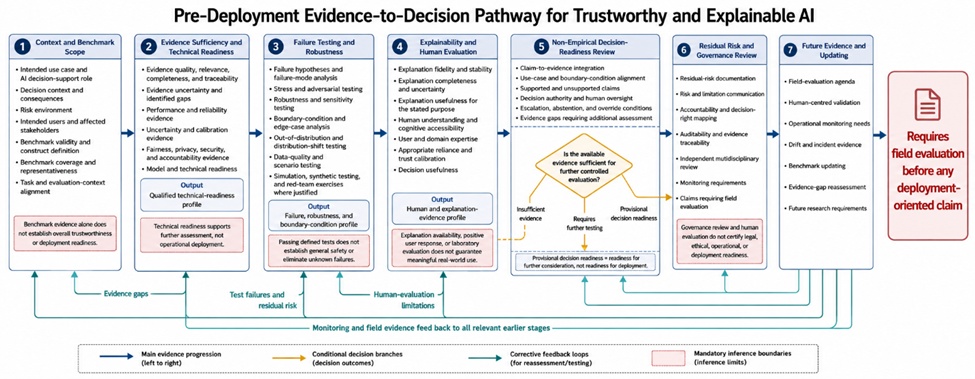
Figure 1. Pre-Deployment Evidence-to-Decision Pathway for Trustworthy and Explainable AI
Alt-text description. A conceptual pathway showing pre-deployment benchmarking evidence moving through validity review, evidence sufficiency, technical readiness, failure testing, human evaluation, non-empirical decision-readiness criteria, residual risk, monitoring needs, and field-evaluation needs.
Table 3 connects human evaluation, explanation usefulness, non-empirical decision-readiness criteria, residual-risk documentation, field-evaluation needs, and pre-deployment decision boundaries.
Table 3. Human Evaluation, Explanation Usefulness, and Non-Empirical Decision-Readiness Criteria for Trustworthy and Explainable AI: Human Understanding, Cognitive Accessibility, User Expertise, Explanation Fidelity, Explanation Stability, Appropriate Reliance, Decision Usefulness, Evidence Sufficiency, Boundary Conditions, Residual Risk, Field Evaluation Needs, and Deployment-Readiness Boundaries
Human, explanation, or readiness criterion | Core evaluation or decision question | Required evidence or condition | Evaluation or readiness function | Potential output | Failure or overclaiming risk | Human-centered or field-evaluation need | Framework role |
Human understanding | Can intended users form an adequately accurate understanding? | Comprehension and mental-model assessment | Evaluates understanding rather than exposure | Understanding profile | Self-reported clarity may not reflect accurate comprehension | Representative-user evaluation | Human-evidence component |
Cognitive accessibility | Can information be interpreted under realistic literacy, time, and workload conditions? | Accessibility and cognitive-load assessment | Tests practical usability | Accessibility profile | Detailed explanations may overwhelm users | Inclusive evaluation | Usability component |
User expertise | How do explanation requirements vary across user roles? | Role- and expertise-sensitive assessment | Prevents one-user-fits-all assumptions | Audience-specific requirements | Expert findings may be generalized to novices | Stratified user evaluation | Audience-fit component |
Domain expertise | Can substantive correctness and relevance be assessed? | Independent domain-expert review | Connects explanation to subject-matter validity | Domain-validity statement | Technically plausible explanations may be substantively misleading | Domain validation | Context-fit component |
Explanation fidelity | Does the explanation reflect relevant model behaviour? | Model-grounded fidelity assessment | Tests explanatory correctness | Fidelity profile | Persuasive but unfaithful explanations may increase reliance | Technical validation | Correctness component |
Explanation stability | Are similar cases explained consistently where expected? | Perturbation and repeatability assessment | Identifies explanation fragility | Stability profile | Stable explanations may still be inaccurate | Joint technical and human review | Reliability component |
Explanation uncertainty | Are explanatory limitations communicated? | Uncertainty characterization and communication review | Prevents false explanatory certainty | Uncertainty statement | Explanations may appear more definitive than evidence permits | Comprehension testing | Uncertainty component |
Explanation completeness | Are relevant factors and limitations represented? | Omission and scope analysis | Identifies explanatory gaps | Completeness statement | Concise explanations may omit decisive information | Domain and user review | Coverage component |
Explanation usefulness | Does the explanation support its stated purpose? | Purpose-specific task evaluation | Evaluates practical contribution | Usefulness profile | Preference may be mistaken for decision benefit | Task-based user evaluation | Utility component |
Appropriate reliance | Do users accept or reject outputs under appropriate conditions? | Evaluation with reliable, uncertain, and incorrect outputs | Tests calibrated use | Reliance profile | Acceptance may be misclassified as successful trust | Error-sensitive assessment | Reliance component |
Trust calibration | Does trust correspond to demonstrated capability and limitation? | Trust assessment across varied system conditions | Distinguishes calibrated trust from trust maximization | Calibration profile | Interface presentation may inflate trust | Longitudinal evaluation | Trust component |
Decision usefulness | Does the AI contribution improve the defined decision process? | Decision-task rather than prediction-only assessment | Links technical output to decision value | Decision-support profile | Speed or confidence may be mistaken for decision quality | Outcome-relevant field evaluation | Decision component |
Use-case alignment | Is the evidence relevant to the intended system role? | Intended-use, excluded-use, and workflow mapping | Establishes scope | Use-case fit statement | Evidence may be transferred to unsupported uses | Domain and governance review | Entry criterion |
Evidence sufficiency | Does the evidence address the defined readiness questions? | Claim-evidence mapping and gap analysis | Supports bounded readiness reasoning | Qualified sufficiency narrative | Sufficiency may become an arbitrary score | Multidisciplinary review | Integrative criterion |
Failure-mode coverage | Have material known failure pathways been examined? | Failure and test-coverage map | Evaluates known-risk coverage | Coverage statement | Unknown failures remain | Lifecycle reassessment | Failure criterion |
Boundary-condition clarity | Are unsupported conditions explicitly identified? | Data, model, task, and operational boundary map | Prevents out-of-scope use | Boundary statement | Boundaries may change or be ignored | Monitoring and governance control | Scope criterion |
Fairness and accountability evidence | Are relevant disparities and responsibilities addressed? | Contextual fairness assessment and decision-right map | Connects impacts to responsibility | Governance-evidence profile | Formal criteria may hide unexamined harms | Stakeholder and organizational evaluation | Governance criterion |
Residual-risk documentation | Which risks remain after testing and mitigation? | Residual-risk and uncertainty register | Prevents zero-risk conclusions | Residual-risk statement | Documentation may be mistaken for risk removal | Governance acknowledgment | Risk-ceiling criterion |
Monitoring requirement | What evidence must be collected if later use is considered? | Drift, incident, performance, and interaction monitoring plan | Connects current gaps to lifecycle learning | Monitoring specification | Monitoring may be treated as a substitute for prior evidence | Operational validation | Lifecycle criterion |
Field-evaluation need | Which claims cannot be established without real-world evidence? | External-validity gap analysis | Defines future empirical requirements | Field-evaluation agenda | Field testing may be postponed despite unresolved risk | Risk-proportionate field study | External-validity criterion |
Decision-readiness boundary | Is evidence adequate for further consideration rather than deployment? | Integrated evidence and limitation review | Separates readiness levels | Provisional decision-readiness narrative | “Ready for review” may become “ready for operation” | Independent governance process | Mandatory boundary |
Deployment-readiness boundary | What prevents the framework from authorizing deployment? | Explicit empirical, legal, ethical, organizational, and operational exclusions | Limits final inference | Non-authorization declaration | Framework completion may resemble certification | Separate deployment decision and field evidence | Final framework ceiling |
The proposed framework begins by defining the use case, decision context, affected stakeholders, risk environment, and intended allocation of human and AI responsibilities. Trustworthy AI is multidimensional and includes technical, ethical, organizational, and human-centered characteristics that cannot be reduced to conventional predictive performance [29]. Context definition therefore precedes benchmark selection. It establishes which claims require evidence, which stakeholders must be considered, which harms are material, and which system uses lie outside the framework’s scope.
The second stage evaluates benchmark validity, coverage, representativeness, limitations, and task alignment. The third stage assesses evidence sufficiency and technical readiness through performance, reliability, uncertainty, calibration, fairness, privacy, security, accountability, and explainability evidence where relevant. Trustworthy AI requires attention to robustness, fairness, accountability, explainability, and other properties beyond traditional measures of accuracy [30]. Evidence is retained as a structured profile rather than aggregated into a universal readiness score.
The fourth stage reviews failure testing, robustness, adversarial conditions, data-quality sensitivity, edge cases, distribution shift, out-of-distribution behaviour, and boundary conditions. The fifth stage evaluates explanation fidelity, stability, uncertainty, usefulness, cognitive accessibility, human understanding, appropriate reliance, and trust calibration. Contemporary trustworthy-AI research links principles to technical and lifecycle practices across fairness, privacy, robustness, security, and explainability domains [31]. The framework therefore treats these evidence families as connected but non-interchangeable.
The sixth stage integrates non-empirical decision-readiness criteria. It examines whether the evidence is sufficiently relevant, traceable, complete, and risk-sensitive to justify further controlled evaluation. Holistic trustworthy-AI assessment requires coordinated consideration of reliability, explainability, fairness, accountability, privacy, security, and human acceptance rather than a pass result in one dimension [32]. The output is a qualified narrative identifying supported claims, unsupported claims, unresolved risks, decision boundaries, and the conditions under which additional testing is required.
The final stage documents residual risk, field-evaluation requirements, monitoring needs, governance review, and feedback updating. Explainable-AI research continues to identify unresolved interdisciplinary challenges involving evaluation, human needs, uncertainty, robustness, and societal context [33]. The framework must therefore remain revisable as new evidence emerges. Its explicit ceilings prohibit benchmark-sufficiency claims, technical-readiness sufficiency claims, robustness-safety guarantees, explanation-usefulness guarantees, human-evaluation sufficiency claims, non-empirical deployment guarantees, and deployment-readiness certification.
Table 4 presents the proposed trustworthy AI benchmarking framework linking use-case context, evidence sufficiency, technical readiness, robustness, failure testing, explanation usefulness, human evaluation, decision readiness, residual risk, and future field-evaluation needs.
Table 4. Proposed Trustworthy AI Benchmarking Framework Without Field Experiments: Use-Case Context, Risk Context, Stakeholder Context, Benchmark Validity, Evidence Sufficiency, Technical Readiness, Performance Evidence, Robustness Evidence, Explainability Evidence, Failure Testing, Human Evaluation, Explanation Usefulness, Decision Readiness, Residual Risk, Monitoring Requirements, Field Evaluation Needs, and Deployment Boundaries
Framework stage | Core purpose | Required input | Benchmarking function | Potential output | Validation or governance need | Failure risk | Feedback mechanism | Decision boundary |
Use-case and decision-context definition | Define the system’s intended decision-support role | Intended use, users, workflow, excluded uses | Anchors evidence to a stated purpose | Context specification | Domain and organizational review | Vague scope enables unsupported inference | Revise when use changes | No transfer to a new use without reassessment |
Risk and stakeholder mapping | Identify harms, affected interests, and evidence needs | Risk scenarios and stakeholder map | Sets proportionate evidence expectations | Risk–stakeholder profile | Indirectly affected groups may be omitted | Ethics and stakeholder review | Update through consultation | No universal risk classification |
Benchmark-validity review | Determine whether benchmarks measure relevant constructs | Benchmark documentation and task rationale | Tests construct and task validity | Validity-qualified benchmark set | Independent methodological review | Convenient benchmarks may be accepted without fit | Replace invalid benchmarks | Invalid benchmarks cannot support readiness claims |
Benchmark-coverage review | Identify represented and omitted evidence dimensions | Benchmark inventory and context map | Reveals coverage gaps | Coverage matrix | High benchmark volume may conceal narrow scope | Multidisciplinary review | Add or redesign evaluation | No completeness assumption |
Evidence-sufficiency assessment | Determine whether claims have adequate support | Claim-evidence map and gap register | Integrates evidence without collapsing dimensions | Qualified sufficiency narrative | Sufficiency may become a rigid score | Expert and governance review | Update as evidence changes | No universal sufficiency threshold |
Technical-readiness assessment | Characterize model-level maturity | Performance, reliability, uncertainty, and documentation | Supports an intermediate readiness judgment | Technical-readiness profile | Model maturity may be equated with operational safety | Independent validation | Repeat after material changes | Technical readiness is not deployment readiness |
Performance and reliability review | Establish bounded capability and consistency | Task, subgroup, repetition, and sensitivity evidence | Reviews model behaviour under stated conditions | Capability profile | Aggregate results may conceal scenario failures | Methodological review | Expand conditions and subgroups | No field-performance claim |
Uncertainty and calibration review | Qualify confidence and unknowns | Uncertainty-source and calibration evidence | Evaluates confidence interpretation | Uncertainty profile | Poor uncertainty estimates may create false reassurance | Statistical and domain review | Reassess under shift | No certainty guarantee |
Fairness, accountability, and governance review | Examine disparities, responsibility, and contestability | Fairness evidence and decision-right map | Connects evaluation to affected interests | Governance-evidence profile | Formal criteria may substitute for substantive review | Stakeholder and organizational evaluation | Revise definitions and responsibilities | No legal or ethical sufficiency claim |
Explainability-evidence review | Evaluate explanations by property, audience, and purpose | Fidelity, stability, usefulness, and accessibility evidence | Separates explanatory dimensions | Explanation-evidence profile | Persuasive explanations may be unfaithful | Technical and human-centered review | Redesign and retest | Explanation availability is insufficient |
Failure-testing and robustness review | Examine known failure hypotheses and perturbations | Test portfolio, threat model, and scenarios | Assesses failure coverage | Failure and robustness profile | Passing narrow tests may imply general safety | Independent challenge | Add tests after new evidence | No robustness-safety guarantee |
Boundary and out-of-distribution review | Identify unsupported regions and shifts | Boundary, edge-case, and shift evidence | Defines where inference should stop | Boundary map | Boundaries may remain incomplete | Monitoring and domain review | Update with new contexts | Out-of-bound use is unsupported |
Human and explanation-usefulness review | Test interaction and comprehension assumptions | Relevant-user or justified-proxy evidence | Evaluates understanding and reliance | Human-evidence profile | Laboratory acceptance may be generalized | Human-factors and field review | Repeat in representative contexts | No human-evaluation sufficiency |
Non-empirical decision-readiness review | Integrate available evidence for bounded consideration | All evidence profiles and gaps | Supports structured readiness reasoning | Provisional decision-readiness narrative | Narrative may resemble certification | Multidisciplinary governance panel | Return deficient stages for revision | Decision readiness is not deployment readiness |
Residual-risk documentation | Preserve unresolved risks and unknowns | Failure findings, gaps, and uncertainty | Prevents zero-risk claims | Residual-risk register | Risks may be documented but not controlled | Governance acknowledgment | Update after new evidence | No operational-safety conclusion |
Field-evaluation need identification | Specify claims requiring real-world evidence | External-validity gaps | Defines future empirical requirements | Field-evaluation agenda | Required field evidence may be deferred | Independent study-design review | Link gaps to empirical questions | No real-world effectiveness claim |
Monitoring-requirement definition | Specify future lifecycle evidence needs | Anticipated drift, incidents, and interaction risks | Connects readiness to continued learning | Monitoring specification | Monitoring may create false reassurance | Operational governance | Trigger reassessment on change | Monitoring does not authorize deployment |
Governance review and feedback updating | Maintain accountability and framework revision | Complete evidence and limitation record | Supports challenge, revision, and traceability | Reviewed framework dossier | Review may become procedural | Feedback to every earlier stage | Governance review is not approval | |
Deployment-boundary declaration | State the framework’s final inference limit | All unresolved empirical and contextual requirements | Prevents assessment from becoming authorization | Explicit non-deployment statement | Framework completion may resemble certification | Separate legal, ethical, operational, and field processes | Mandatory reiteration | The framework cannot certify deployment readiness |
Figure 2 presents the proposed trustworthy AI benchmarking framework, integrating benchmark validity, evidence sufficiency, technical readiness, failure testing, robustness, explanation usefulness, human evaluation, decision-readiness criteria, residual-risk documentation, monitoring requirements, and field-evaluation needs.
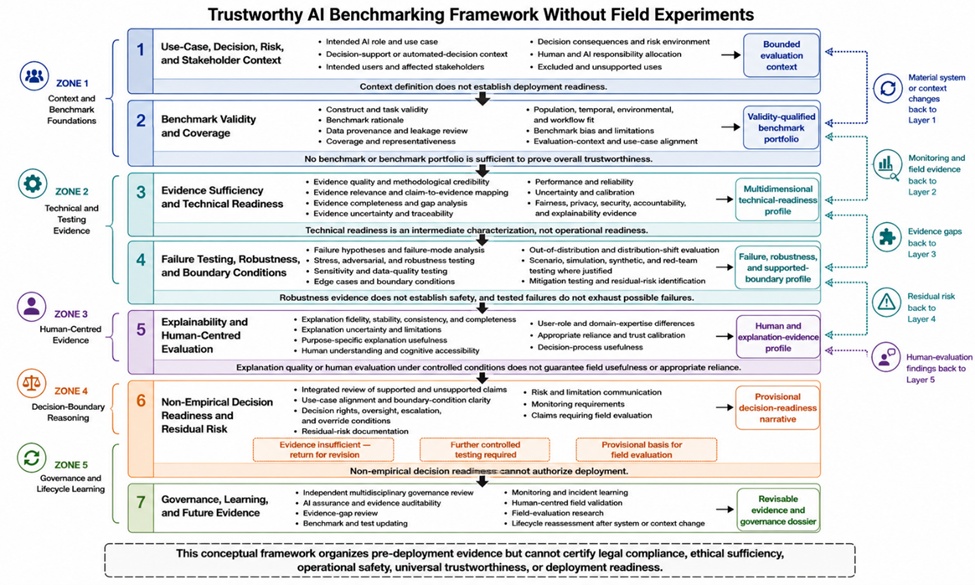
Figure 2. Trustworthy AI Benchmarking Framework Without Field Experiments
Alt-text description. A conceptual trustworthy AI benchmarking framework showing use-case context, benchmark validity, evidence sufficiency, technical readiness, robustness testing, failure testing, explanation usefulness, human evaluation, decision readiness, residual risk, monitoring requirements, governance review, and field-evaluation needs.
The framework implies that benchmark design should be studied as a validity and governance problem rather than only as a technical comparison exercise. Future research should examine how construct validity, task alignment, data provenance, representativeness, and leakage influence the strength of trustworthy-AI claims. Reproducibility failures show why apparently competitive performance can remain evidentially weak when evaluation design is compromised [5]. Research should also investigate how benchmark choices embed assumptions about relevant populations, harms, workflows, and decision objectives.
Evidence-sufficiency research should develop transparent ways of reasoning about coverage without creating universal numerical thresholds. Dataset documentation and lifecycle assurance provide foundations for traceability, but further work is required to connect documented evidence to context-specific readiness claims [6]. Technical-readiness studies should clarify how performance, reliability, uncertainty, fairness, privacy, security, accountability, and explainability evidence interact while remaining distinct. Domain-specific case analysis could test whether the proposed framework helps identify missing evidence without being converted into a certification checklist.
Failure-testing research should connect test-generation methods more directly to realistic hazards, stakeholder concerns, and operating boundaries. The existing testing landscape demonstrates substantial methodological diversity but incomplete coverage of complex AI-system behaviour [14]. Research priorities include out-of-distribution evaluation, distribution-shift analysis, realistic stress conditions, edge-case construction, red-team methods, residual-risk communication, and mechanisms for updating tests after material system or context changes. Comparative field research will be needed to determine which pre-deployment tests are informative about later operational failures.
Human-centered research should examine explanation usefulness, calibrated reliance, cognitive accessibility, and decision validity across representative users, roles, and organizational settings. It should also investigate how monitoring requirements, governance review, and field-evaluation plans can be incorporated without creating false reassurance. These implications are conceptual research directions rather than legal advice, compliance guidance, audit instruction, procurement advice, benchmark- or metric-selection advice, model- or platform-selection advice, safety certification, field-deployment instruction, or deployment authorization.
This article proposed a conceptual trustworthy-AI benchmarking framework for reasoning about evidence sufficiency before deployment when field experiments and operational outcome evidence are not yet available. The framework separates benchmark validity and coverage from technical readiness, distinguishes robustness and failure-testing evidence from operational safety, and evaluates explanation usefulness independently from explanation availability. It further integrates human evaluation, appropriate reliance, accountability, residual-risk documentation, monitoring requirements, and field-evaluation needs into a structured evidence-to-decision pathway. Its central contribution is not a readiness score or approval mechanism, but a disciplined way to state what available evidence supports, what it does not support, and which claims remain dependent on empirical field evaluation. Trustworthy and explainable AI cannot be established through benchmark performance, laboratory testing, or explanation metrics alone. Pre-deployment benchmarking can organize evidence and expose gaps, but it cannot certify legal compliance, ethical sufficiency, operational safety, universal trustworthiness, or deployment readiness.
None
None
None
None
Open Access The author(s) retain copyright. This article is licensed under the Creative Commons Attribution-NonCommercial-ShareAlike 4.0 International License. It may be shared and adapted for non-commercial purposes with appropriate attribution, an indication of changes, and distribution of adaptations under the same license. Third-party material may be subject to separate terms identified in its credit line. View the license at https://creativecommons.org/licenses/by-nc-sa/4.0/.
 Transparent Intelligence Publishing