Artificial intelligence systems may remain operationally usable while carrying unresolved explanation-related deficiencies that are difficult to observe during initial development. These deficiencies can emerge later as opaque model behavior, uncertain data provenance, incomplete documentation, broken traceability, unsuitable explanation interfaces, excluded stakeholder perspectives, weak contestability, and ambiguous accountability. This article introduces explainability debt as a conceptual lifecycle risk arising when explanation design, documentation, traceability, stakeholder engagement, interface alignment, and governance review are deferred or inadequately maintained. The proposed approach adapts technical-debt reasoning without treating explainability debt as a measurable financial liability or validated risk score. It distinguishes model and data opacity from the organizational deficiencies that prevent opacity from being investigated, communicated, challenged, and corrected. Documentation and traceability deficits are interpreted as missing or deteriorating evidence relationships across datasets, model versions, explanations, decisions, and responsible actors. Interface misalignment and stakeholder exclusion are treated as mechanisms through which technical opacity can become misunderstanding, inappropriate reliance, limited participation, and weak reviewability. Unresolved deficiencies may subsequently contribute to accountability gaps, operational uncertainty, decision risk, and broader governance risk. The article’s main contribution is a conceptual model connecting deferred explainability work with accumulating lifecycle costs and feedback failures across development, deployment, monitoring, incident learning, correction, and model updating. The model supports structured reasoning about hidden explainability obligations but does not measure debt, prove trustworthiness, guarantee human understanding, establish legal or ethical sufficiency, certify governance, or determine deployment readiness.
Explainable artificial intelligence encompasses diverse technical methods, interpretive objectives, and human communication requirements. Explanations may describe features, representations, rules, examples, counterfactuals, or local decision rationales, yet their usefulness depends on the question being asked and the person receiving them. In high-stakes settings, a plausible post-hoc explanation cannot automatically remove the risks created by an opaque model [1-3].
Explainability is also not equivalent to trustworthiness. Trustworthy AI depends on several interacting conditions, including technical reliability, transparency, human oversight, organizational responsibility, and appropriate governance. An AI system may therefore produce an explanation while remaining poorly documented, difficult to audit, unsuitable for its users, or weakly governed [4].
This article uses the term explainability debt to describe unresolved explanation-related obligations that accumulate across the AI lifecycle. The concept includes more than the absence of an explanation output. It covers deferred explanation requirements, model and data opacity, incomplete documentation, broken evidence trails, inaccessible interfaces, excluded stakeholders, unclear responsibilities, and failures to update explanatory resources when systems change [1].
The objective is to propose an original conceptual model showing how these deficits can create hidden lifecycle costs. The model connects technical opacity with human interpretation and organizational governance, while preserving important boundaries: it does not assign numerical debt values, establish legal accountability, prove ethical adequacy, or authorize deployment. Instead, it structures reasoning about when explainability should be treated as a continuing lifecycle responsibility rather than a late-stage add-on [4].
Technical debt describes the future burden created when expedient or incomplete work is accepted in the present. Debt can remain latent until maintenance, redesign, integration, or correction becomes necessary. Its consequences depend not only on the original shortcut but also on whether responsibility, knowledge, and resources exist to identify and address it [5, 6].
AI-enabled systems extend this problem because model behavior depends on changing data, pipelines, architectures, operating contexts, and monitoring practices. AI-related debt can affect understandability, maintainability, architecture, and quality, while newer development environments introduce additional dependencies across DevOps, MLOps, and generative-AI lifecycles [7, 8].
Explainability debt is proposed here as a narrower but interconnected form of lifecycle debt. It accumulates when organizations postpone explanation design, documentation, stakeholder engagement, interface evaluation, or governance review. A system may initially function despite these omissions, but later changes can expose missing evidence, stale explanations, unclear ownership, or interfaces that no longer match the decision context [7].
The concept includes latent debt, accumulated debt, model-update risk, monitoring gaps, lifecycle-feedback gaps, incident-learning gaps, and correction gaps. These categories should be interpreted qualitatively until validated measurement approaches exist. Identifying a potential debt source does not demonstrate its severity, predict failure, eliminate residual risk, or determine whether an AI system is ready for deployment [8].
Model opacity concerns the difficulty of understanding how an AI system transforms inputs into outputs. Black-box behavior can arise from complex structures, inaccessible internal representations, nonlinear feature interactions, or decision logic that cannot be reconstructed meaningfully. Because different opacity sources require different explanatory approaches, no single technique can address every model, stakeholder, or decision context [9].
Deep learning introduces several distinguishable forms of opacity. Feature processing may obscure how variables are transformed; internal representations may lack clear semantic meaning; and the relationship between learned representations and final outputs may be difficult to communicate. Post-hoc methods can reveal patterns, but their outputs require careful evaluation and should not be treated as complete replicas of model reasoning [10].
Opacity also has an evaluative dimension. Explainability research contains multiple definitions, objectives, and assessment approaches, with no universally sufficient measure of explanation quality. Technical fidelity, human comprehensibility, usefulness, and decision relevance may produce different conclusions about the same explanation [11].
Data opacity develops when the origin, composition, quality, labeling, transformation, or contextual limitations of data are unclear. Provenance gaps weaken the ability to explain where evidence came from, while undocumented labeling and feature construction can conceal assumptions embedded before model training. Model updates can intensify these problems when new data or retraining alters behavior without corresponding changes to explanations and records [12].
Opacity therefore accumulates through interactions among model complexity, black-box behavior, opaque features and representations, undocumented updates, uncertain data provenance, quality limitations, and weak lineage. Recognizing these sources can guide later documentation and review, but classification alone does not resolve opacity or guarantee faithful explanation. Table 1 summarises how explainability debt accumulates through lifecycle risks, model opacity, data opacity, deferred explanation design, and deferred governance review.
Table 1. Explainability Debt as a Lifecycle Risk in AI Systems: Deferred Explanation Design, Technical Debt, Machine Learning Technical Debt, Model Opacity, Data Opacity, Opaque Feature Processing, Opaque Representations, Opaque Model Updates, Data Provenance Gaps, Data Quality Gaps, Documentation Gaps, Monitoring Gaps, Lifecycle Feedback Gaps, and Debt Boundaries
Debt source or opacity source | Core lifecycle question | How the debt or opacity appears | Potential hidden cost | Affected lifecycle stage or stakeholder | Detection, documentation, or review need | Boundary statement | Model role |
Explainability debt | Which explanation obligations remain unresolved? | Explanation, evidence, interface, and review work is deferred | Later redesign, weak reviewability, and governance escalation | Entire lifecycle | Periodic cross-functional review | The concept does not independently measure debt | Central construct |
Technical debt | Which present compromises create future maintenance burdens? | Short-term choices persist beyond their intended period | Rework, fragility, and reduced maintainability | Design, development, and maintenance | Technical-debt identification and ownership | Not every technical defect is explainability debt | Parent analogy |
Machine-learning technical debt | Which data- and model-dependent dependencies create later burdens? | Pipelines, data, features, and models become tightly coupled | Difficult updating and unstable behavior | Development, deployment, and updating | Lifecycle and dependency review | Broader than explainability debt | Adjacent debt category |
Deferred explanation design | Were explanation needs defined too late? | Explanations are added after core design choices are fixed | Incompatible methods and expensive redesign | Requirements and design teams | Early explanation-requirement review | Early planning does not guarantee usefulness | Primary debt source |
Deferred documentation and governance review | Were records, roles, and review gates postponed? | Evidence remains incomplete and responsibility remains unclear | Costly reconstruction and accountability gaps | Development, deployment, and governance bodies | Documentation and responsibility review | Review cannot eliminate residual risk | Organizational debt source |
Latent and accumulated debt | Which unresolved deficits remain hidden or reinforce one another? | Small omissions persist and combine across stages | Disproportionate correction effort | Entire socio-technical system | Integrated gap assessment | Accumulation remains conceptual without validation | Composite debt stock |
Model opacity and complexity | Which internal mechanisms cannot be meaningfully understood? | High-dimensional or nonlinear processing obscures behavior | Oversimplified or misleading explanations | Developers, reviewers, operators, and decision subjects | Architecture, behavior, and limitation records | Identifying opacity does not resolve it | Core technical pathway |
Opaque feature processing, representation, and decision logic | How are features transformed and connected to outputs? | Internal states and interactions lack accessible meaning | Incorrect attribution or false interpretability | Developers and domain experts | Feature and representation analysis | Post-hoc accounts may remain incomplete | Opacity subtype |
Opaque model updates | What changed between versions and why? | Retraining changes behavior without synchronized explanations | Stale explanations and inappropriate reliance | Maintainers, operators, and reviewers | Version-linked change and explanation records | Updated records do not prove valid explanations | Lifecycle amplifier |
Data opacity and provenance gaps | Where did data originate and under what conditions? | Sources, collection context, or transformations are missing | Weak evidence trails and misuse | Data subjects, developers, and auditors | Provenance and data-lineage documentation | Provenance does not establish data adequacy | Data-opacity pathway |
Data quality, labeling, and feature-documentation gaps | Are limitations and human choices visible? | Error, missingness, labeling rules, or transformations are undocumented | Hidden bias and misleading certainty | Domain experts and affected stakeholders | Quality, labeling, and feature records | Documentation does not remove data limitations | Data-opacity pathway |
Monitoring and lifecycle-feedback gaps | Are emerging explanation failures detected and returned to design? | No process captures misunderstanding, drift, or user concerns | Persistent defects and delayed correction | Deployment and operation | Socio-technical monitoring and feedback review | Monitoring cannot observe every failure | Feedback deficit |
Incident-learning and correction gaps | Do identified failures lead to verified changes? | Findings remain isolated, unassigned, or unresolved | Recurrence and institutional forgetting | Incident response and maintenance | Ownership, corrective action, and effectiveness review | Correction records do not prove risk removal | Remediation deficit |
Debt-measurement and deployment boundaries | Can the model quantify debt or authorize deployment? | Conceptual categories are mistaken for validated scores or approvals | False precision and premature assurance | Governance and deployment decisions | Independent empirical and domain-specific assessment | The model neither measures debt nor establishes readiness | Decision boundary |
Dataset documentation can reduce data opacity by recording motivation, composition, collection conditions, intended uses, and known limitations. Such records help later users understand the context in which data were created, but their value depends on completeness, accessibility, maintenance, and continued connection to downstream models and decisions [13].
Contextual documentation is also relevant to stakeholder inclusion. Data statements can disclose population characteristics, language conditions, annotation assumptions, and generalization boundaries that might otherwise remain invisible. When these conditions are omitted, explanation interfaces may present model outputs without revealing whose experiences were represented, simplified, or excluded during data construction [14].
AI documentation extends beyond dataset records. Model, system, decision, and explanation documentation may be needed to support auditability and accountability. Empirical evidence indicates that documentation practices can be inconsistent, burdensome, or poorly adapted to AI-specific risks, leaving reviewers without sufficient evidence to reconstruct how important choices were made [15].
Documentation approaches also remain fragmented. Different instruments describe datasets, models, systems, impacts, or organizational processes, but these records may not share identifiers, update schedules, ownership rules, or compatible levels of detail. As a result, documentation can appear extensive while still failing to provide an integrated evidence trail across the lifecycle [16].
Explainability debt therefore includes documentation completeness, usability, and maintenance deficits as well as traceability, auditability, evidence-trail, decision-trail, model-lineage, data-lineage, and explanation-lineage gaps. These relationships require versioned links among data, models, explanation methods, interfaces, decisions, and responsible actors. Nevertheless, even complete and traceable records cannot independently prove that an explanation is faithful, a decision is justified, accountability is effective, or governance risk has been eliminated [15].
Explanation interfaces mediate between technical outputs and the people expected to interpret, question, or act on them. Their design should therefore begin with the user’s role, decision task, expertise, and explanation objective rather than with the availability of a particular visualization or post-hoc method. Evaluation must similarly examine whether an explanation supports the intended activity for the relevant stakeholder [17].
Interface alignment includes explanation scope, format, length, timing, visualization, and degree of user control. Preferences can differ substantially across contexts: some users need concise local reasons, whereas others require system-level information, uncertainty, limitations, or comparative evidence. Excessive detail can produce explanation overload, while insufficient detail can conceal assumptions needed for informed judgment [18].
Misalignment also occurs when an explanation contradicts the associated recommendation, omits decisive information, or answers a different question from the one confronting the user. Such inconsistencies may reduce acceptance or encourage users to interpret explanation fluency as evidence of model validity. Explanation availability must therefore be distinguished from explanation coherence and decision usefulness [19].
Human understanding cannot be inferred from the presence of an interface. Perceived explainability and causability may influence trust and acceptance, but these responses depend on context, prior knowledge, expectations, and the quality of interaction. Comprehension, appropriate reliance, and the ability to recognize limitations require direct human-centered assessment [20].
Stakeholder exclusion compounds interface debt when affected persons, decision subjects, operators, developers, deployers, domain experts, or governance bodies are absent from requirements and evaluation. Participation can expose conflicting explanation needs and unequal access to recourse, but inclusion alone does not prove fairness, legitimacy, accountability, or adequate understanding. The proposed model therefore treats stakeholder participation as a continuing evaluative requirement rather than a one-time consultation [17].
AI ethics and governance frameworks frequently endorse transparency, responsibility, fairness, and accountability, but agreement at the level of principles does not ensure consistency in interpretation or implementation. When explanation obligations remain abstract, organizations may lack evidence showing how principles influenced system requirements, operational decisions, or corrective actions [21].
Principles alone cannot establish accountable conduct. Institutional mandates, professional responsibilities, organizational capabilities, and mechanisms for scrutiny are also required. Explainability debt can therefore contribute to governance debt when transparency claims are disconnected from authority, evidence, resources, and procedures for intervention [22].
The transition from principles to practice requires methods suited to different lifecycle stages. Documentation, impact analysis, monitoring, stakeholder engagement, and review mechanisms may help operationalize governance, but fragmented or deferred implementation can leave significant gaps between stated commitments and actual system control [23].
Ethics-based auditing can support review by examining evidence, processes, impacts, and organizational controls. Nevertheless, an audit remains constrained by its scope, criteria, evidence access, reviewer independence, and timing. Auditability is therefore an important governance function but not proof that an AI system is trustworthy, accountable, legally sufficient, or free from residual risk [24].
Unresolved explainability debt may appear as contestability gaps, weak reviewability, unclear responsibility mapping, ineffective role allocation, traceability failure, operational uncertainty, decision risk, or reputational exposure where such consequences are supported by context. Monitoring, incident learning, and correction mechanisms are necessary to prevent known deficiencies from persisting, but they cannot eliminate governance risk or guarantee accountable conduct [24]. Table 2 maps documentation deficits, traceability gaps, interface misalignment, stakeholder exclusion, and governance consequences that can arise when explainability debt remains unresolved.
Table 2. Documentation, Traceability, Interface, Stakeholder, and Governance Consequences of Explainability Debt: Model Documentation Gaps, Data Documentation Gaps, Decision Documentation Gaps, Evidence Trail Gaps, Explanation Interfaces, Explanation Overload, Stakeholder Exclusion, Contestability Gaps, Reviewability Gaps, Accountability Gaps, Operational Risk, Decision Risk, and Governance-Risk Boundaries
Debt consequence or requirement | Core governance or human-centered question | Required evidence, practice, or participation condition | Explainability or governance function | Potential output | Failure or residual risk | Maintenance, evaluation, or accountability need | Model role |
Model, data, and system documentation gaps | Are purpose, assumptions, data context, architecture, and limitations recorded? | Versioned and accessible records | Contextualizes models and explanations | Reviewable documentation set | Incomplete or misleading evidence | Assigned ownership and update triggers | Documentation-debt pathway |
Decision and explanation documentation gaps | Can a decision and its explanation be reconstructed? | Inputs, outputs, explanation method, overrides, timing, and roles | Supports review and contestability | Decision and explanation trail | Unreviewable consequential decisions | Retention, access, and privacy governance | Decision-opacity pathway |
Documentation completeness, usability, and maintenance deficits | Are records sufficient, understandable, and current? | Completeness criteria, user testing, and change-linked updates | Makes evidence usable across the lifecycle | Documentation-gap findings | Documentation theatre or stale evidence | Periodic quality and currency review | Documentation-quality dimension |
Traceability and evidence-trail gaps | Can claims be linked to models, data, processes, and responsible actions? | Persistent identifiers and connected artifacts | Supports reconstruction and audit | Traceability map | Unsupported explanation claims | Independent reconstruction review | Traceability-debt pathway |
Model, data, and explanation-lineage gaps | Can versions and dependencies be followed across changes? | Linked version histories | Prevents stale explanation use | Lineage record | Version mismatch and irreproducibility | Release and change governance | Lifecycle pathway |
Explanation interface and accessibility requirements | Can intended stakeholders access and use the explanation? | Task-sensitive, accessible presentation | Communicates relevant evidence and limitations | Evaluated explanation interface | Exclusion or misinterpretation | Accessibility, usability, and comprehension testing | Interface-debt pathway |
Explanation overload, under-specification, and mismatch | Does the explanation provide suitable depth and answer the relevant question? | Role-, expertise-, and case-sensitive content | Supports cognitive accessibility | Interface-alignment findings | Confusion, false simplicity, or inappropriate reliance | Task-based evaluation | Interface-risk mechanism |
Stakeholder participation and exclusion | Whose needs and harms influence requirements and review? | Meaningful participation and evidence of influence | Introduces situated explanation needs | Stakeholder-gap analysis | Tokenism or omitted perspectives | Participation-process and outcome evaluation | Stakeholder-debt pathway |
Contestability and reviewability gaps | Can an affected party challenge an outcome and can a reviewer assess it? | Accessible reasons, evidence, records, and review procedures | Supports scrutiny and recourse | Contestability and reviewability assessment | Formal channels without meaningful challenge | Independent procedural evaluation | Governance consequence |
Accountability, responsibility, and role-allocation gaps | Who has authority and responsibility for explanation-related obligations? | Role mapping, escalation paths, competence, and resources | Connects evidence to accountable action | Responsibility map | Blame shifting or unresolved findings | Review of actual authority and performance | Governance-debt pathway |
Operational, decision, and reputational risk | How may unresolved deficits affect use and organizational credibility? | Contextual risk evidence and monitored incidents | Connects debt with potential consequences | Qualitative risk narrative | Overstated causality or omitted interactions | Domain-specific risk assessment | Conditional consequence |
Governance-risk and accountability boundaries | Does the model eliminate risk or guarantee accountability? | Independent technical, human, institutional, and domain review | Preserves residual-risk reasoning | Explicit boundary statement | False assurance from framework use | Continuing governance scrutiny | Decision boundary |
The proposed model begins with use-case and lifecycle-context definition. The system’s purpose, decision stakes, operating environment, affected groups, organizational setting, and lifecycle stage establish which explanation obligations may be relevant. Organizational AI governance research indicates that effective oversight depends on coordinated structures, processes, roles, and relational mechanisms rather than a single transparency intervention [25].
The second component maps stakeholders and decision contexts before defining explanation requirements. Developers, operators, deployers, decision subjects, affected persons, domain experts, and governance bodies may require different evidence and levels of detail. Governance practices are also shaped by organizational capabilities, culture, role clarity, monitoring arrangements, and implementation barriers [26].
The model then examines model opacity, data opacity, documentation gaps, traceability gaps, interface alignment, and stakeholder inclusion as connected but non-equivalent debt pathways. These reviews should begin early and persist through updates because governance affordances, assurance evidence, and explanation resources are more difficult to reconstruct after design commitments and operational dependencies have accumulated [27].
Contestability, reviewability, accountability, and responsibility mapping form the governance-assessment layer. Accountability should not be treated as a single undifferentiated obligation: answerability for explaining conduct and responsibility for actions or outcomes may involve different actors, powers, and evidence requirements. Formal allocation is useful only when roles are supported by authority, competence, resources, and review mechanisms [28].
Finally, the model connects identified deficits with a context-specific debt register, qualitative prioritization, bounded remediation planning, monitoring, incident learning, correction feedback, and model updating. Stakeholders should have agency to request task-relevant information and interact with explanations, but increased trust or perceived transparency does not necessarily improve human–AI team performance [29]. Table 3 presents the proposed explainability debt model linking lifecycle context, stakeholder mapping, opacity review, documentation, traceability, interface alignment, stakeholder inclusion, governance risk, monitoring, and model updating.
Table 3. Proposed Explainability Debt Model for Trustworthy AI Lifecycle Governance: Lifecycle Context, Stakeholder Mapping, Explanation Requirements, Model Opacity Review, Data Opacity Review, Documentation Gap Review, Traceability Gap Review, Interface Alignment, Stakeholder Inclusion, Contestability, Accountability, Governance Risk, Debt Prioritization, Remediation Planning, Monitoring, Incident Learning, and Deployment Boundaries
Model component | Core purpose | Required input | Explainability-debt function | Potential output | Validation or governance need | Failure risk | Feedback mechanism | Decision boundary |
Use-case and lifecycle-context definition | Establish scope, stakes, and system setting | Purpose, domain, decisions, users, consequences, lifecycle stage | Prevents context-free debt classification | Context statement | Domain and governance review | Mis-scoped analysis | Revise when purpose or environment changes | Does not authorize the use case |
Stakeholder and decision-context mapping | Identify actors, affected groups, authority, and information needs | Stakeholder map, workflow, decision rights, affected-person analysis | Reveals omitted explanation obligations | Stakeholder–decision map | Meaningful participation review | Missing or tokenized stakeholders | Update after organizational or use changes | Does not prove legitimacy |
Initial explanation-requirement definition | Define why, when, for whom, and how explanation is needed | Tasks, questions, expertise, stakes, access needs | Creates a baseline for identifying deferral | Explanation-requirement record | Human-centered evaluation | Generic requirements | Revise through user and stakeholder assessment | Does not guarantee understanding |
Model and data opacity review | Identify inaccessible mechanisms, evidence, provenance, and limitations | Architecture, behavior, data records, tests, transformations | Locates technical and data-opacity debt | Opacity profile | Technical and domain evaluation | Overstated fidelity or data adequacy | Repeat after material changes | Does not establish complete interpretability |
Documentation-gap review | Identify missing, unusable, or stale records | Model, data, system, decision, and explanation documents | Locates documentation debt | Documentation-gap register | Completeness, usability, and currency review | Documentation quantity mistaken for adequacy | Change-triggered updates | Documentation alone is insufficient |
Traceability-gap review | Test links among claims, artifacts, versions, decisions, and actors | Identifiers, lineage, logs, role records | Locates traceability debt | Traceability map | Independent reconstruction | Nominal links without substantive evidence | Repair after change or incident | Traceability alone is insufficient |
Interface-alignment review | Assess fit among explanation, task, user, and context | Interface, workflow, content, accessibility, expertise | Locates interface debt | Alignment findings | Usability and comprehension testing | Attractive but misleading presentation | Iterative interface evaluation | Does not prove understanding |
Stakeholder-inclusion review | Assess whose needs shaped requirements and evaluation | Participation records and evidence of influence | Locates stakeholder debt | Inclusion-gap analysis | Power, representation, and outcome review | Participation theatre | Re-engage after changes and incidents | Inclusion alone is insufficient |
Contestability and reviewability assessment | Determine whether decisions can be challenged and examined | Reasons, evidence, records, access, review procedures | Connects debt to governance consequences | Reviewability profile | Institutional and domain assessment | Formal recourse without usable evidence | Learn from disputes and reviews | Does not establish legal sufficiency |
Accountability and responsibility mapping | Link lifecycle obligations to actors with authority | Roles, resources, escalation paths, decision rights | Identifies accountability debt | Responsibility map | Organizational-governance review | Blame allocation without effective control | Update after restructuring or incidents | Does not guarantee accountability |
Governance-risk assessment | Structure pathways from deficits to potential consequences | Debt findings, stakes, controls, uncertainty | Synthesizes lifecycle risk | Qualitative governance-risk narrative | Domain-specific evaluation | False precision or causal overstatement | Periodic governance review | Does not eliminate residual risk |
Debt register, prioritization, and remediation where supported | Record deficits and organize bounded corrective work | Verified findings, dependencies, urgency, feasibility, owners | Supports transparent attention and correction | Context-specific register and action rationale | Organizational judgment and effectiveness criteria | Unvalidated scoring or activity without improvement | Reprioritize and test corrective effects | No universal metric or prescription |
Monitoring, incident learning, and model-update review | Detect change and return lessons to design | Usage evidence, complaints, incidents, drift, version changes | Prevents recurring or stale debt | Monitoring and change-impact findings | Privacy, validity, and release governance | Narrow indicators miss human or institutional failures | Feed results into requirements, records, interfaces, and controls | Does not establish operational safety |
Integrated boundary review | Preserve the limits of the conceptual model | Technical, human, organizational, institutional, and residual-risk evidence | Prevents certification or readiness claims | Explicit boundary statement | Independent assessment outside the model | Conceptual findings used as approval | Review whenever claims or conditions change | Does not establish deployment readiness |
Figure 1 presents the proposed explainability debt model, showing how deferred explanation design, opacity, documentation gaps, traceability deficits, interface misalignment, stakeholder exclusion, and unresolved governance risks accumulate across the AI lifecycle.
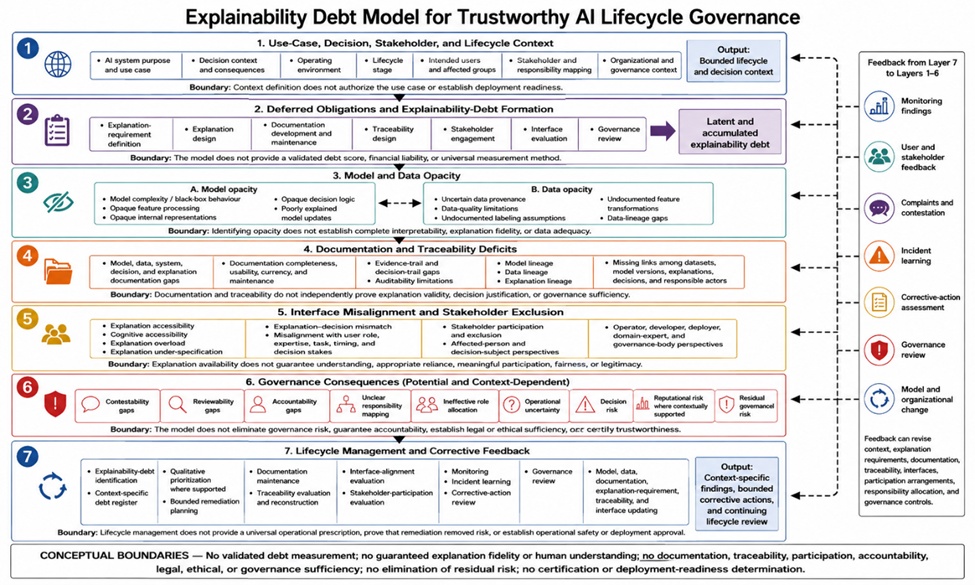
Figure 1. Explainability Debt Model for Trustworthy AI Lifecycle Governance
Figure caption: Figure 1. Explainability Debt Model for Trustworthy AI Lifecycle Governance. The model shows how explainability debt can accumulate across the AI lifecycle through deferred explanation design, model opacity, data opacity, documentation gaps, traceability deficits, interface misalignment, stakeholder exclusion, contestability gaps, accountability gaps, unresolved governance risk, monitoring gaps, incident learning gaps, and weak correction feedback. The figure is conceptual and does not represent a validated debt measurement tool, certified governance model, legally sufficient compliance process, or deployment-ready AI management framework.
Alt-text description: A conceptual lifecycle model showing explainability debt accumulating through opacity, documentation gaps, traceability deficits, interface misalignment, stakeholder exclusion, governance risk, monitoring gaps, incident learning gaps, and correction feedback loops.
For management research, the first priority is to examine how explainability debt can be identified and qualitatively prioritized without converting an unvalidated construct into a simplistic score. Studies could investigate how organizations recognize deferred obligations, assign ownership, compare dependencies, and justify remediation sequencing under limited resources. Such work should evaluate whether debt registers improve institutional learning or merely create additional administrative artifacts [27].
Documentation maintenance, traceability reconstruction, interface alignment, and stakeholder participation also require longitudinal evaluation. Research should determine which changes trigger record updates, whether users can reconstruct model and decision histories, how explanation needs vary by expertise and consequence, and whether affected groups influence requirements rather than merely being consulted. These questions concern the effectiveness of lifecycle practices, not the universal adoption of particular templates [16].
Further research should examine accountability operationalization, monitoring, model-update documentation, incident learning, and correction feedback. Relevant questions include whether responsible actors possess authority to intervene, whether explanation failures are detected after deployment, whether incidents change requirements and interfaces, and whether completed corrections reduce the original problem. Organizational capabilities and barriers are likely to shape each of these processes [26].
Explainability-debt measurement remains a longer-term research direction requiring construct definition, domain-specific indicators, reliability testing, stakeholder validation, and evidence that any proposed measure predicts meaningful lifecycle consequences. Until such evidence exists, the model should support conceptual diagnosis and research design rather than legal advice, compliance guidance, procurement decisions, audit instructions, universal documentation or interface prescriptions, technical-debt management instructions, certification, or deployment decisions [11].
This article proposes explainability debt as a conceptual model connecting deferred explanation design with model and data opacity, documentation and traceability deficits, interface misalignment, stakeholder exclusion, governance risk, monitoring gaps, incident learning, and correction feedback across the AI lifecycle. Its central contribution is to show why unexplained AI may create hidden costs that remain difficult to observe until systems must be reviewed, challenged, updated, audited, or governed. Explainability should consequently be treated as a continuing lifecycle responsibility rather than a late-stage add-on, static interface feature, or optional documentation task. The model can help structure analysis of unresolved obligations and feedback failures, but it does not measure debt, prove accountability or trustworthiness, guarantee human understanding, eliminate residual risk, establish legal or ethical sufficiency, certify governance, or determine deployment readiness.
None
None
None
None
Open Access The author(s) retain copyright. This article is licensed under the Creative Commons Attribution-NonCommercial-ShareAlike 4.0 International License. It may be shared and adapted for non-commercial purposes with appropriate attribution, an indication of changes, and distribution of adaptations under the same license. Third-party material may be subject to separate terms identified in its credit line. View the license at https://creativecommons.org/licenses/by-nc-sa/4.0/.
 Transparent Intelligence Publishing