Explainable artificial intelligence increasingly supports decisions whose consequences extend beyond prediction, yet many explanations remain grounded in associations, feature contributions, saliency, or local perturbations. Such outputs may clarify model behaviour without establishing what would happen under intervention, why an outcome arose through a particular mechanism, or whether a proposed change is feasible and decision-valid. This article develops a conceptual causal explainability framework for moving from prediction-oriented explanation toward intervention-aware reasoning. The framework begins by separating predictive, associative, and model-behaviour claims from causal questions. It then connects explicit causal assumptions with causal structures, mechanistic reasoning, interventional explanation, counterfactual reasoning, confounding assessment, identifiability, sensitivity, external validity, uncertainty communication, and human interpretation. Particular attention is given to the distinction between model counterfactuals and real-world recourse, the risks created by unmeasured confounding, selection and collider bias, and the need to define decision boundaries before explanations inform action. Human users are treated as active interpreters whose causal literacy, expertise, cognitive constraints, and susceptibility to false causal confidence affect explanation usefulness. The main contribution is an integrated framework that organizes the evidential transition from prediction to intervention while preserving explicit no-guarantee boundaries concerning causal truth, intervention validity, recourse, identifiability, human understanding, decision validity, and deployment readiness. The framework is intended to support disciplined conceptual development and evaluation planning, not to prescribe a universal causal model, intervention procedure, or operational decision system.
Explainable artificial intelligence has developed into a broad field concerned with transparency, interpretability, accountability, and responsible use. Its methods range from intrinsically interpretable models to post-hoc feature attributions, examples, rules, visualisations, and local approximations. This diversity is valuable, but it also creates a recurrent ambiguity: an explanation of how a model produced a prediction may be interpreted as an explanation of why the represented event occurred. A causal explainability agenda must therefore begin by distinguishing model-relative explanation from claims about the data-generating process [1].
That distinction is also human-centred. People rarely seek exhaustive descriptions of every factor associated with an output; they commonly ask selective and contrastive questions such as why one outcome occurred rather than another, or what would have changed it. The usefulness of an explanation consequently depends on the contrast being addressed, the user’s knowledge, and the social setting in which the explanation is communicated. Causal explainability must preserve these interpretive features without allowing intuitive narratives to outrun evidential support [2].
Machine-learning systems are usually optimised to exploit stable statistical regularities in observed data. Even highly accurate representations may fail when environments change, interventions alter the generating process, or relationships that were predictive cease to be invariant. Moving from prediction toward intervention therefore requires assumptions about causal variables, mechanisms, and contextual stability that are not supplied by predictive performance alone. Causal representation and mechanism-oriented reasoning provide a stronger conceptual basis, but they remain dependent on explicit assumptions and validation [3].
This article proposes a causal explainability framework that organises this transition without claiming that causal explanations reveal true causes automatically. It links the review of correlational explanations to causal-question formulation, assumption specification, mechanism mapping, intervention and counterfactual reasoning, confounding and identifiability assessment, uncertainty communication, human interpretation, and decision-validity boundaries. Counterfactuals and causability are treated as connected but non-equivalent: a generated alternative may support contrastive understanding while still lacking causal, feasible, or consequential validity [4].
Predictive explanations can show which variables, patterns, or regions of an input influence a model’s output. Local surrogates, rule approximations, examples, global feature rankings, and perturbation methods can therefore make black-box behaviour more inspectable. Their explanatory object, however, is normally the trained model rather than the world that generated the data. Unless causal assumptions are added and justified, these methods cannot establish direction, mechanism, manipulability, or the effect of changing a feature in practice [5].
The gap becomes especially important in high-stakes settings. A post-hoc account may appear coherent while remaining incomplete, unstable, or disconnected from the model’s actual decision process. It can also divert scrutiny from whether an opaque model should be used at all. Interpretability and causal explainability are not identical, but both require a no-sufficiency boundary: a plausible explanation is not by itself evidence that a decision is valid, fair, safe, or appropriate [6].
Saliency, attention, and feature importance can intensify false causal confidence because they visually or numerically foreground selected inputs. A highlighted region or highly ranked feature may be predictive, correlated with a latent cause, or functioning as a proxy; none of these possibilities establishes that intervening on it will alter the outcome. In clinical decision support, this gap can make post-hoc explanations appear actionable even when they do not demonstrate causal relevance, external validity, or benefit to the affected decision [7].
More elaborate attribution does not remove this boundary. Propagating Shapley values through linked models can improve traceability across a predictive pipeline and show how intermediate outputs contribute to a final prediction. Yet the resulting decomposition remains tied to model dependencies and background-data choices. It should not be interpreted as a discovered causal pathway, an identified intervention effect, or proof that changing the attributed variable will produce the predicted consequence. Correlational explanation can support inspection, but not a prediction-to-intervention guarantee [8].
Causal explainability begins with a well-formed causal question. It must specify the putative cause or action, comparator, outcome, population, time horizon, and decision context. This differs from asking which variables predict an outcome or which features influence a model. Causal learning further separates structure discovery, effect estimation, counterfactual inference, and validation; combining these tasks under a single explanation label can conceal distinct assumptions and failure modes [9].
Causal graphs and related formalisms can make those assumptions inspectable. Directed acyclic graphs may represent hypothesised pathways, confounders, mediators, colliders, and selection processes, while structural causal models can provide formal intervention and counterfactual semantics where their equations and disturbance assumptions are defensible. These representations do not create causal knowledge by themselves. They organise existing assumptions and evidence so that identification questions, adjustment logic, and alternative explanations can be examined explicitly [10].
Mechanism discovery is likewise different from mechanism verification. Data-driven discovery methods may generate candidate directions or equivalence classes, whereas causal inference asks whether a defined effect can be recovered under stated assumptions. Tool-supported workflows can improve transparency, but method outputs remain sensitive to sampling, measurement, temporal information, prior restrictions, and model class. A framework should therefore document whether a relation is assumed, learned, externally supported, contested, or not identifiable rather than presenting every edge as established [11].
High-dimensional settings sharpen these limitations. Weak signals, limited samples, latent variables, and many candidate relations can make causal structure underdetermined. Incorporating prior scientific or domain knowledge may constrain the search and improve plausibility, but it also introduces dependence on the quality, currency, and diversity of that knowledge. Mechanistic reasoning should therefore combine data evidence with transparent expert judgement, robustness checks, and opportunities to revise the structure when contradictory evidence emerges [12].
Mediators, moderators, and causal pathways help clarify how an effect may operate and for whom it may differ, but they must be linked to the estimand and temporal process under examination. Adjustment for a mediator may remove part of the effect of interest, while an unrecognised moderator may make a population-average explanation misleading for a subgroup. Table 1 summarises why correlational explanations require causal structures, causal assumptions, and mechanistic reasoning before they can support stronger causal or intervention-oriented claims.
Table 1. From Correlational Explanation to Causal Structure and Mechanistic Reasoning: Prediction, Association, Feature Importance, Saliency, Attention, Post-Hoc Explanation, Causal Assumptions, Causal Pathways, Mechanism Discovery, Mediators, Moderators, Confounders, Domain Knowledge, and Causal-Truth Boundaries
Explanation or causal requirement | Core explanation question | What it can support | What it cannot establish | Failure or overclaiming risk | Validation or assumption need | Decision-validity relevance | Framework role |
Prediction | What outcome is estimated? | Expected model output | Effect of acting | Forecast treated as prescription | Target and context validation | High | Starting point |
Association or correlation | Which variables co-vary? | Statistical dependence | Direction or mechanism | Spurious causal wording | Structural and temporal assumptions | High | Non-causal evidence |
Feature importance | Which input influences output? | Model-relative contribution | Real-world causal leverage | Importance equated with cause | Causal-role assessment | High | Behaviour inspection |
Saliency or attention | Where is model sensitivity focused? | Local or internal emphasis | Faithful mechanism or effect | Persuasive visual overclaim | Stability and faithfulness tests | Moderate to high | Scope-limited explanation |
Post-hoc or local explanation | Why did the model respond locally? | Approximate decision logic | Data-generating process | Rationalisation | Fidelity and robustness review | High | Correlational review |
Global ranking | What matters across cases? | Aggregate dependence | Individual effect | Population-to-person transfer | Heterogeneity assessment | High | Global boundary |
Proxy-variable review | Is a feature standing for another construct? | Possible indirect dependence | Legitimate intervention target | Proxy treated as mechanism | Construct and pathway validation | High | Measurement checkpoint |
Causal assumptions | What conditions enable the claim? | Transparent claim basis | Truth of assumptions | Hidden dependence | Explicit assumption register | Critical | Mandatory input |
Causal graph or structural model | Which pathways are hypothesised? | Organised causal reasoning | Verified true structure | Model reification | Domain and empirical review | Critical | Structure layer |
Causal pathway | How may an effect operate? | Process hypothesis | Proven mechanism | Plausible story treated as fact | Temporal and mechanistic evidence | High | Mechanism mapping |
Mechanism discovery | What structures are data-compatible? | Candidate mechanisms | Unique causal truth | Equivalence ignored | External or interventional validation | High | Hypothesis generation |
Mediator | What transmits an effect? | Indirect-path reasoning | Valid mediation without assumptions | Overadjustment | Estimand-specific analysis | High | Pathway annotation |
Moderator | When or for whom does an effect vary? | Heterogeneity reasoning | Stable subgroup effect | Fragile subgroup claim | Adequate data and validation | High | Boundary refinement |
Confounder | What common cause biases the relation? | Bias-path identification | Complete bias removal | Omission or misclassification | Defensible causal structure | Critical | Validity gate |
Domain knowledge | Which relations are plausible? | Contextual constraints | Empirical proof | Authority bias | Diverse expert review | High | Validation resource |
No causal-truth boundary | Has causation been proved? | Qualified hypothesis status | Universal causal truth | Framework presented as proof | Continuing validation | Critical | Hard boundary |
An interventional explanation addresses what would happen if an action were imposed, not merely observed. This requires a defined action, comparator, outcome, and population, together with assumptions linking the intervention to the data-generating process. Treatment-effect, action-effect, or policy-intervention language is appropriate only where the corresponding estimand and identification conditions are specified. Predictive accuracy, even when high, does not substitute for counterfactual validation or establish that a recommended action will improve outcomes [13].
Counterfactual explanations often answer a narrower model-level question: what change to an input would alter the model’s output? This can provide a useful contrastive explanation, especially for an affected person seeking to understand an adverse decision. It becomes recourse only when the proposed change is controllable, feasible, causally connected to the desired outcome, and likely to remain effective after the system responds. A contrastive example and a consequential recommendation must therefore be separated explicitly [14].
Counterfactual-generation methods operationalise competing criteria such as target validity, proximity, sparsity, diversity, and plausibility. A nearby alternative may be mathematically convenient yet socially costly, temporally impossible, or inconsistent with the joint distribution of features. Conversely, a plausible data point may still violate causal dependencies. These trade-offs mean that no single distance function or benchmark criterion can establish counterfactual quality across users, tasks, and decision contexts [15].
Feasibility constraints should include immutable characteristics, temporal ordering, resource access, institutional rules, indirect effects, and the possibility that a decision system will change after users act. Recourse assessment must also ask whether altering one variable causes downstream changes in others and whether the resulting state remains acceptable. These requirements extend beyond prediction flipping and require human, domain, and causal validation. Accordingly, the framework treats recourse as a separately evaluated claim rather than an automatic property of counterfactual explanation [16].
Finally, counterfactual reasoning should not be equated with causal understanding. A model may support internally coherent what-if statements while misrepresenting the real process, omitting relevant causes, or relying on an unsuitable contrast. Interventional and counterfactual explanations can strengthen causal explainability when their assumptions, feasibility constraints, and uncertainty are explicit, but they retain a no-intervention-validity guarantee and a no-recourse guarantee. Their role is to structure disciplined questions and candidate interpretations, not to prove causation or prescribe action [17].
Causal explanations derived from observational data require an explicit account of confounding. A confounder is a common cause of the proposed action and outcome, and its role should be determined through substantive causal reasoning rather than correlation, statistical significance, or automated variable selection alone. Directed acyclic graphs can clarify assumed pathways, mediators, colliders, and possible adjustment variables, but their usefulness depends on the completeness and plausibility of the encoded structure [18].
Adjustment can also introduce bias. Conditioning on a collider may open a non-causal path, while controlling for a mediator or post-treatment variable may remove or distort part of the effect being examined. Selection mechanisms can similarly create associations that do not represent the target population or intervention context. A causal explanation should therefore state why variables were included, excluded, or treated as intermediates rather than implying that larger adjustment sets necessarily produce more credible causal claims [19].
Unmeasured confounding remains possible even after a defensible adjustment strategy has been specified. Sensitivity analysis can examine how strongly an omitted variable would need to relate to the proposed cause and outcome to alter a conclusion. Such analysis does not prove that hidden bias is absent, identify the omitted cause, or repair an incorrect causal structure. Its value lies in communicating the dependence of the explanation on assumptions and showing where causal confidence should remain limited [20].
External validity creates an additional boundary. An effect or causal explanation developed in one population, institution, period, or environment may not transfer when baseline risks, mechanisms, intervention access, or effect modifiers differ. Transportability consequently requires an explicit target context and evidence about relevant population differences. Decision usefulness cannot be inferred from internal identification alone when the intended users or circumstances lie outside the evidential setting [21].
The movement from prediction to intervention therefore requires more than an accurate predictive model. It requires a defined decision objective, causal assumptions, mechanism reasoning, confounding assessment, identifiability analysis, uncertainty communication, and explicit limits on when an explanation should guide action. Prescriptive analytics likewise depends on action spaces, constraints, objectives, and consequences rather than prediction alone [22]. Figure 1 illustrates the prediction-to-intervention logic of causal explainability, showing how correlational explanation must pass through causal assumptions, mechanism reasoning, confounding assessment, identifiability, uncertainty, and decision-boundary checks before supporting intervention-oriented interpretation.
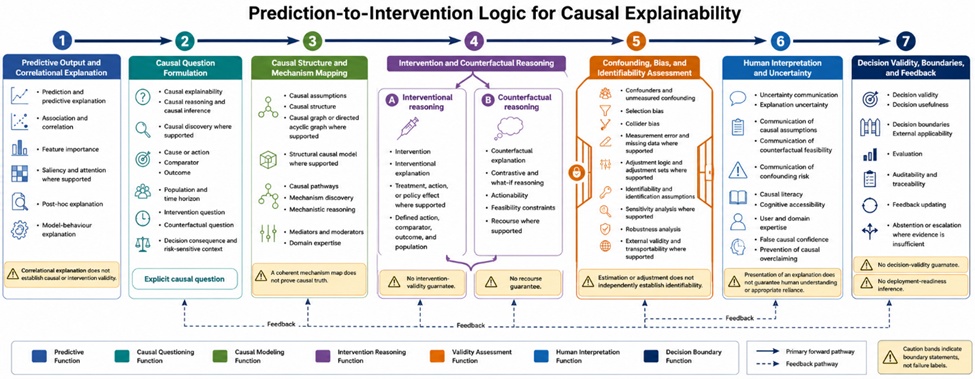
Figure 1. Prediction-to-Intervention Logic for Causal Explainability
A conceptual pathway showing prediction and correlational explanation moving through causal assumptions, mechanisms, interventions, counterfactuals, confounding, identifiability, uncertainty, human interpretation, and decision boundaries.
Causal explanations are interpreted by users with different objectives, expertise, responsibilities, and opportunities to contest decisions. A data scientist may need assumptions and sensitivity details, an operator may need escalation conditions, and an affected person may need an accessible account of why an outcome occurred and whether a proposed alternative is feasible. Explanation design and evaluation should therefore begin with stakeholder goals rather than assuming that one representation can satisfy every user [23].
Cognitive accessibility should not be confused with evidential completeness. Graphs, narratives, contrasts, and simplified causal language may improve readability while hiding identification assumptions, omitted variables, or uncertainty. Evaluation should consequently assess fidelity, stability, completeness, usability, and task relevance rather than relying on visual plausibility or anecdotal satisfaction. Existing evaluation research shows that explanation quality is multidimensional and cannot be represented by one universal metric [24].
Human-centred evaluation must also examine reliance. Explanations can increase confidence without improving judgement, and their effects depend on task difficulty, user knowledge, model accuracy, and the information available before the explanation is presented. Appropriate reliance means accepting useful assistance while detecting limitations and resisting erroneous recommendations. It is therefore different from trust, satisfaction, perceived transparency, or stated preference [25].
Counterfactual explanations illustrate this dependency clearly. Combining counterfactual, contrastive, or normative information may affect comprehension and decision performance differently across tasks. Additional explanation can impose cognitive burden, direct attention toward irrelevant changes, or produce an impression of causal certainty unsupported by the evidence. Human-performance testing is therefore needed before claiming that counterfactual explanations improve understanding or decisions [26].
Causal literacy includes the ability to distinguish prediction, association, intervention, and counterfactual claims and to recognise that an identified estimate remains conditional on assumptions. Interfaces should communicate causal assumptions, feasible action constraints, confounding risk, uncertainty, and decision boundaries in forms appropriate to user expertise. Nevertheless, comprehension cannot be presumed from exposure to an explanation, and better comprehension does not guarantee better reliance or outcomes [23]. Table 2 maps interventional explanations, counterfactual reasoning, confounding control, identifiability, decision validity, and human interpretation requirements for causal explainability.
Table 2. Interventional, Counterfactual, Confounding, Identifiability, Decision-Validity, and Human-Interpretation Requirements for Causal Explainability: What-If Reasoning, Recourse, Feasibility, Confounders, Selection Bias, Collider Bias, Adjustment, Sensitivity, External Validity, Causal Literacy, Uncertainty, and Decision Boundaries
Causal explainability requirement | Core causal or human-centred question | Required evidence or assumption | Causal or interpretation function | Potential output | Failure or residual risk | Evaluation or governance need | Framework role |
Intervention definition | What action is imposed? | Clear action, comparator, outcome, and population | Separates observation from manipulation | Qualified intervention question | Ambiguous or unrealistic action | Domain review | Intervention entry point |
Interventional explanation | What may follow from the action? | Identified causal estimand | Explains action–outcome relation | Conditional causal account | Prediction treated as effect | Empirical validation | Intervention layer |
Counterfactual reasoning | What would have occurred otherwise? | Factual case and causal assumptions | Supports why/why-not reasoning | Counterfactual statement | Alternative treated as observable fact | Assumption disclosure | Contrastive layer |
Counterfactual validity | Does the alternative alter the target output? | Valid model and target definition | Tests model-level outcome change | Valid alternative under model | Model validity confused with causal validity | External review | Technical checkpoint |
Counterfactual plausibility | Is the alternative realistic? | Data and causal constraints | Filters incoherent alternatives | Plausibility-qualified case | Realistic-looking but impossible state | Domain validation | Realism checkpoint |
Actionability | Can the person alter the feature? | Control, timing, access, and resource evidence | Filters unusable changes | Actionable candidate | Immutable or inaccessible change | Stakeholder review | Feasibility filter |
Recourse | Will feasible action improve the outcome? | Causal response and system stability | Connects explanation with consequence | Candidate recourse pathway | Prediction flips without lasting benefit | Longitudinal evaluation | Separate recourse stage |
Confounding | Are non-causal paths mixed with the target effect? | Causal structure and domain knowledge | Assesses exchangeability | Confounding statement | Residual bias | Transparent adjustment rationale | Validity gate |
Selection bias | Does sample inclusion distort the relation? | Sampling-process analysis | Tests population relevance | Selection-risk statement | Non-representative effect | Population review | Data-validity stage |
Collider bias | Has conditioning opened a false pathway? | Graph-based control review | Prevents induced association | Collider warning | Adjustment creates bias | Independent audit | Adjustment safeguard |
Identifiability | Can the target effect be recovered? | Identification assumptions and adequate data | Determines estimability | Identified-under-assumptions status | Estimation without identification | Methodological review | Hard gate |
Sensitivity analysis | Could hidden bias alter the conclusion? | Plausible violation scenarios | Assesses robustness | Sensitivity profile | Narrow scenarios create reassurance | Assumption reporting | Residual-risk layer |
External validity | Does the claim apply elsewhere? | Target-context comparison | Defines scope | Applicability statement | Overgeneralisation | Target-population validation | Scope boundary |
Causal literacy | Can users distinguish causal claim types? | User-knowledge assessment | Supports correct interpretation | Literacy-adjusted explanation | Causal terminology overpersuades | Comprehension testing | Human precondition |
Uncertainty communication | How fragile is the explanation? | Statistical and structural uncertainty | Calibrates confidence | Uncertainty profile | Caveats misunderstood | Interface evaluation | Mandatory disclosure |
Appropriate reliance | Does use improve judgement when warranted? | Behavioural task evidence | Evaluates human–AI interaction | Reliance assessment | Confidence rises without benefit | Controlled evaluation | Human outcome |
Decision validity | Does evidence support the contemplated decision? | Causal, utility, feasibility, and consequence evidence | Connects explanation with action | Bounded decision-support statement | Valid causal claim used for wrong decision | Multidisciplinary review | Integrative gate |
Decision boundary | When should the explanation not guide action? | Scope, uncertainty, and risk thresholds | Establishes abstention conditions | No-use or escalation rule | Boundary ignored | Salience and compliance monitoring | Hard safeguard |
The proposed framework begins with use-case and decision-context definition. It identifies the decision, affected parties, intended outcome, risk level, population, and evidence available. It then separates prediction from intervention and reviews existing model explanations as evidence about model behaviour rather than causation. This initial boundary reflects the distinction between technical explainability and human-oriented causability: an output can be interpretable without providing adequate causal understanding [27].
The second stage formulates the causal question and records its assumptions. A candidate causal structure or mechanism map can then represent hypothesised pathways, mediators, moderators, contextual variables, and sources of bias. Graph-based or multimodal representations may help experts integrate heterogeneous evidence, but they remain conceptual structures requiring empirical scrutiny and human evaluation. Their visual coherence must not be interpreted as proof that the represented mechanisms are true [28].
The third stage connects causal structure with intervention and counterfactual design. It asks whether the intended explanation concerns an intervention effect, a model-level counterfactual, a contrastive account, or possible recourse. Causal methods may function as explanatory targets, resources for constructing explanations, or tools for evaluating explanation validity. These roles should remain distinct because success in one role does not establish success in the others [29].
The fourth stage evaluates confounding, selection, measurement, identifiability, sensitivity, external validity, and transportability. It then communicates uncertainty and assumptions in forms matched to users’ causal literacy and decision roles. Documentation records provenance, structural choices, disputed assumptions, changes, and decision boundaries. These requirements respond to wider XAI challenges involving context, interdisciplinary evaluation, uncertainty, stakeholder adaptation, and responsible use [30].
The final stage assesses decision validity and creates feedback loops. It examines feasibility, consequences, human understanding, reliance, and whether evidence remains applicable as populations or systems change. Causal machine learning can support intervention-oriented questions, including heterogeneous treatment outcomes, only where assumptions, overlap, confounding control, validation, and target-context relevance are addressed [31]. Table 3 presents the proposed causal explainability framework linking prediction, causal assumptions, mechanism mapping, intervention reasoning, counterfactual explanation, confounding assessment, identifiability, human interpretation, decision validity, and feedback updating.
Table 3. Proposed Causal Explainability Framework for Decision Validity: Use-Case Definition, Prediction-Intervention Distinction, Correlational Explanation Review, Causal Question Formulation, Assumption Specification, Mechanism Mapping, Confounding Assessment, Identifiability, Interventional Explanation, Counterfactual Reasoning, Feasibility, Uncertainty, Human Interpretation, Decision Boundaries, Auditability, Evaluation, and Deployment Boundaries
Framework stage | Core purpose | Required input | Causal explainability function | Potential output | Validation or evaluation need | Failure risk | Feedback mechanism | Decision boundary |
Use-case and context definition | Specify purpose, users, consequences, and scope | Decision, population, outcome, risk | Establishes explanatory context | Context statement | Stakeholder review | Undefined or shifting objective | Revise scope | No use beyond defined context |
Prediction–intervention distinction | Classify the intended claim | Prediction and intended action | Prevents target conflation | Question classification | Methodological review | Prediction used as intervention evidence | Reframe question | Stop causal wording when unsupported |
Correlational explanation review | Identify what the model explanation shows | Attribution, saliency, rules, examples | Limits evidence to model behaviour | Explanation inventory | Fidelity and stability testing | Association described as cause | Correct interpretation | No correlational sufficiency |
Causal question formulation | Define action, comparator, outcome, population, and time | Decision objective | Establishes estimand | Structured causal question | Domain review | Ambiguous target | Reformulate | No estimation without clear question |
Assumption specification | Record claim dependencies | Structural and identification assumptions | Makes conditions visible | Assumption register | Plausibility review | Hidden assumptions | Update register | Claims remain conditional |
Mechanism mapping | Organise candidate causal pathways | Evidence and domain knowledge | Represents causes, mediators, and moderators | Candidate mechanism map | Empirical and expert validation | Plausible narrative treated as truth | Revise pathways | No causal-truth guarantee |
Confounding and bias assessment | Identify open bias pathways | Causal structure and sampling process | Assesses exchangeability | Bias-risk map | Graph and domain review | Omitted causes or bad controls | Reassess structure | Stop when critical bias is unresolved |
Identifiability assessment | Determine whether the target is recoverable | Estimand, assumptions, and data | Separates identifiable and non-identifiable claims | Identification status | Formal verification | Estimation without identification | Narrow question | No identifiability sufficiency |
Data and measurement review | Assess construct and sample validity | Provenance, measures, missingness | Connects data with causal concepts | Data-validity statement | Reliability and construct review | Proxy or measurement error | Improve data | Restrict unsupported claims |
Interventional explanation design | Explain qualified action effects | Identified intervention and uncertainty | Supports intervention-aware interpretation | Conditional explanation | Effect and domain validation | Unsupported recommendation | Revise action definition | No intervention-validity guarantee |
Counterfactual explanation design | Construct relevant contrasts | Factual case, target, and constraints | Supports why/why-not reasoning | Counterfactual explanation | Validity, plausibility, and stability checks | Unrealistic alternative | Revise constraints | Counterfactual is not causal truth |
Feasibility and recourse review | Assess attainability and consequence | Action set and causal dependencies | Separates explanation from recourse | Feasibility-qualified candidate | User and longitudinal evaluation | Impossible or ineffective action | Remove invalid pathway | No recourse guarantee |
Uncertainty and sensitivity communication | Show fragility and residual risk | Estimates and violation scenarios | Calibrates confidence | Uncertainty profile | Comprehension testing | Caveats hidden or misunderstood | Redesign presentation | Abstain under excessive uncertainty |
Human interpretation assessment | Test causal literacy and understanding | User roles and explanation format | Evaluates meaning and reliance | Comprehension assessment | Behavioural testing | Satisfaction mistaken for understanding | Adapt explanation | No understanding guarantee |
Decision-validity assessment | Determine whether evidence supports action | Causal evidence, utility, feasibility, risk | Links inference to bounded decision support | Decision-validity statement | Multidisciplinary evaluation | Causal result treated as prescription | Reassess consequences | No decision-validity guarantee |
Decision-boundary definition | Specify abstention and escalation conditions | Risk and scope thresholds | Prevents unsupported use | Boundary statement | Scenario testing | Boundary overridden | Monitor violations | Mandatory no-use conditions |
Documentation and auditability | Preserve provenance and responsibility | Versioned assumptions and evidence | Enables traceability | Framework dossier | Completeness review | Untraceable change | Version control | Documentation is not certification |
Evaluation and feedback updating | Revise assumptions and boundaries | New evidence and outcomes | Supports iterative correction | Updated framework | Prospective evaluation | Feedback entrenches bias | Periodic reassessment | Revalidate after material change |
Deployment boundary | Preserve conceptual status | Separate operational evidence | Prevents conceptual-to-operational leap | Research-use designation | Independent implementation testing | Framework presented as validated system | Suspend unsupported claims | Not deployment-ready |
Figure 2 presents the proposed causal explainability framework, integrating prediction-intervention distinction, causal assumptions, mechanism mapping, counterfactual reasoning, confounding assessment, identifiability, human interpretation, decision validity, and feedback updating.
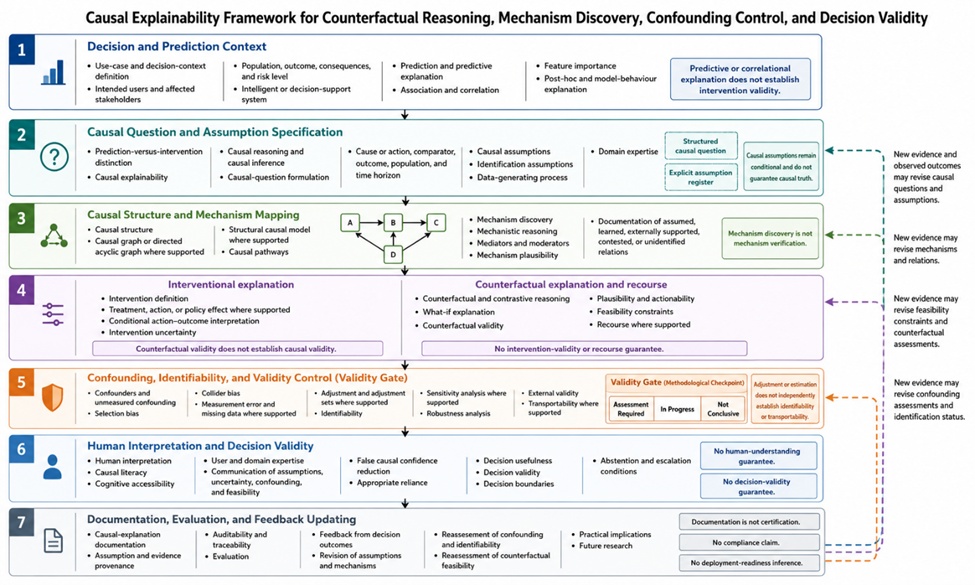
Figure 2. Causal Explainability Framework for Counterfactual Reasoning, Mechanism Discovery, Confounding Control, and Decision Validity
A conceptual causal explainability framework showing prediction review, causal questions, assumptions, mechanisms, interventions, counterfactuals, confounding, identifiability, uncertainty, human interpretation, decision validity, auditability, and feedback loops.
A central practical implication is that organisations and researchers should separate explanation-generation capability from causal-claim validity. Feature attributions, saliency displays, counterfactual generators, and fluent narratives should carry explicit scope statements identifying whether they describe model behaviour, statistical association, hypothetical prediction, or an identified causal effect. Future work should test whether such distinctions reduce causal overclaiming without making explanations inaccessible.
Causal assumption transparency and structure validation require further research. Candidate graphs and mechanisms should be evaluated across environments, expert groups, measurement choices, and contradictory evidence. Counterfactual feasibility and recourse assessment should incorporate temporal, economic, institutional, and causal dependencies rather than proximity alone. Sensitivity analysis should also be adapted for explanations so users can see how assumptions or unmeasured confounding could change an interpretation [20].
External validity, transportability, and human interpretation remain particularly underdeveloped. Causal explanations should be studied across populations and decision contexts rather than evaluated only on the data used to construct them [21]. Research should distinguish causal literacy, comprehension, confidence, reliance, and decision performance because improvement in one outcome may not improve another [25]. Foundation-model explanations require especially cautious evaluation because fluent causal narratives may appear mechanistic even when they are generated from statistical regularities.
These implications are research directions rather than operational prescriptions. The framework does not select causal discovery algorithms, adjustment procedures, counterfactual generators, datasets, metrics, platforms, interventions, or deployment processes. It does not provide legal, compliance, procurement, auditing, clinical, financial, safety-engineering, or policy guidance. Its contribution is to identify the assumptions, evidence, human evaluation, and decision boundaries that future causal explainability research should make visible [30].
This article proposed a causal explainability framework for moving from prediction toward intervention by connecting correlational-explanation review, causal-question formulation, explicit assumptions, mechanism mapping, interventional explanation, counterfactual reasoning, feasibility assessment, confounding control, identifiability, sensitivity, uncertainty communication, human interpretation, decision validity, documentation, and feedback updating. The framework emphasises that feature importance, saliency, attention, correlations, local perturbations, and post-hoc plausibility may explain model behaviour without establishing causes or valid actions. Causal explainability should instead be evaluated through transparent assumptions, defensible structures, validity checks, feasible counterfactual constraints, human-understanding assessment, and explicit decision boundaries. Even when these requirements are satisfied, the framework does not independently prove causal truth, guarantee intervention validity or recourse, establish decision validity, ensure appropriate reliance, or demonstrate operational readiness.
None
None
None
None
Open Access The author(s) retain copyright. This article is licensed under the Creative Commons Attribution-NonCommercial-ShareAlike 4.0 International License. It may be shared and adapted for non-commercial purposes with appropriate attribution, an indication of changes, and distribution of adaptations under the same license. Third-party material may be subject to separate terms identified in its credit line. View the license at https://creativecommons.org/licenses/by-nc-sa/4.0/.
 Transparent Intelligence Publishing