The escalating value placed on organizational human capital underscores the necessity for firms to optimize their systems for sourcing, evaluating, acquiring, onboarding, deploying, and retaining premium talent. Although embedding artificial intelligence (AI) within recruitment infrastructure promises unmatched workflow acceleration, operational scalability, minimized human subjectivity, and enhanced candidate sourcing, its deployment introduces distinct friction points that can degrade candidate attitudes and behavioral trajectories. Grounded in signaling and organizational justice frameworks, the deficit of interpersonal relational dynamics paired with the opaque nature of automated screening algorithms can prompt prospective candidates to question the integrity and structural fairness of the employment screening process. These institutional challenges risk modifying not only how job seekers deduce corporate principles, but also whether they choose to abandon the submission process altogether. Consequently, this investigation explores the comparative impact of AI-mediated versus human-mediated selection pathways on applicant trust, perceived procedural equity, corporate appeal, and subsequent intent to apply. Furthermore, we map the precise pathways through which trust and structural fairness mediate the link between the initial screening modality and early-stage candidate attraction and submission intentions. Data from an experimental student questionnaire indicate that job candidates view automated hiring protocols as significantly less credible, less equitable, and less appealing. Similarly, respondents exhibited depressed motivation to pursue open roles within enterprises leveraging automated recruitment architectures. Cultivating higher levels of institutional trust during the selection pathway and designing touchpoints that allow candidates to authentically showcase their professional capabilities can constructively reshape applicant attitudes and behavioral outcomes. These insights challenge the reductive assumption that operational velocity inherently yields strategic talent management success, emphasizing instead the vital role of interpersonal markers in securing top-tier talent within an automated recruitment environment.
The escalating value placed on organizational human capital underscores the necessity for firms to optimize their systems for sourcing, evaluating, acquiring, onboarding, deploying, and retaining premium talent [1]. In response to these modern structural requirements, an increasing number of enterprises are capitalizing on disruptive innovations—specifically artificial intelligence (AI)—to automate and refine their talent acquisition pipelines. Automated architectures promise unmatched operational velocity, systemic scalability [2], and optimized applicant screening [3] by digitalizing multiple phases of the recruitment cycle, including automated resume filtration, initial candidate testing, and interactive interviews [4, 5].
Nonetheless, alongside these procedural efficiencies, implementing automated mechanisms within recruitment workflows introduces fundamental dilemmas, ranging from the elimination of authentic interpersonal contact to challenges regarding algorithmic transparency and systemic bias [6, 7]. AI utilities are frequently characterized by a total absence of human attributes such as empathetic engagement, active listening, and personalized rapport [6, 8], which can depress the overall candidate journey and alter critical behavioral trajectories, such as the motivation to finalize an ongoing employment submission [1]. Furthermore, algorithmic partiality within automated setups has emerged as a major vulnerability that can generate discriminatory selection outcomes [7]. Given an industry reliance on opaque mathematical modeling and a broader deficit of functional transparency in automated systems, it is understandable that job seekers might question the credibility and procedural fairness of the review pathway [9].
Building upon these concerns, fundamental dilemmas regarding how these digital interventions manipulate early-stage candidate attitudes (e.g., corporate appeal, systemic trust, and perceived structural equity) and behavioral paths remain unresolved—particularly during the initial phases of talent sourcing where enterprises signal their core identity and workplace culture to prospective candidates. Signaling theory posits that when explicit information is unavailable, individuals construct internal assessments based on visible operational indicators [10]. A recent report by the New York Times underscored these friction points, noting that candidates reacted poorly to automated interview interfaces by terminating their sessions mid-way and characterizing the digital interaction as an entirely "hollow" experience [11]. Such interactions can signal to prospective employees that the hiring organization lacks personal warmth and may prioritize operational speed over people-focused employment methodologies [1]. These degraded institutional reputations can ultimately discourage prospective candidates from pursuing vacant positions within firms that integrate automated components into their talent pipelines [12].
From an organizational fairness perspective, enterprises must guarantee that candidates form positive assessments regarding their treatment across the entire candidate journey to ensure successful long-term hiring metrics [13]. Organizational justice theory highlights the critical importance of procedural equity—the perception of fairness regarding systemic methodologies—which can be significantly strengthened when applicants are granted the platform to communicate clearly or when the evaluation pathway remains strictly uniform and free from systemic partiality [14]. Yet, empirical data indicate that automated interview interfaces yield a drastically diminished sense of social presence (the psychological perception of authentic interpersonal connection), causing candidates to speak at an accelerated cadence and shorten natural conversational pauses, thereby impeding meaningful communication [15]. Additionally, the lack of transparency in automated workflows combined with the latent risk of computational bias can prompt candidates to doubt the equity of final hiring decisions [16-18]. These adverse experiences threaten to distort not only how job seekers interpret systemic fairness and corporate values, but also whether they choose to engage with the recruitment track or exit the pipeline completely.
Even though automated enterprise tools are spreading rapidly, scientific investigations assessing candidate psychology prior to formal application submission continue to lag behind actual marketplace deployment. Current projections indicate that 68% of corporate entities intend to adopt automated systems within their selection pipelines to manage resume screening (83%), execute candidate testing (69%), handle applicant communication (39%), and host digital interviews (19%) by the conclusion of 2025 [19]. Existing academic literature has concentrated almost exclusively on candidate evaluations captured during or after the final selection filters [18], largely bypassing the definitive pre-application phase where foundational impressions crystallize and the actual decision to apply is finalized [1]. Determining exactly how the inclusion of automated tools within the selection workflow manipulates applicant attitudes and behavioral tracks is both highly relevant and urgently needed. To bridge these identified literature gaps, this research project isolates two primary inquiries:
How does AI use in hiring process impact perception of applicants (e.g. organizational attraction, trust, and procedural justice) and intent to apply?
Do psychological mechanisms (e.g. applicants’ trust in the hiring process and procedural justice dimensions) mediate the association between AI use and organizational attraction and intent to apply?
By investigating these questions, we offer fresh empirical data that illuminate how AI-mediated versus human-mediated selection pipelines govern candidate views of an enterprise and steer their subsequent actions through distinct mediating paths. This provides both theoretical advancements to signaling and organizational justice frameworks alongside practical strategies for designing more balanced, human-centered automated talent platforms.
The accelerating deployment of automated architectures within employment workflows has fundamentally reshaped how enterprises filter, evaluate, and acquire talent. Although computational screening platforms promise heightened efficiency and objectivity, empirical evidence indicates that job candidates frequently respond poorly to these digital interventions, characterizing them as less credible, sterile, or inequitable [17, 18, 20]. Such unfavorable assessments are particularly damaging during the introductory phases of talent sourcing, when prospective candidates cultivate their initial mental models of the enterprise and determine whether to advance through the application pipeline [9]. In this context, organizational attraction signifies a candidate's holistic affective determination of the enterprise as a highly desirable workplace, whereas the intent to apply represents the explicit behavioral motivation to formally seek employment within that firm [10, 21]. The integration of automated screening tools within talent acquisition systems influences organizational attraction both via a direct pathway and through an indirect trajectory mediated by perceived fairness [22]. Correspondingly, alternative investigations demonstrate that job seekers exhibit a significantly higher willingness to submit applications when they maintain a positive institutional impression of the employer [1]. These convergent insights underscore the necessity of deeply exploring candidate reactions to algorithmic screening during recruitment workflows alongside their subsequent behavioral choices.
A job seeker's interpretation of the talent acquisition pipeline also heavily dictates their broader assessment of the enterprise itself. Within an algorithmically managed recruitment framework, the absence of authentic interpersonal engagement can function as a symbolic proxy for the institution's operational identity [23]. Drawing upon signaling theory [10], a deficit of personal interaction or an inadequate expenditure of time on candidates during an automated evaluation track [24] may be interpreted as an organizational signal that the company places a lower value on prospective talent relative to competitors who invest in more traditional, face-to-face evaluation methods. This interpretative process can generate highly unfavorable candidate assessments regarding enterprises that rely heavily on automated screening [25]. Conversely, as previously noted, some job seekers may respond enthusiastically to automated recruitment tracks if they interpret the technological integration as a sign of corporate innovativeness [1] or if they draw upon positive historical encounters with highly intuitive, user-friendly digital application platforms [26].
The bulk of current scientific literature mapping candidate motivations to engage with novel technologies is derived from foundational frameworks of digital adaptation, such as the Technology Acceptance Model, which posits that perceived utility and perceived user-friendliness serve as the primary catalysts for technological adoption [27]. While structurally valuable, these paradigms were established prior to the widespread implementation of automated recruitment systems, which explicitly demand the incorporation of human-centered dimensions such as reliable decision-making, engaging interpersonal dialogue, and platforms for authentic self-expression. This paradigm shift emphasizes the critical importance of embedding these human-centric values directly into models evaluating a candidate's behavioral willingness to participate in automated selection systems.
The utilization of algorithmic tools within selection tracks gives rise to novel psychological evaluations that can either constructively or destructively steer a candidate's motivation to submit a formal application [24, 28]. Crucially, the applicant experience with an employer begins well before the formal decision to submit materials, initiating at the very first touchpoint, such as reviewing a public job posting [29]. At this introductory juncture, candidates typically face a pronounced information deficit regarding both the internal corporate culture and the day-to-day realities of the vacant role. Given this pervasive information gap, signaling theory suggests that candidates lean heavily on visible operational cues to formulate cognitive deductions [10]. The deployment of advanced automated selection mechanisms can signal to applicants that the enterprise is highly progressive and innovative, thereby stimulating their interest in executing an application [1]. Conversely, negative candidate perceptions regarding computational unreliability, sterile detachment, and rigid procedural inflexibility can lead job seekers to conclude that the organization discounts individualized evaluation and meaningful human connection, ultimately dampening their enthusiasm for pursuing open roles [30, 31]. These conflicting outcomes validate the urgent need for rigorous empirical research analyzing how automated selection tracks dictate application intent, specifically when evaluated alongside human-centered constructs such as institutional credibility, bi-directional dialogue, opportunities for skill demonstration, and systemic administrative uniformity.
Grounded in signaling and organizational justice frameworks, the specific impact of selection pipeline trust and procedural equity on both organizational attraction and candidate application intent is analyzed. Signaling theory establishes that enterprises broadcast their core attributes and organizational quality via their human resource methodologies. Distinct talent management tracks can signal to prospective employees whether an institution is fundamentally attractive or trustworthy. Although the landmark Gilliland (1993) framework details nine distinct dimensions for quantifying procedural fairness within corporate practices, the current investigation isolates only those dimensions that an automated selection process characteristically lacks when contrasted with a human-managed track: bi-directional communication, the opportunity to perform, and administrative consistency.
In addition to manipulating subsequent behavioral trajectories and corporate impressions, the deployment of algorithmic screening can severely compromise systemic trust within the talent acquisition pipeline. Prior organizational research asserts that a failure to satisfy key procedural parameters, such as the complete suppression of bias or operational transparency, directly diminishes candidate trust in the selection pathway [14]. Automated utilities are routinely engineered with the explicit objective of generating objective, data-driven decisions [32, 33]; however, in real-world deployment, these frameworks can inadvertently mirror and reinforce historical systemic prejudices due to inherent constraints in advanced statistical analysis modeling [34, 35]. Furthermore, the opaque, "black-box" nature of automated decision-making prompts deep skepticism among job seekers, sharply reducing their overall trust in the integrity of the recruitment process [36]. Sociocultural dynamics can also intensify this skepticism, as individuals from collectivist or high uncertainty-avoidant cultural backgrounds are statistically more likely to challenge algorithmic selections that they perceive as arbitrary or unfair [37].
While the integration of automated mechanisms into the recruitment workflow threatens candidate trust through the amplification of historical bias and the substitution of human discernment with opaque formulas, it simultaneously alters how job seekers evaluate fairness across the selection track. Candidates do not formulate fairness judgments exclusively around final selection outcomes; rather, they judge fairness based on the structure and delivery of the selection process itself [14]. Procedural justice—defined as the perceived equity of the specific methodologies that culminate in a final decision—as conceptualized in Gilliland’s (1993) model, offers a robust framework for explaining how algorithmic selection paths shift candidate fairness assessments. The Gilliland (1993) paradigm dictates that procedural justice evaluations within a selection system encompass the job-relatedness of the testing mechanism, bi-directional communication, the opportunity to perform, administrative consistency, avenues for formal reconsideration, honesty, constructive feedback, question propriety, the interpersonal effectiveness of the administrator, and the explicit provision of decision rationales.
However, this investigation concentrates exclusively on bi-directional communication, the opportunity to perform, and administrative consistency, as these specific variables embody the interactive and relational facets of procedural equity that are most severely impacted by automated processing. By design, automated screening setups curtail opportunities for real-time, spontaneous interpersonal dialogue (degrading bi-directional communication), restrict a candidate's capacity to naturally exhibit their professional capabilities (degrading the opportunity to perform), and lack baseline transparency regarding internal operational sequences (degrading administrative consistency).
A candidate's capacity to engage dynamically with recruitment interfaces, their ability to fully showcase their professional competencies during evaluation, and their participation in a highly standardized, uniform selection track can positively or negatively dictate their broader justice evaluations [14]. Dynamic, interactive communication channels have been proven to elevate perceptions of procedural equity and drive overall applicant satisfaction [38, 39]. Conversely, automated screening setups regularly lack instantaneous human dialogue, which can trigger profound ambiguity and leave candidates with a perceived loss of situational control [40]. Moreover, treating automated architectures as impenetrable "black boxes" makes the delivery of constructive feedback for either selection or rejection decisions exceedingly difficult to execute [41]. This lack of human interaction can severely damage a candidate's evaluation of the recruitment pipeline. Similarly, a candidate's belief that they have been granted an authentic opportunity to demonstrate their professional competencies can be compromised within automated pipelines. Because applicants are frequently unfamiliar with the precise mechanics of automated recruitment tools, they remain highly uncertain regarding the hidden metrics applied by the software. This systemic ambiguity stems from an incomplete grasp of algorithmic operations, forcing candidates to rely on cognitive heuristics to interpret the selection track [23]. Paradoxically, administrative consistency represents a dimension where automation may actually elevate candidate fairness perceptions. Job seekers often perceive automated tracks as highly structured frameworks that systematically apply perfectly standardized queries across all applicants [23].
Cumulatively, systemic trust within the selection pathway and dimensions of procedural equity do not function as isolated phenomena; instead, they interact dynamically to govern how job seekers interpret and navigate automated recruitment setups. Empirical literature indicates that elevated levels of organizational appeal strongly correspond with an increased likelihood of candidates formally engaging with the application pipeline [42, 43]. For example, automated recruitment utilities engineered to deliver seamless candidate interactions, individualized feedback loops, and structural transparency can significantly augment an organization's overall appeal [44]. On the other hand, algorithmically biased or opaque screening mechanisms tend to alienate prospective talent, thereby depressing their ultimate intent to apply [36]. Furthermore, job seekers originating from collectivist social structures or cultural backgrounds characterized by high uncertainty avoidance frequently display diminished trust toward automated talent acquisition tracks, which indirectly dampens their willingness to submit employment materials [37]. Multiple investigations confirm that perceptions of procedural equity are tightly coupled with corporate attractiveness, an applicant's willingness to endorse the company to peers, and active job pursuit trajectories [45, 46]. These foundational studies indicate that stronger assessments of procedural fairness culminate in constructive candidate responses, prominently including enhanced organizational attraction and formal intent to apply [23]. Figure 1 illustrates the conceptual model of the relationship between AI use in hiring process and organizational attraction and intent to apply.
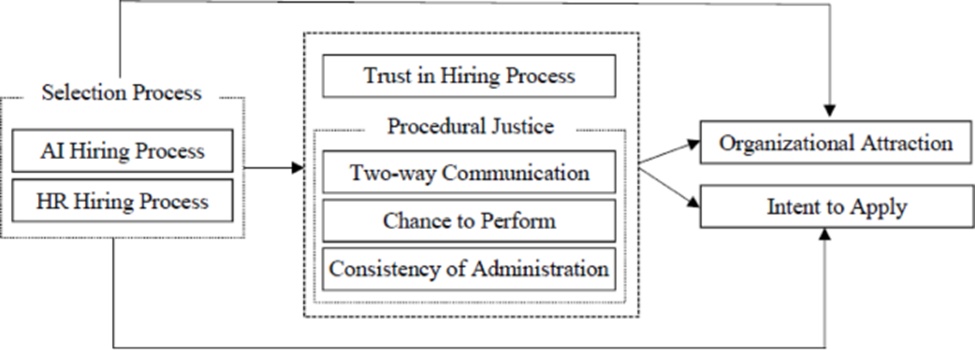
Figure 1. Conceptual model
This research project evaluated the precise impact of automated screening workflows on candidate attitudes and subsequent behavioral choices, such as their explicit intent to apply. A between-subject experimental design was deployed utilizing a sample of undergraduate and postgraduate students. A total population of 210 students engaged with and completed the data collection instrument. Upon reviewing a descriptive vignette delineating the selection protocols of a hypothetical enterprise designated as TechNex Inc., respondents completed 31 questionnaire items configured to quantify intent to apply, organizational attraction, trust in hiring process, and specific organizational justice dimensions (e.g., two-way communication, chance to perform, and consistency of administration). Prior to data collection, formal administrative clearance to conduct the experiment was secured from the institutional Review Board.
To optimize response rates and ensure robust engagement, a multi-channel recruitment strategy was deployed. The digital link to the questionnaire was delivered directly via institutional electronic mail networks, and informational flyers were circulated across the university campus to solicit student enrollment in the study. Additionally, dedicated information stations were established within the university library and popular student hubs to facilitate direct interaction with potential respondents. Because the empirical focus of this investigation centers on pre-application candidate reactions to the procedural, administrative, and relational attributes of a selection pipeline rather than job-specific technical competencies, a student cohort represents a highly suitable empirical proxy for early-career job seekers. While distributing the informational materials, researchers verbally detailed the primary objectives of the study alongside explicit candidate expectations. The final analytical sample comprised 210 participants. Within this group, 108 respondents were randomly assigned to evaluate the automated recruitment workflow vignette (condition 1), whereas 102 respondents evaluated the human-managed recruitment workflow vignette (condition 2). The demographic composition of the sample included 81 female participants, 111 male participants, and 18 individuals who selected the "preferred-not-to-say" option. Respondents received no financial or academic compensation for their involvement. The data collection instrument was deployed in May 2025. Power analysis calculations executed via G*Power indicated that a minimum threshold of 50 respondents per experimental cell was required to achieve a statistical power of 0.80, assuming an alpha level of \alpha = 0.05 and a large anticipated effect size.
Following the acquisition of formal informed consent at the introduction of the digital instrument, respondents were randomly assigned to evaluate a concise narrative depicting a recruitment process managed either via an automated computational system or by a human human resource manager. Adapted from established empirical protocols [47], the experimental vignette operationalized multiple critical operational conditions (Table 1). Immediately following their exposure to the narrative, respondents were required to answer an integrated attention check query; an incorrect response compelled the participant to re-examine the descriptive vignette before proceeding. This corrective cycle was restricted to a maximum of two attempts. Subsequently, respondents completed psychometric scales evaluating organizational attraction, trust in the hiring process, two-way communication, chance to perform, consistency of administration, and intent to apply. Complete demographic profiles—encompassing gender, racial background, chronological age, and educational attainment—were gathered from all respondents. To analyze the compiled dataset and resolve the primary research inquiries, a series of statistical analyses, including independent samples t-tests and multiple parallel mediation modeling, were executed using the R statistical computing software environment.
Table 1. Vignette
AI-Based Recruitment Scenario | Human Manager Recruitment Scenario |
TechNex Inc. has adopted a fully automated recruitment system powered by artificial intelligence. The AI-driven platform extracts information from applicants’ resumes and ranks candidates according to job requirements and predefined criteria, including educational background, professional experience, skills, and certifications. The system also predicts applicants’ potential job performance by comparing their profiles with those of previously successful employees. | TechNex Inc. utilizes a conventional recruitment process in which the Human Resources (HR) manager plays the primary role in candidate evaluation. After receiving applications, the HR manager reviews resumes and ranks candidates according to job requirements and predefined criteria such as education, work experience, skills, and certifications. The HR manager also evaluates applicants’ likelihood of success by comparing their profiles with those of previously high-performing employees. |
The AI-powered platform is responsible for making the final hiring decision. | Subsequently, the HR department reviews the evaluation outcomes collectively and reaches a final hiring decision. |
Candidates who are selected receive an automatically generated email inviting them to participate in an AI-supported virtual interview. | Candidates who are selected receive an invitation email from the HR manager to attend an in-person interview with their prospective supervisor. |
During the virtual interview, the AI system asks questions designed to assess communication abilities, interpersonal competencies, and job-related qualifications. Applicants are provided with sufficient time to respond and explain their perspectives comprehensively. The system additionally develops a personality profile using vocal characteristics, facial-expression analysis, and response content. This profile is then compared against predefined job requirements and is used as the basis for the AI system’s decision-making process. | During the face-to-face interview, the HR representative asks questions intended to evaluate communication skills, interpersonal abilities, and job-relevant competencies. Applicants are provided with sufficient time to respond and present their viewpoints accurately. Based on notes recorded during the interview, the HR manager develops a personality profile, which is subsequently compared with the predefined requirements of the position and serves as the foundation for the HR manager’s final evaluation and decision-making process. |
Some part of vignette is adapted from “Can I show my skills? Affective responses to artificial intelligence in the recruitment process.”, by [47], Review of Managerial Science, 17(6), 2109–2138
As detailed in Table 2, the empirical framework operationalized 6 distinct theoretical constructs derived systematically from signaling and organizational justice paradigms [10, 14]. The entire respondent cohort completed identical psychometric items designed to quantify organizational attraction, intent to apply, trust in the hiring process, and the core procedural justice sub-dimensions of bi-directional communication, opportunity to perform, and uniformity of administration. The measurement items remained uniform across both experimental groups, with the sole exception of the third psychometric indicator utilized to evaluate the consistency of administration dimension.
Table 2. Summary of survey items
Construct | Measurement Items | Reference |
Organizational Attractiveness (α = 0.85) | In my opinion, TechNex Inc. would be an excellent organization to work for. | |
I would consider pursuing employment at TechNex Inc. even if alternative opportunities were unavailable. | ||
TechNex Inc. is appealing to me as a potential employer. | ||
I would like to obtain additional information about TechNex Inc.. | ||
If hired, I would be highly motivated to remain employed at TechNex Inc. over the long term. | ||
Employment with TechNex Inc. is highly desirable to me. | ||
Application Intention (α = 0.82) | How likely would you be to reach out to TechNex Inc. for additional details regarding the advertised position? | |
How likely would you be to proceed with and complete the application process? | ||
How likely do you think it is that TechNex Inc. would extend a job offer to you? | ||
If a position were offered, how likely would you be to accept it? | ||
Trust (α = 0.86) | This recruitment process appears reliable and trustworthy. | |
This recruitment process seems capable of producing fair outcomes for individuals affected by its decisions. | ||
I trust that the recruitment process will operate in the manner promised. | ||
I would modify one or more elements of this recruitment process to improve its trustworthiness*. | ||
Two-Way Communication (α = 0.89) | The interview process would provide sufficient opportunities for communication. | |
I would be able to ask questions concerning the recruitment process. | ||
I would be satisfied with the level of communication throughout the interview process. | ||
If I had questions, I would feel comfortable raising them about the recruitment process. | ||
I would feel at ease expressing any concerns during the interview session. | ||
Opportunity to Demonstrate Performance (α = 0.93) | The interview session would allow me to effectively demonstrate my skills and capabilities. | |
This recruitment process would enable me to showcase my professional competencies. | ||
This recruitment process would provide applicants with a genuine opportunity to demonstrate their abilities. | ||
During the interview session, I would be able to show what I am capable of accomplishing. | ||
Consistency of Administration (α = 0.90) | The interview process would be conducted uniformly for all applicants. | |
There would be no variation in how the interview is administered across different candidates. | ||
The AI system/the HR manager would treat all applicants consistently without differentiation. |
*Items with an asterisk were reverse-coded
Psychometric indicators measuring a candidate's intent to apply were captured utilizing a five-point Likert response format anchored from very unlikely (1) to very likely (5). Variables operationalizing organizational attraction, trust in the hiring process, two-way communication, chance to perform, and consistency of administration were quantified utilizing a corresponding five-point Likert metric ranging from strongly disagree (1) to strongly agree (5).
Participants across both experimental conditions were also subjected to a forced-choice attention validation metric specifically targeting the operational attributes of the described selection track. For respondents assigned to the automated recruitment pathway, the validation query asked: “What does the AI system assess in the interview?” Conversely, for respondents assigned to the human-managed recruitment pathway, the validation query asked: “What does the HR manager ask during the interview?”
This investigation was designed and executed in strict compliance with established ethical standards and regulatory protocols governing human subject experimentation, and received formal administrative approval from the Institutional Review Board at the University of Missouri.
To address the initial inquiry, “How does AI use in hiring process impact perception of applicants (e.g. organizational attraction, trust, and procedural justice) and intent to apply?”, independent-samples t-tests were executed to compare the automated and human-led conditions (Table 3). Statistically significant variances were identified across all dependent measures with the exception of consistency of administration, with human-managed procedures consistently yielding elevated scores relative to AI-managed tracks.
Table 3. Means and t-test comparison of participant ratings between AI and human conditions
Variable | Cohen's d | p-value | t (df) | Human condition mean (SD) | AI condition mean (SD) |
Organizational attraction | 0.73 | < .001 | − 5.316 (200.07) | 3.67 (0.66) | 3.11 (0.86) |
Intent to apply | 0.46 | < .001 | − 3.368 (206.04) | 3.50 (0.88) | 3.05 (1.03) |
Trust | 1.4 | < .001 | − 10.175 (183.95) | 3.62 (0.64) | 2.45 (1.00) |
Two-way communication | 1.04 | < .001 | − 7.516 (202.87) | 3.75 (0.83) | 2.78 (1.04) |
Chance to perform | 0.69 | < .001 | − 5.039 (206.07) | 3.37 (1.00) | 2.62 (1.17) |
Consistency of administration | 0.05 | 0.713 | − 0.369 (208.00) | 3.53 (1.09) | 3.48 (1.16) |
*p < .05; **p < .01; ***p < .001
To address the secondary inquiry, “Do psychological mechanisms (e.g. applicants’ trust in the hiring process and procedural justice dimensions) mediate the association between AI use and organizational attraction and intent to apply?”, we evaluated these underlying pathways utilizing Covariance-Based Structural Equation Modeling (CB-SEM). Employing a deductive paradigm, CB-SEM analysis was applied to validate an established framework [22] and determine whether the empirical data gathered in this investigation supported that theoretical model. The estimation protocol for this method relies on covariance structures, matching its objective to assess the goodness-of-fit between a theoretical model and the observed variances among variables. The initial model positions systemic trust, bi-directional communication, opportunity to perform, and administrative consistency as potential explanatory mediators of corporate appeal. The secondary model incorporates these identical explanatory mechanisms to predict a candidate's formal intent to apply (Table 4).
Table 4. Direct, indirect, and total effects of hiring system perceptions on organizational attraction and intent to apply
Intention to Apply |
| Organizational Attractiveness |
| |
95% CI | β | 95% CI | β | |
Overall Model Effects |
|
|
| |
Combined Effect | [0.174, 0.707] | 0.444* | [0.362, 0.790] | 0.559* |
Direct Influence | [− 0.462, 0.067] | − 0.185 | [− 0.210, 0.232] | 0.007 |
Indirect Influence | [0.390, 0.841] | 0.629* | [0.391, 0.757] | 0.552* |
Mediating Effects |
|
|
| |
Trust in the Recruitment Process | [0.033, 0.462] | 0.254* | [0.145, 0.474] | 0.303* |
Bidirectional Communication | [0.054, 0.441] | 0.228* | [0.029, 0.308] | 0.147* |
Opportunity to Demonstrate Ability | [0.009, 0.302] | 0.144* | [0.006, 0.209] | 0.097* |
Administrative Consistency | [− 0.018, 0.038] | 0.004 | [− 0.020, 0.040] | 0.001 |
*Confidence interval does not include zero
In predicting corporate appeal, a statistically significant indirect pathway was observed from the experimental condition through systemic trust, bi-directional communication, and the opportunity to perform (cumulative indirect effect: β = 0.55, p < 0.001). Prior to the inclusion of these mediating variables, the direct link between the experimental condition and organizational attraction was statistically significant (β = 0.559, p < 0.001). However, the direct impact of the experimental condition became statistically non-significant once the mediators were integrated into the framework (β = 0.007, p = 0.949), confirming a pattern of full mediation. Among the isolated mediators, trust within the recruitment track exerted the most robust indirect influence (β = 0.303), followed sequentially by bi-directional communication (β = 0.147) and the opportunity to perform (β = 0.097). All three pathways achieved statistical significance, as evidenced by their 95% confidence intervals, which exclude zero. Conversely, administrative consistency did not function as a statistically significant mediator (β = 0.005, CI [-0.020, 0.040]). These insights demonstrate that trust within the selection track serves as the primary driver of corporate appeal, while conversational dialogue and the perceived capacity to showcase capabilities also offer meaningful contributions. This outcome corroborates previous research that explored the connection between automated selection tracks and organizational attraction via Partial Least Squares Structural Equation Modeling (PLS-SEM) [22]. That exploratory methodology focuses on theory development with an emphasis on variance-based prediction.
Similarly, while a statistically significant baseline association was observed between the experimental condition and application intent prior to the introduction of the mediators (β = 0.444), the direct impact of the selection condition on intent to apply became non-significant (β = -0.185) following their inclusion. Candidate intent to apply was indirectly driven by the assigned recruitment condition through systemic trust (β = 0.25), bi-directional communication (β = 0.23), and the opportunity to perform (β = 0.14). All three indirect pathways reached statistical significance, given that their 95% confidence intervals exclude zero. In contrast, administrative uniformity did not emerge as a significant mediating variable (β = 0.004, CI [-0.023, 0.038]). These patterns indicate that systemic trust and dynamic communication are primary catalysts governing an applicant's intent to apply, with the perceived opportunity to display professional talents playing an additional meaningful role. Although this specific path design had not been previously scrutinized in the literature, equivalent variance-focused PLS-SEM techniques designed to project a dependent variable without rigid theoretical anchoring lend empirical weight to these insights.
The empirical outcomes of this investigation offer a nuanced perspective on how integrating AI within talent acquisition tracks shapes candidate experiences—demonstrating that this reaction stems not from an intrinsic rejection of modern technology, but rather from a degradation of the social and procedural indicators that signal trust and human-centered connectivity.
The data demonstrate that the automated recruitment pathway yields less favorable candidate evaluations across nearly every metric quantified in this research, with the sole exception of administrative uniformity. Corroborating earlier literature, individuals exposed to the automated condition evaluated the employer less favorably [22, 25], displayed a depressed willingness to submit applications [28, 29], and perceived fewer avenues to equitably demonstrate their professional competencies [23]. This investigation extends this line of research by revealing that candidates subject to automated evaluation express lower baseline trust in the selection workflow and perceive diminished interactive communication. A potential explanation for these unfavorable reactions may involve the perceived inability of job seekers to exert behavioral control or meaningful influence over algorithmically managed evaluation tracks [16, 51]. Regarding the non-significant findings for administrative consistency, the underlying reason may be that candidates assign far greater cognitive weight to relational dynamics like trust and communication, which signal corporate warmth, professional respect, and individualized attention—attributes that automated tools are widely perceived to lack. Taken together, these insights indicate that while candidates may view automated and human-managed workflows as structurally uniform and consistent [23], algorithmic systems lack the interpersonal, human-centric dimensions required to cultivate trust and open communication.
This study adds to the expanding body of talent management literature by mapping the underlying psychological mechanisms that link recruitment methodologies (AI versus human) to corporate appeal and application intent. The parallel mediation framework confirmed that systemic trust, bi-directional communication, and the opportunity to demonstrate skills fully mediate these paths. Consequently, enterprises integrating automated features into their recruitment pipelines must proactively formulate strategies designed to elevate applicant trust and protect channels for meaningful dialogue and skill showcase. Failing to address these adjustments risks reducing the organization's capacity to attract top-tier talent, ultimately shrinking the overall depth and quality of its applicant pool.
The empirical insights derived from this study extend the expanding domain of literature evaluating candidate reactions to automated systems within talent acquisition workflows [1, 22, 23, 25]. Structurally, this investigation substantiates an indirect, mediated process framework. Specifically, subjective evaluations of systemic trust, bi-directional communication, and the opportunity to perform dictate how favorably job seekers assess the enterprise, while simultaneously steering their subsequent willingness to apply. These interconnected pathways demonstrate that the purely technical attributes of algorithmic tools are not the sole determinants of corporate appeal and candidate application intent. By isolating the distinct roles played by selection-track trust, open dialogue, and capability showcase, this study refines prior empirical models to clarify exactly how human-centric interactive touchpoints translate into concrete applicant behaviors. Furthermore, these findings advance the theoretical development of signaling and organizational justice paradigms. Deploying these frameworks within an algorithmically managed recruitment context illustrates how conventional signaling and justice mechanics function when an automated interface assumes the role of an organizational gatekeeper.
From a managerial and operational standpoint, these outcomes emphasize that even if automated screening tools are engineered to guarantee structural equity and objective consistency, they routinely lack the subtle interpersonal signals of fairness and empathy that job seekers natively connect with human-led workflows. This dynamic creates a distinct strategic dilemma for enterprises incorporating artificial intelligence into their talent pipelines. To mitigate these friction points, hiring organizations should maintain or strengthen direct human involvement at critical recruitment milestones, such as formal interviews or direct applicant communication, positioning automated utilities as decision-support systems that assist human resource professionals rather than replace them. Additionally, enterprises can optimize candidate reactions toward automated screening mechanisms by proactively sharing detailed information regarding how the software operates, specifying the exact criteria it quantifies, detailing the logic underlying its selections, and embedding explainable AI (XAI) functionalities into the candidate interface.
First, this investigation relied on hypothetical scenario-based vignettes, which may not fully replicate the psychological complexities or real-world pressures of authentic candidate reactions. Future empirical endeavors could validate these outcomes by utilizing field experiments or direct tracking data captured within active talent pipelines, especially since real-life employment stakes heavily dictate an applicant's assessment of procedural equity [16]. Second, examining the impact of baseline individual differences—such as varying levels of technological anxiety or historical familiarity with automated tools—could provide a more granular understanding of the specific conditions and demographic profiles where automated screening is most readily accepted. For instance, implementing automated selection tools for employee cohorts who have historically faced systemic social marginalization within professional environments has been shown to yield heightened fairness evaluations and a more favorable impression of the employing firm [52]. Such nuanced dynamics surrounding algorithmic screening demand broader academic investigation. Third, the experimental vignettes in this study did not independently manipulate the mediating constructs, which presents a challenge for establishing absolute causal directionality across the model. Future research can expand upon this paradigm by actively manipulating the hypothesized mediators or altering the structural sequence of the path configuration.
This investigation provides essential clarity regarding how the fundamental architecture of talent acquisition systems—specifically comparing automated versus human-managed pathways—shapes applicant attitudes and subsequent behavioral trajectories. Although the baseline data indicate that job seekers view automated recruitment workflows as less engaging, less credible, and less interactive, the parallel mediation analyses demonstrate that these unfavorable reactions are not triggered by an intrinsic aversion to technology itself, but rather by the underlying psychological mechanisms that automated systems fail to sustain. Crucially, both an enterprise's organizational appeal and a candidate's explicit intent to apply are driven by trust, perceived structural equity, and the interpersonal signals embedded within the selection track.
These discoveries dispute elementary assumptions that operational velocity and technical efficiency automatically yield strategic human resource success, underscoring instead the vital role of relational indicators in securing premium talent within an automated recruitment environment. Consequently, corporate entities intending to adopt automated screening tools must evaluate both the technological capabilities and the psychological consequences of artificial intelligence. Finally, this study sharpens the application of signaling and organizational justice theories within the digital recruitment landscape. By confirming that the psychological dynamics of automated workflows serve as core mediators linking the primary selection method to applicant behavior, this research illuminates how conventional justice and signaling paradigms function when traditional interpersonal contact is substituted or supplemented by artificial intelligence.
None
None
None
None
Open Access The author(s) retain copyright. This article is licensed under the Creative Commons Attribution-NonCommercial-ShareAlike 4.0 International License. It may be shared and adapted for non-commercial purposes with appropriate attribution, an indication of changes, and distribution of adaptations under the same license. Third-party material may be subject to separate terms identified in its credit line. View the license at https://creativecommons.org/licenses/by-nc-sa/4.0/.
 Transparent Intelligence Publishing