Generative artificial intelligence can produce fluent, context-sensitive, and apparently authoritative responses even when relevant knowledge is incomplete, evidence is unavailable, or generated claims are false. This creates an epistemic safety problem concerning not only what a system produces, but also what it appears to know, how its claims are supported, how uncertainty is expressed, and when answering should be limited. This article develops a conceptual safety framework organized around four operational principles: ground, qualify, verify, and abstain. The framework treats hallucination as a multidimensional risk involving fabrication, factuality failure, groundedness failure, unsupported claims, false confidence, source and context errors, reasoning errors, citation errors, overgeneralization, confabulation, speculative output, and incomplete evidence. Grounding links material claims to relevant and sufficiently reliable evidence; qualification communicates uncertainty, assumptions, scope, and evidential limitations; verification examines claims, sources, citations, and inferential consistency; and abstention enables refusal, deferral, escalation, or constrained output when evidence or system competence is insufficient. Human review, meaningful oversight, decision boundaries, failure containment, incident monitoring, and lifecycle updating operate across these principles rather than functioning as final guarantees. The main contribution is an integrated generative AI safety framework that connects output-level hallucination control with source quality, knowledge verification, uncertainty communication, review quality, response limitation, and downstream risk containment. The framework is intended to structure domain-specific assessment and future research. It does not independently establish factual reliability, ethical sufficiency, legal compliance, operational safety, certification, or deployment readiness.
Generative AI systems can synthesize language, images, code, explanations, and recommendations across a widening range of tasks, creating substantial informational and organizational opportunities while also introducing distinctive reliability and governance risks [1]. Their outputs are generated through learned statistical relationships rather than through an independently warranted understanding of truth, evidence, or meaning. Consequently, coherent language and broad apparent competence should not be interpreted as proof that a system possesses justified knowledge or dependable semantic understanding [2]. This distinction is central to epistemic safety because users may treat fluent responses as authoritative even when the underlying evidence is missing, uncertain, outdated, or incorrectly represented.
Trustworthy AI cannot be reduced to accuracy or usefulness alone. It encompasses interacting requirements concerning reliability, robustness, transparency, accountability, human agency, fairness, privacy, and appropriate governance [3]. These requirements are socio-technical because system behavior is influenced by data, model design, interfaces, organizational processes, user expectations, review arrangements, and the environments in which outputs are applied [4]. For generative AI, trustworthiness therefore depends partly on whether claims are grounded, uncertainty is made intelligible, verification is proportionate to the claim, human intervention is meaningful, and unsupported responses can be constrained before they influence consequential decisions.
Existing discussion often treats hallucination as a discrete model defect or a problem to be solved through better prompting, retrieval, training, or filtering. Such approaches may reduce particular errors, but they do not by themselves resolve the broader problem of what a generative system should claim to know. Epistemic safety requires attention to evidence provenance, source reliability, contextual applicability, uncertainty, user reliance, and downstream decision consequences. It also requires recognition that apparently correct outputs can remain unsafe when their evidential basis is obscure, their scope is overstated, or users cannot distinguish verified information from plausible synthesis.
This article proposes an original conceptual framework organized around four connected principles: ground, qualify, verify, and abstain. Grounding concerns the relationship between claims and relevant evidence; qualification concerns uncertainty, assumptions, scope, and evidential limitations; verification concerns claim checking, source assessment, and consistency; and abstention concerns refusal, deferral, escalation, or output restriction when response conditions are not satisfied. Human review, decision boundaries, failure containment, monitoring, and lifecycle governance connect these principles. The framework is intended to clarify safety requirements and research priorities rather than prescribe universal technical architectures, thresholds, governance instruments, or deployment decisions.
Hallucination in natural-language generation commonly refers to content that is plausible in form but unsupported by the relevant input, source, or established knowledge [5]. In large language models, the problem includes multiple forms of factual, contextual, reasoning, citation, and faithfulness error arising from training conditions, decoding processes, knowledge limitations, retrieval defects, and interaction context [6]. A single definition is therefore insufficient for every use case. The relevant safety question is not merely whether an output contains an error, but whether the system presents a claim with a level of evidential authority, certainty, or completeness that the available information cannot justify.
Hallucination risk is intensified when the system cannot adequately distinguish between a supported answer and a linguistically coherent completion. Semantic uncertainty may help identify some confabulations by measuring variation in meaning across alternative generations, but it does not establish the factual truth of an answer or detect every unsupported claim [7]. Broad task evaluations likewise show that conversational systems can perform strongly in some contexts while remaining inconsistent or unreliable in others [8]. Apparent versatility must therefore be separated from dependable competence, especially when users may generalize success in familiar tasks to domains where the system has not demonstrated comparable reliability.
Treating hallucination as an epistemic safety problem broadens the analysis beyond factual inaccuracy. Fabrication concerns invented entities, events, evidence, or sources; groundedness concerns fidelity to supplied material; factuality concerns correspondence with externally checkable facts; and truthfulness concerns whether the response communicates warranted information rather than merely persuasive text. Unsupported claims may be true by coincidence yet remain epistemically defective because no adequate evidence connects the system’s assertion to the proposition. False confidence adds another layer of risk by presenting uncertain, incomplete, or speculative material in language that encourages inappropriate reliance.
The resulting harm pathway is relational rather than purely technical. A generated statement becomes consequential when users interpret it, integrate it into another process, communicate it onward, or use it to support a decision. Responsible and trustworthy AI therefore require controls over both content and the conditions under which content is presented. No grounding method, uncertainty estimator, verification process, human reviewer, or refusal rule can independently eliminate hallucination or establish safety. The proposed framework retains explicit no-hallucination-elimination and no-safety-guarantee boundaries so that partial safeguards are not misrepresented as comprehensive assurance.
The term hallucination is sometimes used so broadly that it obscures important distinctions between factual error, source unfaithfulness, unsupported inference, and other failures [9]. A safety-oriented classification should therefore begin with the relationship among the claim, its context, and the evidence expected to support it. A factuality error contradicts verifiable information; a groundedness error departs from provided or retrieved material; a truthfulness failure misrepresents what is warranted; and an unsupported claim lacks an adequate evidential basis even when it cannot immediately be shown to be false. Distinguishing these forms helps determine whether the appropriate response is grounding, qualification, verification, correction, or abstention.
Error can also arise from incentives embedded in model evaluation and interaction design. When systems are rewarded principally for supplying an answer, without adequate recognition of justified non-answering, they may be encouraged to guess rather than acknowledge insufficient knowledge [10]. False confidence, speculative completion, and overgeneralization can consequently emerge from pressures toward completeness and responsiveness. A model may answer beyond the available context, extend a limited observation into a general rule, or convert an ambiguous possibility into a definite statement. Epistemic safety therefore requires evaluation that considers appropriate abstention and qualification alongside answer accuracy.
Upstream data and knowledge conditions create additional risks. Recursive reliance on model-generated material can degrade informational distributions and progressively weaken model reliability, demonstrating why data provenance and source authenticity matter throughout the lifecycle [11]. Retrieval-supported systems can also fail when queries are poorly formed, relevant evidence is absent, sources are outdated, or retrieved material is unreliable. Citation errors may involve non-existent references, incorrect bibliographic details, or real sources that do not support the associated claim. These failures can be particularly misleading because the appearance of sourcing may increase user confidence even when the evidential connection is defective.
Calibration and knowledge distribution also shape error behavior. Research on monofacts and miscalibration indicates that limited exposure to particular facts and unreliable confidence estimates can contribute to hallucination risk [12]. Context errors arise when generally correct information is applied to an unsuitable case, while reasoning errors occur when valid premises are combined through invalid inference. Confabulation fills evidential gaps with coherent narrative, and incomplete evidence creates a misleading appearance of comprehensiveness. Table 1 summarises sources and forms of generative AI error that create hallucination, factuality, grounding, uncertainty, and epistemic safety risks.
Table 1. Sources and Forms of Generative AI Error: Hallucination, Fabrication, Unsupported Claims, False Confidence, Factuality Errors, Groundedness Errors, Truthfulness Failures, Source Errors, Context Errors, Retrieval Errors, Reasoning Errors, Citation Errors, Overgeneralization, Confabulation, Speculative Output, Incomplete Evidence, and Hallucination Boundaries
Error source or form | Core safety question | How the error appears | Potential harm pathway | Affected use context | Detection or mitigation need | Boundary statement | Framework role |
Hallucination | Is the output adequately supported? | Plausible but unsupported content | Fluent error is accepted as knowledge | Knowledge-intensive generation | Grounding, verification, qualification | No single control eliminates hallucination | Umbrella epistemic-risk category |
Fabrication | Has an entity, event, result, or source been invented? | Non-existent facts or references | False evidence enters downstream work | Research and professional writing | Entity and source validation | Coherence does not establish existence | Verification trigger |
Unsupported claim | What evidence justifies the assertion? | Claim lacks traceable support | Unwarranted statement influences action | Evidence-sensitive tasks | Claim-to-evidence mapping | Possible truth does not equal justification | Grounding trigger |
False confidence | Does wording overstate certainty? | Definitive language under uncertainty | Users over-rely on weak output | Ambiguous or novel requests | Calibration and qualification | Expressed confidence may be unreliable | Qualification trigger |
Factuality error | Does the claim conflict with facts? | Incorrect dates, names, quantities, or relations | Incorrect belief or decision | Information and analytical use | External fact-checking | Verification can still miss errors | Verification target |
Groundedness error | Is the answer faithful to supplied evidence? | Response departs from context or sources | Source-backed appearance conceals inconsistency | Document-based generation | Source–claim alignment checking | Faithfulness does not prove source truth | Grounding control |
Truthfulness failure | Is the system communicating warranted information? | Misleading or distorted presentation | Users infer dependable knowledge | Conversational and advisory use | Claim and context review | Truthfulness exceeds factual accuracy | Cross-cutting objective |
Source error | Is the relied-upon source authentic and suitable? | Invented, stale, biased, or weak source | Poor evidence appears authoritative | Research and synthesis | Source-quality assessment | Source presence does not establish quality | Evidence-quality gate |
Context error | Is the information applicable to the actual case? | Correct general information is misapplied | Inappropriate transfer causes harm | Domain-specific requests | Scope and context confirmation | General validity does not ensure local fit | Decision-boundary input |
Retrieval error | Was relevant and reliable evidence retrieved? | Missing, irrelevant, or conflicting material | Generation is grounded in defective context | Retrieval-supported generation | Retrieval and coverage evaluation | Retrieval does not guarantee truth | Retrieval failure branch |
Reasoning error | Does the conclusion follow from the evidence? | Invalid inference or contradiction | Accurate facts yield a false conclusion | Multi-step analysis | Consistency and logic checking | Correct evidence does not ensure correct reasoning | Verification gate |
Citation error | Does the citation support the exact claim? | Invented, misplaced, or non-entailing citation | Unsupported output gains false authority | Academic and technical writing | Citation existence and entailment checking | Citation format does not prove support | Traceability control |
Overgeneralization | Is limited evidence presented universally? | Narrow result becomes a broad rule | Contextually unsuitable application | Synthesis and advisory tasks | Scope qualification | Local evidence cannot prove universality | Qualification gate |
Confabulation | Is coherent narrative filling a knowledge gap? | Internally consistent unsupported explanation | Coherence hides absence of evidence | Open-ended dialogue | Uncertainty and grounding checks | Coherence is not justification | Abstention trigger |
Speculative output | Is conjecture distinguished from established knowledge? | Possibility is presented as fact | Predictions influence action | Forecasting and emerging topics | Explicit speculation labels | Qualification does not validate prediction | Qualified-response category |
Incomplete evidence | Are material sources or conditions absent? | Partial evidence appears comprehensive | Alternatives and limitations are overlooked | Research synthesis and complex decisions | Coverage review and escalation | Available evidence may be insufficient | Low-evidence trigger |
Hallucination boundary | Can safeguards remove all residual error? | Errors persist despite controls | Safeguard confidence creates new exposure | All generative AI use | Monitoring and residual-risk documentation | Hallucination elimination is not established | Mandatory framework boundary |
Evidence grounding connects generated claims to identifiable information that is relevant to the question and suitable for the intended context. Retrieval-augmented generation can provide access to external documents and more current knowledge, but its reliability remains dependent on query formulation, retrieval coverage, ranking, source quality, context construction, and the model’s use of retrieved material [13]. Grounding should therefore be treated as a structured evidence process rather than as the simple inclusion of retrieved text. A response may be faithful to a retrieved passage while remaining factually wrong because the source itself is unreliable, outdated, incomplete, or inapplicable.
Grounding requirements should distinguish evidence grounding, knowledge grounding, source grounding, grounded generation, and citation grounding. Evidence grounding asks what supports the claim; knowledge grounding asks whether an appropriate domain of knowledge has been consulted; source grounding asks whether identifiable sources are accurately represented; and grounded generation asks whether the response remains faithful to the supplied context. Factuality research and fact-checking scholarship indicate that verification can strengthen claim assessment, but difficulties remain in defining checkable claims, locating suitable evidence, resolving disagreement, and evaluating changing or context-dependent information [14]. These limitations require explicit no-grounding-sufficiency and no-verification-guarantee boundaries.
Claim verification should begin by decomposing an output into material assertions rather than treating the response as a single unit. Automated fact-checking research commonly separates claim identification, evidence retrieval, source assessment, and evidence-based judgment [15]. This structure is useful for generative AI because different sentences in one response may have different evidence needs. Descriptive claims may require direct documentation, causal claims may require stronger methodological support, predictions may require qualification, and recommendations may depend on context that the system cannot independently establish. Verification outputs should therefore permit categories such as supported, contradicted, mixed, unresolved, or outside the available evidence.
Cross-checking and consistency checking provide complementary safeguards. Cross-checking compares claims against independent evidence pathways, whereas consistency checking examines contradictions within the response, across repeated generations, or between the response and the supplied evidence. Surveys of automated fact-checking show that verification systems remain sensitive to dataset design, evidence availability, domain assumptions, and the relationship between retrieved material and the final judgment [16]. Agreement among sources may be misleading when those sources reproduce the same original error, and internal consistency may merely indicate that an unsupported narrative has been generated coherently.
Evidence traceability, knowledge provenance, and data provenance extend verification across the lifecycle. Traceability should permit reconstruction of the relationship among the request, sources, retrieved passages, generated claims, qualifications, and review decisions. Knowledge provenance concerns the origin, version, and transformation of relied-upon information, while data provenance concerns the lineage of training, retrieval, or updating material where such information is available. These practices may support auditability and incident analysis, but they cannot guarantee factuality. The framework therefore treats grounding and verification as mutually reinforcing controls whose adequacy must be evaluated for the specific claim, source environment, user context, and potential consequence.
Uncertainty should be treated as a property requiring interpretation rather than as a single confidence value. Epistemic uncertainty concerns limitations in knowledge that may be reduced through additional evidence, whereas aleatoric uncertainty concerns variability that may remain even when knowledge improves [17]. This distinction can help determine whether a system should retrieve further evidence, qualify an answer, present alternatives, defer to expertise, or abstain. It does not follow, however, that a generative model can reliably identify every knowledge gap through its own confidence signals.
Uncertainty communication translates uncertainty estimates and evidential limitations into language that users can interpret. Linguistic calibration may reduce conversational overconfidence by aligning the strength of an assertion with the available confidence or support [18]. A qualified response may state assumptions, identify conflicting sources, distinguish established evidence from speculation, narrow the scope of a conclusion, or explain why a complete answer is not warranted. Qualification should not be reduced to generic disclaimers, because repetitive warnings may be ignored and may fail to communicate the particular source of uncertainty.
The usefulness of uncertainty communication depends on how intended users interpret it. Evidence from high-consequence machine-learning contexts indicates that uncertainty information can support second opinions and review, but poorly presented signals may confuse users or create unwarranted reassurance [19]. Numerical confidence can appear more precise than the underlying estimate justifies, while verbal terms such as “likely” or “uncertain” may be understood differently across users and settings. Explanation uncertainty should also be considered because a plausible explanation of an answer may itself be unstable, incomplete, or unsupported.
Human review can supplement model outputs with contextual understanding, domain knowledge, responsibility, and access to evidence not available to the system. Human-in-the-loop arrangements nevertheless require defined interaction points, reviewer roles, decision authority, evidence access, feedback channels, and escalation pathways [20]. Human-on-the-loop supervision may be suitable for monitoring some operations, whereas material claims may require review before an output is used. Meaningful review requires sufficient time, competence, independence, and authority to challenge or reject the system rather than merely approve its recommendation.
Human involvement does not automatically prevent harm. Empirical research on trust in AI shows that users may over-trust or under-trust systems depending on perceived competence, transparency, anthropomorphic cues, prior experience, and task context [21]. Reviewers may display automation bias, accept fluent content without checking evidence, or become overloaded by excessive referrals. The framework therefore includes a no-uncertainty-guarantee boundary and a no-human-review-sufficiency boundary: communicated uncertainty does not guarantee calibrated reliance, and human presence does not independently establish correctness or safety.
A decision boundary specifies what a generative AI system may answer, what kind of support it may provide, and when a request must be limited or transferred. Machine-learning systems with a reject option demonstrate the general value of withholding predictions when confidence or coverage conditions are not satisfied [22]. In generative AI, comparable response options include a grounded answer, a qualified answer, a request for additional evidence, deferral, refusal, abstention, or escalation. Their appropriateness depends on evidence availability, system scope, expected consequences, and the capacity of an alternative reviewer.
Generative AI systems should not always answer. Low-evidence contexts, out-of-scope requests, unresolved factual conflicts, safety-critical contexts, and risk-sensitive decisions may justify response limitation even when fluent completion is possible. Abstention has epistemic value because it acknowledges that answering can be less responsible than withholding a claim, but abstention also has limitations and may shift responsibility rather than resolve it [23]. A refusal can be inappropriate, inconsistent, or excessively broad; deferral can fail when no competent reviewer is available; and delayed answers can themselves create harm.
Figure 1 illustrates the ground–qualify–verify–abstain safety logic for generative AI, showing how evidence availability, uncertainty, risk context, human review, and decision boundaries shape safe response behavior.
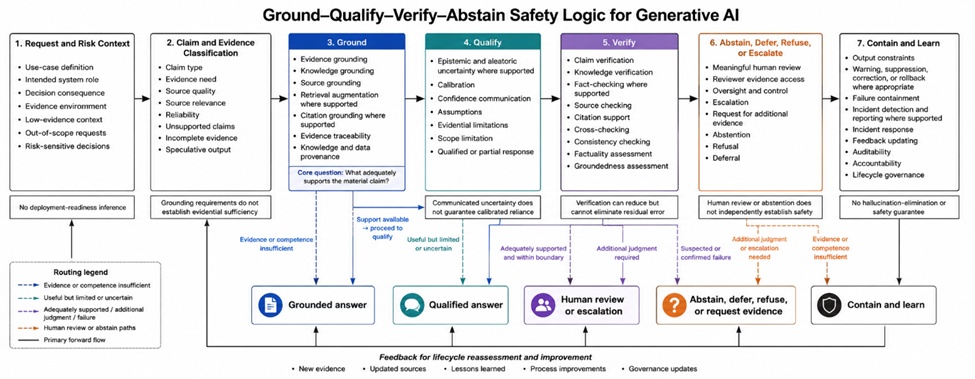
Figure 1. Ground–Qualify–Verify–Abstain Safety Logic for Generative AI
A safety logic diagram showing generative AI outputs routed through grounding, qualification, verification, human review, abstention, refusal, deferral, decision boundaries, and failure containment.
Failure containment is required because error prevention will remain incomplete. Safety assurance research shows that technical controls interact with ethical, organizational, and legal considerations, leaving gaps that cannot be closed by one mechanism [24]. Containment can include suppressing a suspected output, constraining its detail, attaching a correction, withdrawing distributed content where feasible, directing users to validated sources, suspending a function, or escalating an incident. These actions reduce propagation risk but cannot ensure that every recipient sees a correction or reverses a decision already influenced by the error.
Containment must continue across the machine-learning lifecycle. Assurance requirements include data and model traceability, change management, monitoring, evaluation after updates, incident detection, and reassessment when the operating context changes [25]. Incident reporting and response processes should identify what failed, what evidence was unavailable, how the output passed existing controls, and whether similar outputs may have been produced elsewhere. Feedback updating may revise retrieval sources, verification procedures, interface warnings, decision boundaries, or escalation triggers, but each update requires renewed evaluation because corrective action can introduce different failures.
Human–AI task allocation should also be treated as a boundary-design problem. Research on human–AI collaboration indicates that delegation can create cognitive challenges, including reduced attention, misplaced reliance, and difficulty integrating human and machine judgments [26]. High-risk cases should not be transferred to nominal reviewers without evidence access or real authority, and low-risk cases should not generate so many alerts that meaningful review becomes impossible. Table 2 maps evidence grounding, knowledge verification, uncertainty communication, human review, decision boundaries, abstention, and failure containment as core safety requirements for generative AI.
Table 2. Core Safety Requirements for Hallucination Control and Epistemic Risk Management: Evidence Grounding, Knowledge Verification, Source Quality, Claim Verification, Cross-Checking, Uncertainty Communication, Qualified Responses, Human Review, Abstention, Refusal, Deferral, Decision Boundaries, Failure Containment, Monitoring, and Governance Boundaries
Safety requirement | Core safety question | Required evidence, practice, or trigger | Safety function | Potential output | Failure or residual risk | Human review, monitoring, or governance need | Framework role |
Evidence grounding | What supports the claim? | Claim-to-evidence mapping | Reduces unsupported output | Grounded or withheld claim | Weak evidence may appear sufficient | Claim-level evaluation | Ground |
Knowledge grounding | Was the appropriate knowledge domain consulted? | Relevant and current knowledge resources | Constrains open generation | Domain-linked answer | Knowledge base may be incomplete | Domain stewardship | Ground |
Source quality | Is the source suitable and dependable? | Authority, currency, method, and independence review | Filters weak support | Quality-qualified source set | Prestigious sources may still be inapplicable | Source governance | Evidence gate |
Source relevance | Does the evidence address the exact claim? | Contextual and semantic matching | Prevents irrelevant support | Relevance-qualified evidence | Keyword similarity can mislead | Relevance checking | Evidence gate |
Claim verification | Does evidence support the generated assertion? | Claim extraction and evidence comparison | Detects conflict | Supported, disputed, or unresolved claim | Verification errors remain possible | Independent assessment | Verify |
Cross-checking | Do independent evidence paths converge? | Comparison across sufficiently independent sources | Reduces single-source dependence | Corroborated or conflicting result | Sources may share one original error | Independence assessment | Verify |
Consistency checking | Is the output internally and externally coherent? | Contradiction and entailment review | Detects logical conflict | Consistent or unresolved output | Consistency does not prove truth | Method evaluation | Verify |
Uncertainty communication | Are knowledge limits understandable? | Context-specific confidence and evidence language | Reduces false certainty | Qualified response | Users may misinterpret qualifiers | Human-centered testing | Qualify |
Qualified response | Can useful information be given within limits? | Scope, assumptions, uncertainty, and evidence stated | Avoids false completeness | Conditional or partial answer | Qualifications may be overlooked | Reliance monitoring | Qualify |
Human review | Is contextual judgment required? | Competent reviewer with evidence and authority | Adds accountable assessment | Approve, revise, reject, or escalate | Automation bias and overload | Review-quality assessment | Review |
Abstention | Is answering less justified than withholding? | Insufficient evidence, competence, or permitted scope | Prevents forced guessing | Explicit non-answer | Excessive or uneven abstention | Coverage and outcome monitoring | Abstain |
Refusal | Is the requested response prohibited or unsafe? | Defined safety, authorization, or scope trigger | Blocks impermissible output | Refusal with limited explanation | False refusal or missed risk | Refusal audit | Boundary action |
Deferral | Should another agent decide? | Specialist knowledge or authority required | Transfers judgment | Referral or pending review | Reviewer may be unavailable | Escalation governance | Boundary action |
Decision boundary | What may the system answer or influence? | Use-case, evidence, uncertainty, and consequence analysis | Limits unsupported use | Proceed, qualify, defer, or refuse | Boundary may be bypassed | Boundary review | Central control |
Output constraint | Should content or actionability be restricted? | Elevated uncertainty or consequence | Limits downstream exposure | Extractive or source-bounded output | Constraints may be circumvented | Constraint testing | Containment |
Failure containment | How can suspected error be prevented from spreading? | Error signal or incident trigger | Reduces propagation | Warning, suppression, correction, or rollback | Error may already have influenced users | Incident response | Contain |
Monitoring | How will recurring or emerging failures be detected? | Complaints, corrections, source changes, and performance signals | Extends safeguards over time | Alert or investigation | Silent failures and alert fatigue | Lifecycle ownership | Monitor |
Governance boundaries | Do safeguards establish safety or compliance? | Explicit residual-risk and scope statements | Prevents overclaiming | Non-certified risk assessment | Users may infer approval | Documentation and oversight | Mandatory boundary |
The proposed framework begins with use-case and risk-context definition. Human-centered AI emphasizes that reliable automation should be combined with meaningful human control rather than treated as an autonomous substitute for accountable judgment [27]. The first stage therefore identifies the intended task, likely users, evidence environment, possible decision consequences, and conditions under which the system should not operate. It distinguishes informational support from consequential decision authority and establishes that framework completion does not imply operational safety or deployment readiness.
The second stage classifies the claim type and its evidence needs, followed by source and knowledge-domain assessment. Hybrid intelligence suggests that human and machine capabilities may be combined where their strengths are complementary and their limitations are explicitly managed [28]. A system may assist with retrieval, comparison, and drafting, while people may contribute domain knowledge, contextual interpretation, and accountable judgment. This complementarity should be designed rather than assumed, because human involvement can introduce delay, inconsistency, or bias and model output can shape the reviewer’s interpretation before independent assessment occurs.
The third stage defines grounding requirements, retrieves or reviews evidence where supported, and verifies material claims. The fourth stage estimates and communicates uncertainty, designs a qualified response, and determines whether meaningful human review is required. Automation and augmentation should not be treated as mutually exclusive choices because each can create dependencies that alter the risks of the other [29]. The framework therefore asks which activities may be automated, which should augment human analysis, which require independent review, and which should remain outside the system’s permitted role.
The fifth stage defines abstention, refusal, deferral, escalation, and decision-boundary triggers. The sixth establishes failure-containment, traceability, monitoring, incident detection, incident response, and feedback updating. Broad AI-governance principles frequently converge around transparency, responsibility, fairness, and human oversight, but their interpretation and implementation vary considerably [30]. Accordingly, the framework does not prescribe universal thresholds or institutional procedures. Each control requires context-specific validation, ownership, documentation, and reassessment when models, sources, users, or operating conditions change.
The final stage is a lifecycle governance review that preserves explicit sufficiency boundaries. Principles and conceptual frameworks cannot independently guarantee ethical AI because implementation depends on institutions, professional responsibilities, procedures, incentives, and mechanisms for accountability [31]. The proposed framework consequently retains no-grounding-sufficiency, no-verification-guarantee, no-uncertainty-guarantee, no-abstention-sufficiency, no-human-review-sufficiency, no-decision-boundary-sufficiency, no-hallucination-elimination, no-safety-guarantee, and no-deployment-readiness boundaries. Table 3 presents the proposed hallucination and epistemic risk framework linking grounding, qualification, verification, abstention, human review, failure containment, monitoring, and lifecycle governance.
Table 3. Proposed Hallucination and Epistemic Risk Framework for Generative AI: Use-Case Definition, Risk Context, Claim Classification, Evidence Need, Source Assessment, Grounding Requirements, Verification, Uncertainty Communication, Qualified Response Design, Human Review, Abstention, Refusal, Deferral, Decision Boundaries, Failure Containment, Auditability, Monitoring, Incident Response, and Deployment Boundaries
Framework stage | Core purpose | Required input | Safety function | Potential output | Validation or governance need | Failure risk | Feedback mechanism | Decision boundary |
Use-case and risk-context definition | Establish intended role and consequence | Task, users, domain, stakes | Prevents context-free use | Use-case profile | Stakeholder and domain review | Context misclassification | Review after material change | No use outside defined context |
Claim and evidence-need classification | Match support requirements to claim type | Proposed claims and consequence level | Identifies material assertions | Evidence profile | Classification validation | Weak requirements | Verification feedback | Unsupported material claims cannot proceed |
Source and knowledge-domain assessment | Identify suitable knowledge resources | Available domains and sources | Filters unsuitable evidence | Approved or qualified source domain | Domain stewardship | Outdated or irrelevant domain | Source-performance review | Unapproved sources require qualification |
Grounding requirement definition | Specify required claim support | Evidence profile | Makes grounding proportionate | Grounding specification | Context-specific testing | Requirements too weak or rigid | Incident-driven revision | Mandatory grounding failure triggers limitation |
Evidence retrieval or source review | Gather relevant support | Source domain and query | Supplies external evidence | Evidence set | Retrieval evaluation | Missing or manipulated evidence | Retrieval-error logging | Poor evidence triggers further review |
Claim verification and cross-checking | Test claims against evidence | Claims and evidence set | Detects unsupported assertions | Supported, disputed, or unresolved status | Independent assessment | False verification | Compare later corrections | Unresolved claims cannot be definitive |
Uncertainty estimation and communication | Identify and express residual limits | Evidence gaps and model signals | Reduces false confidence | Qualified uncertainty statement | Calibration and comprehension testing | Miscalibration or misunderstanding | User-response evaluation | Elevated uncertainty triggers review |
Qualified response design | Provide bounded useful information | Verified claims, scope, assumptions | Prevents false completeness | Conditional or partial answer | Human-centered assessment | Qualifier is overlooked | Reliance feedback | No expansion beyond support |
Human review and escalation | Add contextual judgment and authority | Trigger, evidence package, reviewer role | Supports accountable intervention | Revision, rejection, or escalation | Reviewer competence and workload review | Automation bias | Review-outcome monitoring | High-risk unresolved cases escalate |
Abstention and refusal triggers | Define when not to answer | Evidence, uncertainty, scope, consequence | Prevents forced completion | Abstention, refusal, or evidence request | Coverage and consistency evaluation | Excessive or uneven refusal | Deferred-case review | Mandatory triggers block answer |
Decision-boundary definition | State permitted support role | Use-case and control capabilities | Separates assistance from decision authority | Boundary specification | Governance approval | Ambiguous or bypassed boundary | Violation analysis | Outside-boundary use is refused or deferred |
Failure-containment design | Limit propagation of error | Distribution paths and incident scenarios | Reduces downstream exposure | Warning, correction, suppression, or rollback | Scenario testing | Delayed detection | Post-incident analysis | Material failure activates containment |
Auditability and traceability | Reconstruct evidence and actions | Logs, provenance, versions, reviews | Supports accountability | Auditable record | Access and retention governance | Missing or misleading records | Audit findings | Untraceable high-risk output cannot proceed |
Monitoring and incident detection | Detect drift and recurring failures | Reports, corrections, source and model changes | Extends control over time | Alert or incident record | Validated signals and ownership | Silent failure or alert fatigue | Signal refinement | Significant alerts trigger investigation |
Incident response and feedback updating | Correct failure and reduce recurrence | Confirmed incident and causal analysis | Supports learning | Correction, suspension, or redesign | Change control | Corrective action creates new risk | Closed-loop learning | Severe unresolved incidents restrict use |
Lifecycle governance review | Reassess after material change | Updated model, data, source, or context | Prevents obsolete controls | Revised framework profile | Scheduled and event-driven review | Static governance | Versioned decisions | Material change requires reassessment |
Sufficiency and deployment boundaries | Prevent framework overclaiming | Results from all stages | Preserves residual-risk awareness | Conceptual risk profile | Independent domain validation | Framework mistaken for certification | Evidence accumulation | No automatic safety or deployment authorization |
Figure 2 presents the proposed hallucination and epistemic risk framework for generative AI, integrating error identification, grounding, verification, uncertainty communication, human review, abstention, failure containment, monitoring, and governance updating.
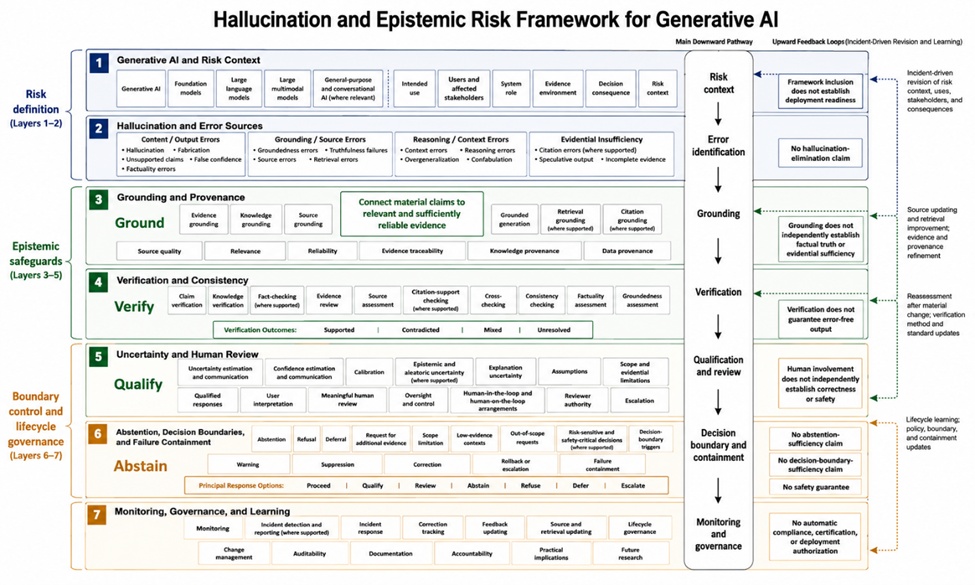
Figure 2. Hallucination and Epistemic Risk Framework for Generative AI
A conceptual generative AI safety framework showing hallucination risk, error sources, grounding, verification, uncertainty communication, human review, abstention, decision boundaries, failure containment, monitoring, incident response, and governance updating.
Future hallucination-risk assessment should distinguish factuality, groundedness, citation support, reasoning validity, confidence expression, and decision consequence rather than reporting one undifferentiated error category. The conceptual distinctions developed in hallucination research can support claim-level evaluation, but measures should be tested across domains, languages, interaction formats, and changing model versions [5]. Foundation-model factuality research should also examine temporal knowledge, rare facts, conflicting evidence, and the incentives created by evaluation procedures. Multimodal research is needed because cross-modal inconsistencies may not be captured by text-centered detection methods.
Grounding research should evaluate the complete evidence pathway rather than whether retrieval was merely used. Relevant questions include whether suitable evidence existed, whether the retrieval process found it, whether sources were reliable and independent, whether the system represented them faithfully, and whether cited evidence entailed the generated claim. Retrieval-supported generation remains exposed to missing evidence, irrelevant passages, source manipulation, and defective context construction [13]. Verification workflow studies should consequently evaluate claim extraction, evidence retrieval, source appraisal, cross-checking, judgment, and unresolved-case handling as separate but interacting stages.
Human-centered research should investigate how users interpret qualified answers, source limitations, uncertainty language, abstention, and escalation. Linguistic calibration may improve confidence communication, but its effectiveness depends on context and user interpretation [18]. Human-review research should measure reviewer expertise, workload, independence, evidence access, disagreement handling, and the ability to override outputs. Abstention and refusal evaluation should consider not only error reduction but also coverage, fairness, usefulness, delay, and whether deferred users can access an appropriate alternative process.
Lifecycle research should examine how incident monitoring, correction, source updating, model change, and feedback affect subsequent risk. Assurance cannot end with an initial evaluation because model behavior, retrieval resources, interfaces, and use contexts can change [25]. These implications are conceptual research directions rather than legal advice, compliance guidance, procurement or audit instructions, model- or platform-selection advice, safety certification, clinical, financial, educational, or legal decision guidance, or deployment instruction. Operational requirements must be developed and validated for each domain, institution, user population, and consequence structure.
This article proposes a conceptual generative AI safety framework organized around grounding, qualification, verification, and abstention, supported by human review, decision boundaries, failure containment, monitoring, and lifecycle governance. Its central premise is that fluent, complete, confident, or useful output is not necessarily evidence-grounded, appropriately uncertain, verifiable, or safe to rely upon. Epistemic safety therefore requires attention to what a system claims, what evidence supports the claim, how limitations are communicated, when independent review is meaningful, when answering should be constrained, and how failures are detected and contained. The framework can help structure research and domain-specific assessment, but it does not eliminate hallucination or independently establish factuality, calibrated trust, ethical sufficiency, legal compliance, operational safety, certification, or deployment readiness.
None
None
None
None
Open Access The author(s) retain copyright. This article is licensed under the Creative Commons Attribution-NonCommercial-ShareAlike 4.0 International License. It may be shared and adapted for non-commercial purposes with appropriate attribution, an indication of changes, and distribution of adaptations under the same license. Third-party material may be subject to separate terms identified in its credit line. View the license at https://creativecommons.org/licenses/by-nc-sa/4.0/.
 Transparent Intelligence Publishing