Explainable artificial intelligence is often presented as a means of making intelligent systems more understandable, trustworthy, and usable, yet explanation availability does not reliably produce adoption, appropriate reliance, accountability, or improved decisions. This realist review examines why explainable AI is adopted, ignored, rejected, discontinued, overused, underused, or misused across organizational, professional, technical, and decision settings. It applies context–mechanism–outcome reasoning to interpret how explanation design interacts with workflow integration, user and domain expertise, decision risk, organizational incentives, governance arrangements, and human-oversight conditions. The synthesis focuses on mechanisms including perceived transparency, cognitive accessibility, mental-model formation, perceived usefulness, trust calibration, accountability confidence, contestability awareness, algorithm aversion, algorithm appreciation, automation bias, and explanation overload. These mechanisms may support selective reliance and meaningful challenge, but they may also generate false reassurance, superficial compliance, defensive rejection, or uncritical dependence. The review distinguishes adoption from acceptance, trust from trustworthiness, reliance from appropriate reliance, and explanation usefulness from decision quality. It identifies plausible configurations in which professional expertise, uncertainty communication, traceability, feedback, and contestability support careful use, while poor workflow fit, limited accessibility, weak governance, and automation pressure suppress scrutiny or encourage misuse. The main contribution is a bounded realist synthesis and design agenda for evaluating explainable AI through context-sensitive human responses and decision outcomes rather than explanation availability alone. The configurations are explanatory propositions requiring human-centered, organizational, and decision-context validation; they are not universal causal laws, implementation protocols, or evidence of deployment readiness.
Explainable artificial intelligence has become central to trustworthy intelligent systems because users, organizations, and affected persons may need reasons for predictions, recommendations, or automated decisions. However, explanation is a communicative and selective process shaped by the recipient, question, contrast, and social setting rather than a simple transfer of technical information [1].
The XAI field contains heterogeneous objectives, including interpretability, transparency, debugging, trust support, accountability, and responsible system design. These objectives are not interchangeable, and an explanation designed for developers may not satisfy the informational or procedural needs of decision makers, operators, auditors, managers, or affected persons [2].
Technical methods also produce different explanatory objects. Feature importance, local rules, examples, counterfactuals, and global model summaries answer different questions and impose different assumptions. Consequently, explanation quality cannot be assessed independently of the decision problem, intended user, model characteristics, and practical purpose for which an explanation is requested [3].
The expansion of XAI research therefore does not establish that explanations are adopted, understood, or used appropriately. This review examines adoption, rejection, non-use, disuse, overuse, underuse, and misuse through realist context–mechanism–outcome reasoning. Its contribution is to explain variable human responses while maintaining explicit no-adoption, no-decision-quality, and no-deployment-readiness boundaries [4].
Explainable-AI adoption is not a single transition from opacity to acceptance. Explainability can activate confidence, comprehensibility, and perceived usefulness while also generating confidentiality concerns, cognitive burden, strategic disclosure, or false assurance. These opposing effects make adoption contingent on organizational conditions, stakeholder goals, explanation properties, and decision consequences [5].
Users also approach AI-supported decisions with different levels of epistemic uncertainty. When users are unsure about their own judgment, an explanation may increase advice acceptance; when they possess stronger evidence or perceive inconsistency, the same explanation may be discounted. Adoption therefore reflects interaction between explanation design and the user’s perceived knowledge position [6].
Stakeholders differ in what they expect explanations to accomplish. Developers may seek debugging information, managers may seek operational justification, professionals may need decision-relevant evidence, auditors may require traceability, and affected persons may need understandable reasons and recourse. An explanation can consequently be useful to one stakeholder while remaining inaccessible or irrelevant to another [7].
Adoption must also be distinguished from acceptance, intention, and beneficial use. Narrow local explanations may encourage initial engagement yet fail to support deeper questions about system goals, causal assumptions, uncertainty, or limitations. Context-sensitive adoption analysis must therefore examine cognitive accessibility, continued use, decision fit, misuse risks, and whether explanation depth supports the required human–AI interaction [8].
The review asks: in which contexts is XAI adopted, ignored, rejected, or misused; which mechanisms connect explanation design with trust, understanding, usefulness, reliance, accountability, and contestability; how do aversion, appreciation, automation bias, overreliance, and underreliance shape use; what outcomes follow; which CMO configurations explain variation; and which priorities may support safer, more useful implementation [9].
A context is a condition that shapes whether a mechanism becomes active, including organizational readiness, professional role, technical quality, workflow, expertise, incentives, governance, time pressure, and decision risk. A mechanism concerns how actors interpret and respond to available resources. Outcomes include adoption, non-use, rejection, reliance, misuse, learning, challenge, accountability, and decision consequences. Explainability is therefore not treated as one stable intervention [10].
Evidence was selected from peer-reviewed Q1 journal articles with DOI information and relevance to XAI, human–AI interaction, organizational adoption, trust, reliance, accountability, recourse, or decision use. Extraction focused on reported contexts, mechanisms, outcomes, human responses, implementation conditions, and limitations. Technical demonstrations without usable human, organizational, or decision evidence were not treated as sufficient support for adoption claims [11].
The synthesis compares recurring evidence patterns rather than calculating pooled adoption or trust effects. It distinguishes directly reported findings from proposed realist interpretations and treats every configuration as conditional. Evidence that human–AI combinations vary by task reinforces the boundary that system use, explanation provision, or human oversight cannot independently establish complementary performance or improved decision quality [12].
Table 1 summarises the realist review logic used to map explainable AI adoption through context, mechanism, outcome, evidence extraction, and synthesis categories.
Table 1. Realist Review Logic for Explainable AI Adoption: Review Questions, Context–Mechanism–Outcome Reasoning, Inclusion Criteria, Exclusion Criteria, Evidence Extraction Categories, Context Mapping, Mechanism Mapping, Outcome Mapping, Citation Planning, and Review Boundaries
Review component | Core realist question or purpose | Inclusion logic | Exclusion logic | Evidence mapped | CMO dimension addressed | Bias or limitation risk | Realist review role |
Review questions | Why does XAI use vary across settings? | Evidence explaining contexts, responses, or outcomes | Purely descriptive method papers | Adoption, rejection, misuse, reliance | Cross-cutting | Questions may privilege known mechanisms | Directs explanatory synthesis |
Evidence eligibility | Is the source suitable for planned claims? | Peer-reviewed Q1 journal article with DOI | Conference, preprint, report, or non-peer-reviewed source | Source type and claim relevance | Cross-cutting | Venue screening does not guarantee evidence quality | Establishes minimum eligibility |
XAI relevance | Does the article concern explanation or AI-supported use? | XAI, opacity, trust, advice, accountability, or recourse relevance | Generic adoption without AI relevance | System and explanation characteristics | Context | Broad adjacent literature may be remote | Defines phenomenon boundaries |
Context mapping | Under what conditions does a response occur? | Organizational, professional, technical, workflow, expertise, or risk evidence | Context-free generalization | Setting, role, task, incentives, governance | Context | Some studies report context incompletely | Identifies enabling and suppressing conditions |
Mechanism mapping | How do actors interpret available explanations? | Trust, usefulness, accessibility, agency, burden, aversion, or accountability evidence | Unsupported psychological speculation | Human reasoning and response | Mechanism | Mechanisms may be inferred rather than measured | Explains why resources produce different responses |
Outcome mapping | What follows from explanation use or non-use? | Behavioral, decision, implementation, or accountability outcomes | Technical accuracy without human-use relevance | Adoption, reliance, rejection, misuse, performance | Outcome | Intentions may be mistaken for behavior | Distinguishes attitudes from consequences |
CMO configuration | Which context activates which mechanism and outcome? | Plausible evidence-linked configurations | Universal causal claims | Recurrent cross-study patterns | C–M–O | Associations may be overinterpreted | Produces bounded realist explanations |
Evidence extraction | What information supports each interpretation? | Reported aims, settings, mechanisms, outcomes, and limitations | Invented or unreported details | Structured article-level evidence | Cross-cutting | Selective extraction | Maintains traceability |
Citation planning | Does each citation support the exact sentence? | Direct or carefully bounded conceptual support | Random or convenience citation | Claim–source alignment | Cross-cutting | Citation clustering may conceal weak fit | Preserves Vancouver sequencing and evidential fit |
Review boundaries | What cannot be inferred? | Explicit uncertainty and generalization limits | Readiness, certification, or guaranteed-benefit claims | Evidence gaps and transfer limits | Cross-cutting | Readers may treat configurations as rules | Protects realist-review integrity |
Figure 1 illustrates the realist review context–mechanism–outcome logic used to explain why explainable AI is adopted, ignored, rejected, or misused across decision settings.
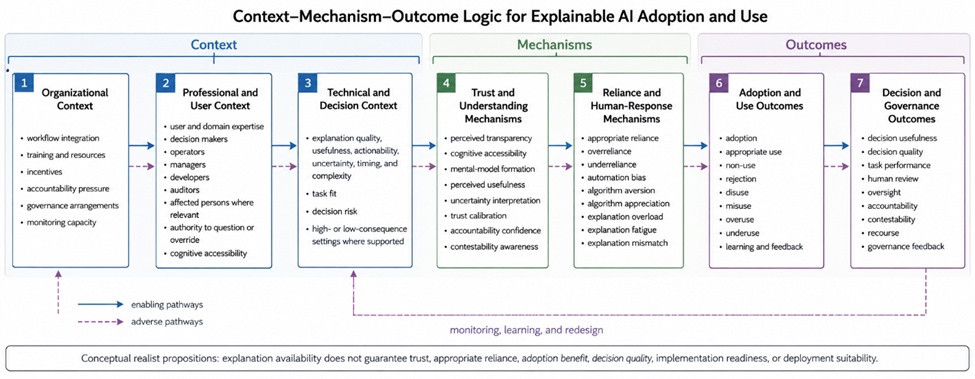
Figure 1. Context–Mechanism–Outcome Logic for Explainable AI Adoption and Use
A realist review diagram showing contexts feeding into mechanisms such as trust calibration, cognitive accessibility, perceived usefulness, accountability, and automation bias, which then lead to adoption, rejection, misuse, reliance, and decision outcomes.
Organizational adoption depends on whether an institution possesses suitable data, skills, leadership commitment, governance, resources, and a defined purpose for AI use. Readiness is therefore purpose-specific rather than a general organizational attribute. Explanations introduced without compatible capabilities, monitoring, or responsibility structures may produce symbolic adoption rather than sustained and meaningful use [13].
Professional context shapes how AI output is interrogated. Domain experts may compare recommendations with clinical, operational, or experiential knowledge, but expertise does not automatically generate calibrated reliance. Professional engagement also depends on workflow, ambiguity-management practices, authority to challenge outputs, and whether the organization permits users to investigate disagreements rather than merely accept recommendations [14].
Decision context determines the evidentiary burden placed on explanations. High-stakes and risk-sensitive decisions require stronger validation, uncertainty communication, and review than reversible low-stakes tasks. Medical-XAI scholarship illustrates why technical interpretability must be connected with domain knowledge, education, accountability, and human evaluation before explanations can be considered suitable for professional decision support [15].
Human oversight must likewise be assessed as a contextual condition rather than a binary safeguard. Decision makers, operators, managers, developers, and auditors may have different information, time, authority, and incentives. In high-pressure settings, nominal review may become rubber-stamping, while persuasive explanations can conceal system weaknesses. Current explanations cannot independently establish clinical trustworthiness or implementation readiness [16].
User and domain expertise also affect accessibility. Lay users and affected persons may need plain-language reasons, consequences, and challenge routes, whereas expert users may require technical evidence, uncertainty, and traceability. Evidence from stakeholder-tailored clinical interfaces shows that clinicians and patients can require different explanatory content and presentation, limiting context-generalization across roles and decision environments [17].
Trust is an attitude concerning expected system behavior, whereas trustworthiness concerns whether that confidence is warranted by actual properties and performance. Reliance is behavioral and may diverge from stated trust. Organizational representation, task characteristics, system embodiment, prior experience, and user expectations therefore shape trust without necessarily producing appropriate use [18].
Perceived transparency and causability can influence whether users feel able to understand an AI recommendation. Such perceptions may increase acceptance by making system behavior appear more intelligible and useful, but perceived explainability is not equivalent to faithful explanation. Trust formed through a persuasive interface may remain disconnected from model validity or decision suitability [19].
Trust calibration depends on users receiving credible information about both strengths and limitations. Explanation effects may differ according to model accuracy and whether explanatory content appears coherent or nonsensical. Explanations should therefore be evaluated alongside performance evidence, because intelligible presentation can otherwise increase confidence in systems whose recommendations should be questioned [20].
Cognitive accessibility and explanation usefulness are similarly insufficient when they produce understanding without calibration. In clinical decision support, understandable explanation classes may increase reliance while failing to help users distinguish correct from incorrect advice. Explanation design should therefore support uncertainty interpretation, verification, and recognition of failure conditions rather than merely increasing confidence [21].
Appropriate reliance occurs when behavior reflects system competence, task fit, and available contrary evidence. In a defined high-risk task, explanations may support trust and performance, but such effects remain dependent on the system, user, and decision setting [22]. Explanation fatigue, overload, algorithm aversion, algorithm appreciation, and automation bias should consequently be treated as conditional mechanisms, with no trust-guarantee or reliance-benefit guarantee.
Rejection and underuse may arise when users observe algorithmic errors and feel unable to influence the resulting judgment. Providing limited opportunities to adjust an imperfect algorithm can restore agency and increase willingness to use it. This mechanism may reduce algorithm aversion, but greater adoption does not independently establish that the resulting decisions are more accurate or appropriate [23].
The opposite response is also possible. Users may assign greater weight to algorithmic advice than to human advice when they perceive the system as objective, consistent, or comparatively competent. Algorithm appreciation can support useful adoption, but it can also encourage overuse when perceived authority exceeds demonstrated capability or when users neglect contextual evidence [24].
Use patterns vary with the perceived relationship between an algorithm and its task. People may be more receptive when a task appears objective and rule-governed and more resistant when it appears subjective or personally sensitive. Adoption, rejection, and reliance should therefore be interpreted against perceived task fit rather than treated as stable attitudes toward AI [25].
Algorithm aversion is produced by interacting user, task, system, and environmental conditions. Non-use may reflect error sensitivity, loss of agency, professional judgment, inadequate explanation, or rational concern about consequences. It should not automatically be classified as poor understanding, just as high use should not automatically be treated as successful implementation [26].
Misuse includes applying AI outside its intended scope, accepting recommendations despite contradictory evidence, or using explanations as substitutes for verification. Experimental evidence demonstrates that AI advice can generate costly overreliance even when decision makers possess relevant conflicting information [27]. Decision usefulness, decision quality, task performance, accountability, contestability, learning, and feedback must therefore be evaluated independently of adoption volume.
Table 2 maps organizational, professional, technical, and decision contexts to trust, understanding, reliance, adoption, rejection, misuse, and decision outcomes in explainable AI use.
Table 2. Contexts, Mechanisms, and Outcomes in Explainable AI Use: Organizational Context, Professional Context, Decision Context, Workflow Integration, User Expertise, Trust Calibration, Cognitive Accessibility, Reliance, Automation Bias, Algorithm Aversion, Adoption, Rejection, Misuse, and Decision Outcomes
Context, mechanism, or outcome component | Core realist question | Relevant condition or trigger | Human response or mechanism pathway | Potential use pattern or outcome | Failure or misuse risk | Monitoring or evaluation need | Boundary statement |
Organizational context | Can the institution support meaningful XAI use? | Skills, resources, governance, data, leadership | Feasibility and organizational confidence | Adoption, piloting, or non-use | Symbolic adoption | Readiness and longitudinal-use assessment | Readiness is purpose-specific |
Professional context | How do role obligations affect interpretation? | Expertise, liability, norms, authority | Critical interrogation or defensive avoidance | Selective use or rejection | Uncritical deference or identity-based dismissal | Role-specific field evaluation | Expertise is not uniformly protective |
Decision context | What consequences and reversibility apply? | High, low, or risk-sensitive stakes | Caution, urgency, or perceived usefulness | Reliance, escalation, or deferral | Inappropriate transfer across tasks | Decision-specific outcome assessment | Findings cannot be generalized across decisions |
Workflow integration | Is explanation available at the right point and cost? | Timing, workload, interruption, interface fit | Reduced burden or disruption | Routine use or disuse | Skimming and bypassing | In-situ workflow observation | Technical quality does not ensure workflow usefulness |
User expertise | Can the intended user interpret the explanation? | AI literacy, domain knowledge, language, experience | Cognitive accessibility or mismatch | Understanding, non-use, or false reassurance | Jargon or oversimplification | Expertise-stratified comprehension testing | One explanation cannot serve every user |
Trust calibration | Does confidence track system capability? | Performance evidence and visible limitations | Confidence increases or decreases appropriately | Selective reliance | Blind trust or excessive distrust | Compare trust with accuracy awareness and behavior | More trust is not necessarily better |
Mental-model formation | Can users anticipate strengths, limits, and errors? | Repeated interaction, feedback, contrastive information | Understanding and expectation updating | Verification and learning | Confident but inaccurate mental model | Longitudinal prediction and comprehension tests | Immediate comprehension does not prove durable learning |
Cognitive accessibility | Is explanation effort manageable? | Complexity, time pressure, disability, expertise | Comprehension or overload | Use, superficial use, or non-use | False simplification | Workload and accessibility assessment | Readability is not equivalent to understanding |
Explanation actionability | Can users respond to the explanation? | Feasible recourse or decision alternatives | Challenge, correction, or adaptation | Contestability and remediation | Symbolic explanation without practical route | Recourse accessibility and outcome tracking | Reasons alone do not create recourse |
Appropriate reliance | Does behavior reflect system competence and task fit? | Calibrated trust and verification opportunity | Selective advice acceptance | Potentially improved decisions | Reliance measured only by frequency | Behavioral and outcome-linked evaluation | Reliance must be normatively and contextually defined |
Overreliance | Is AI followed despite contrary evidence? | Automation pressure and authoritative presentation | Deference and reduced checking | Overuse or misuse | Costly or harmful decisions | Contradiction tests and advice-acceptance logs | Misuse is sociotechnical |
Underreliance | Is competent assistance discounted? | Prior error, weak fit, identity conflict | Aversion or trust erosion | Underuse or rejection | Missed complementarity | Compare behavior with validated system competence | Rejection may be rational |
Automation bias | Does AI become the default anchor? | Time pressure, workload, repeated automation | Reduced independent search | Commission or omission errors | Rubber-stamping | Review time, override, and escalation monitoring | Human presence does not guarantee oversight |
Algorithm aversion | Does visible imperfection prompt rejection? | Errors, low control, subjective task | Loss of confidence or agency | Rejection and underuse | Dismissing useful assistance | Reason-for-rejection analysis | Aversion is context-dependent |
Algorithm appreciation | Is algorithmic advice given excessive authority? | Objectivity cues and low user confidence | Preferential advice weighting | Adoption or overuse | Overconfidence in automation | Compare source weighting with competence | Appreciation may be uncalibrated |
Adoption | Is XAI incorporated into practice? | Readiness, usefulness, workflow fit | Acceptance and repeated engagement | Initial or sustained use | Adoption without scrutiny | Distinguish trial from routine institutional use | Adoption does not guarantee benefit |
Non-use and disuse | Why is available XAI ignored or abandoned? | Burden, poor fit, errors, weak support | Avoidance or trust erosion | Bypass or discontinuation | Lost benefit or avoided harm | Longitudinal use and qualitative evidence | Non-use is not inherently irrational |
Misuse and overuse | Is AI used beyond suitable scope or without safeguards? | Weak governance and convenience incentives | False reassurance or excessive delegation | Unsupported application | Harm, deskilling, responsibility diffusion | Incident and scope-violation monitoring | High use is not proof of success |
Decision and accountability outcomes | Does XAI improve decisions or answerability? | Valid system, appropriate allocation, governance | Verification, traceability, challenge | Better, unchanged, or worse outcomes | Explanation used as liability shield | Comparative performance and responsibility assessment | No decision-quality or implementation-readiness guarantee |
In contestable decisions, explanations become more meaningful when they support feasible action, correction, or appeal. Algorithmic recourse research indicates that contrastive reasons and consequential recommendations require contextual and causal validity; superficially actionable advice may otherwise direct affected persons toward changes that are ineffective, inaccessible, or unrelated to the actual decision process [28].
Transparency alone provides no universal accountability pathway. Making selected system elements visible may produce an impression of openness without giving users meaningful knowledge, institutional authority, or control. In weak-governance settings, perceived transparency may therefore activate false reassurance or symbolic compliance rather than scrutiny and correction [29].
High-accountability contexts can support more careful use when explanations are linked to traceability, assigned responsibility, and genuine review authority. Transparency may contribute to accountability only when institutions specify who owns the system, who reviews its outputs, who can intervene, and how adverse decisions are challenged. Without these arrangements, responsibility may remain diffuse [30].
Perceived fairness, accountability, and transparency can influence trust and willingness to use algorithmic services [31]. Yet such perceptions do not prove that a system is actually fair, accountable, or transparent. Realist interpretation must therefore distinguish governance-related confidence from institutional performance and examine whether trust activates appropriate scrutiny, passive acceptance, defensive use, or rejection.
Affected persons may reject high-stakes AI when they believe it cannot recognize individual circumstances. Resistance to medical AI can be explained partly by perceived uniqueness neglect rather than a general inability to understand technology [32]. Explanation form also matters: rule-based and example-based explanations may influence understanding, persuasion, and performance differently, requiring these outcomes to be evaluated separately [33].
Table 3 presents the realist synthesis of explainable AI use, including context–mechanism–outcome configurations, interpretation, design implications, residual risks, and implementation priorities.
Table 3. Realist Synthesis of Explainable AI Adoption, Rejection, and Misuse: Context–Mechanism–Outcome Configurations, Explanation Usefulness, Trust Calibration, Cognitive Burden, Workflow Fit, Accountability Pressure, Contestability, Human Oversight, Decision Outcomes, Residual Risks, and Design Agenda
CMO configuration or synthesis theme | Context involved | Mechanism involved | Outcome involved | Evidence pattern | Design or implementation implication | Residual risk | Realist review contribution |
Accountability-supported careful use | Clear responsibility, review authority, professional accountability | Explanation usefulness and traceability | Verification and selective use | Professionals engage more critically when they can interrogate and justify decisions | Connect explanations to records, escalation, and assigned ownership | Defensive documentation or blame shifting | Explains how accountability may activate scrutiny |
Accessibility failure | Low expertise, dense presentation, time pressure | Cognitive burden and explanation mismatch | Superficial use or non-use | Stakeholders require different explanatory content and depth | Tailor language, format, timing, and detail | Oversimplification may conceal uncertainty | Explains why technically correct explanations are ignored |
Automation-pressure overreliance | High workload, authoritative AI, weak review | Trust without verification and automation bias | Overuse or misuse | Users may follow advice despite conflicting evidence | Add contradiction prompts and risk-based escalation | Safeguards may become routine clicks | Connects organizational pressure with misuse |
Weak-trust rejection | Visible errors, low control, poor task fit | Algorithm aversion | Rejection or underuse | Control and task framing alter willingness to use algorithms | Provide bounded agency and credible performance evidence | Higher acceptance may remain inappropriate | Treats rejection as context-sensitive |
Workflow-disruption disuse | Poor timing and high interaction cost | Reduced usefulness and explanation fatigue | Bypass or abandonment | Readiness and design fit affect sustained use | Integrate concise explanations at decision points | Reduced detail may impair scrutiny | Explains post-adoption disuse |
Expertise-enabled critical reliance | Domain knowledge and opportunity to investigate disagreement | Critical interpretation and mental-model formation | Calibrated reliance or principled rejection | Experts compare AI advice with other evidence when practices permit | Preserve authority to challenge and examine supporting evidence | Expertise may produce overconfidence | Makes expertise a conditional mechanism |
Expertise-limited false reassurance | Limited AI or domain literacy | Cognitive mismatch and perceived transparency | Misuse or misplaced confidence | Accessible explanations may still fail to communicate limitations | Use progressive disclosure, uncertainty, and comprehension checks | Fluent interfaces may remain persuasive | Separates accessibility from calibration |
Risk-sensitive cautious reliance | High-consequence and uncertain decision | Uncertainty interpretation | Deferral, verification, or conditional use | High-risk settings require stronger evidence and limitation communication | Present alternatives and escalation thresholds | Uncertainty may prompt indiscriminate rejection | Explains context-specific caution |
Weak-governance accountability gap | Diffuse responsibility and nominal oversight | Unclear answerability | Symbolic transparency and misuse | Visibility does not create institutional accountability | Map system ownership, review duties, and incident handling | Formal governance may remain performative | Extends XAI beyond interface properties |
Contestability-enabled correction | Consequential decision with accessible review | Actionability and contestability awareness | Challenge, correction, or recourse | Explanations become consequential when linked to feasible action | Pair reasons with human review and status tracking | Recourse may remain costly or inaccessible | Connects explanation with affected-person agency |
Feedback-enabled learning | Repeated use and outcome feedback | Mental-model updating | Improved use, reporting, or redesign | Calibration can change through observed errors and outcomes | Build reporting, review, and redesign loops | Feedback may be ignored or selectively captured | Introduces dynamic CMO feedback |
No universal pathway | Changed domain, user, system, incentive, or risk | Mechanism may fail to activate or reverse | Different or opposing outcome | Effects vary across tasks and stakeholders | Treat configurations as locally testable propositions | Overgeneralization from prominent domains | Preserves realist rather than prescriptive interpretation |
Figure 2 presents the realist synthesis model of explainable AI use, linking context-sensitive explanation design, trust mechanisms, human responses, adoption pathways, misuse risks, decision outcomes, and implementation feedback.
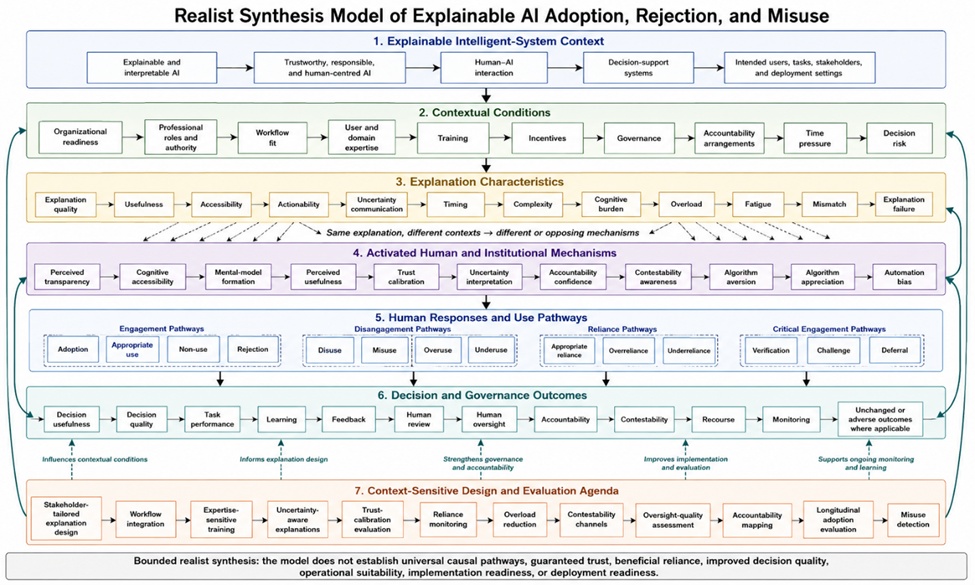
Figure 2. Realist Synthesis Model of Explainable AI Adoption, Rejection, and Misuse
A conceptual realist synthesis model showing explainable AI use across contexts, mechanisms, human responses, adoption pathways, misuse risks, decision outcomes, design agenda, and feedback loops.
Explanation design should begin with the user’s role, decision purpose, expertise, and capacity to act rather than with the explanation method alone. Stakeholder-sensitive design requires separating developer debugging, professional verification, managerial accountability, auditor traceability, and affected-person recourse. Progressive disclosure may reduce overload while preserving access to technical depth where needed [7].
Explanations should also be integrated into actual workflows and accompanied by task-specific training. Evaluation should examine whether users notice limitations, detect contradictions, interpret uncertainty, and distinguish model competence from persuasive presentation. Human-centered evaluation must therefore extend beyond satisfaction and include comprehension, reliance behavior, workload, and decision consequences [11].
Trust-calibration assessment should compare confidence and advice-taking with system performance and contextual evidence. Monitoring should identify overreliance, underreliance, automation bias, overrides, out-of-scope use, and cases in which users accept AI recommendations despite contradictions. Explanation interfaces should reduce unnecessary complexity without presenting simplified narratives as proof of validity [21].
Implementation also requires contestability channels, substantive human oversight, organizational accountability mapping, incident review, and longitudinal assessment of adoption, workarounds, disuse, learning, and misuse. These priorities are realist-review implications and research directions, not procurement, legal, compliance, certification, model-selection, platform-selection, workflow, safety, or deployment instructions [30].
Explainable-AI adoption is best understood as a context-dependent process rather than a direct consequence of explanation availability. Organizational readiness, professional authority, workflow fit, user expertise, technical quality, decision risk, incentives, and governance conditions shape whether explanations activate understanding, usefulness, calibrated trust, contestability, aversion, automation bias, or cognitive burden. These mechanisms can lead to adoption, careful use, non-use, rejection, disuse, overuse, underuse, misuse, learning, challenge, or accountability outcomes. The realist synthesis therefore shifts evaluation away from asking whether an explanation exists and toward examining who receives it, for what purpose, under which constraints, with what opportunity to verify or contest it, and with what decision consequences. The proposed configurations and design priorities remain bounded explanatory propositions requiring context-specific human-centered validation, organizational assessment, monitoring, and outcome evaluation.
None
None
None
None
Open Access The author(s) retain copyright. This article is licensed under the Creative Commons Attribution-NonCommercial-ShareAlike 4.0 International License. It may be shared and adapted for non-commercial purposes with appropriate attribution, an indication of changes, and distribution of adaptations under the same license. Third-party material may be subject to separate terms identified in its credit line. View the license at https://creativecommons.org/licenses/by-nc-sa/4.0/.
 Transparent Intelligence Publishing