Agentic artificial intelligence extends beyond conventional model-output generation by interpreting objectives, decomposing tasks, maintaining contextual information, selecting tools, interacting with external environments, and executing sequences of actions that may create downstream consequences. These capabilities complicate the question of who controls an agent and expose limitations in governance approaches based only on alignment, instruction following, output review, or nominal human supervision. This article develops a conceptual governance architecture for trustworthy agentic AI. The approach treats agentic AI as an autonomous decision system embedded within a wider socio-technical environment and organizes governance around explicit control points rather than a single supervisory mechanism. It distinguishes governance requirements for goal formation, goal interpretation, instruction hierarchy, task boundaries, tool access, memory retention, environmental interaction, action verification, failure containment, human approval, override capacity, responsibility allocation, auditability, and lifecycle review. The architecture proposes that consequential actions should be connected to authorized goals, bounded permissions, traceable memory and data inputs, pre-action checks, post-action evaluation, escalation pathways, and accountable human or institutional actors. It also establishes explicit sufficiency boundaries: goal alignment does not guarantee appropriate behavior; tool restrictions do not eliminate harmful use; memory controls do not guarantee reliable context; verification does not certify safe action; and human override does not independently establish meaningful control. The principal contribution is an integrated architecture-level account of how technical, human, and organizational controls may be connected across the agent lifecycle. The architecture supports conceptual analysis, governance planning, and future empirical evaluation, but does not establish legal compliance, operational safety, ethical sufficiency, institutional accountability, or deployment readiness.
Agentic AI creates a distinctive governance problem because an intelligent system may do more than generate a recommendation or response. It may interpret a goal, construct subgoals, retain context, select external capabilities, act across multiple stages, and influence people or environments. Trustworthy governance therefore requires interconnected ethical, technical, and institutional controls rather than reliance on model behavior alone [1].
The responsible-AI literature contains recurring principles concerning transparency, safety, fairness, responsibility, and human agency, but agreement at the principle level does not produce uniform operational control. Governance language can remain too abstract to determine who authorizes an agent’s objective, who limits its tools, who validates its actions, or who responds when its behavior creates an unforeseen consequence [2].
A human-centered perspective further challenges the assumption that greater autonomous capability should reduce human authority. High levels of automation can be compatible with strong human control only when people retain relevant information, appropriate decision rights, sufficient time, and effective intervention mechanisms. Human presence without practical capacity to understand or alter agent behavior is not meaningful control [3].
This article therefore proposes a conceptual governance architecture that distributes control across multiple layers: purpose definition, responsibility mapping, goal and instruction governance, task limitation, tool authorization, memory governance, environmental monitoring, action verification, failure containment, human override, auditability, and lifecycle review. This layered approach recognizes that governance responsibilities are distributed among technical components, system integrators, operators, reviewers, institutions, and affected stakeholders [4].
An agentic AI system can be understood as an autonomous or semi-autonomous decision system that links model-based reasoning with memory, planning, tool use, action, and environmental feedback. Foundation model agents and large language model agents commonly combine profiles or instructions with working context, task decomposition, stored information, and external actions, thereby creating a functional sequence rather than an isolated prediction [5].
This functional autonomy changes the human role. An operator may move from direct decision-making to supervision of a system that acts at a speed, scale, or level of complexity that limits situation awareness. Established human–automation research shows that monitoring burdens, automation bias, skill degradation, and delayed intervention can undermine nominal oversight even when a person remains formally responsible [6].
Autonomy should consequently be decomposed by function. An agent might independently summarize information while requiring approval for tool invocation, data disclosure, financial commitment, code execution, or irreversible environmental change. Function-specific allocation clarifies which activities are performed by the agent, which remain under human authority, and where trust depends on verified capability rather than a general label of autonomy [7].
Agentic AI is also a socio-technical participant. Its behavior is shaped by model capabilities, system prompts, organizational objectives, available tools, human collaborators, institutional rules, and external conditions. In multi-agent or human–AI settings, unclear roles can create coordination failures and responsibility gaps. Agency or teamwork language must therefore not be treated as evidence that the system is trustworthy, accountable, or suitable for independent action [8].
Goal governance begins with the question of whose values and objectives the agent is expected to advance. Alignment cannot be reduced to literal obedience because user requests, organizational purposes, safety constraints, and affected-party interests may conflict. A governable agent requires an identifiable goal owner, an authorized objective source, and a documented distinction between stated user intent and the wider system objective [9].
High-level principles or instructions are also insufficient without mechanisms for interpretation and enforcement. Instruction governance should establish source authority, precedence rules, conflict detection, ambiguity handling, and escalation thresholds. When instructions are incomplete or inconsistent, the agent should not silently select the interpretation that most readily permits task completion [10].
Goal decomposition introduces further risk because an apparently acceptable objective may produce problematic subgoals. Agents may optimize proxy measures, influence evaluative signals, or alter the conditions through which their performance is judged. Goal-change records, parent–subgoal links, protected feedback channels, and runtime drift detection can help identify unauthorized expansion, although such controls cannot prove enduring alignment [11].
Emergency intervention cannot compensate for weak upstream governance. A late-stage shutdown mechanism may be ineffective when an action is rapid, distributed, difficult to reverse, or already propagated through external tools. Goal formation, task boundaries, scope exclusions, and authorization conditions should therefore be established before planning and execution. Table 1 summarises goal formation and instruction governance requirements for trustworthy agentic AI, including goal interpretation, task boundaries, instruction conflicts, goal drift, and unauthorized goal expansion [12].
Table 1. Goal Formation and Instruction Governance Requirements for Trustworthy Agentic AI: Goal Interpretation, Goal Decomposition, Subgoal Generation, Instruction Hierarchy, Instruction Conflict, Instruction Ambiguity, User Intent, System Objectives, Task Boundaries, Scope Limitation, Goal Drift, Goal Misalignment, Unauthorized Goal Expansion, and Goal-Governance Boundaries
Goal or instruction requirement | Core governance question | Required evidence or design condition | Control function | Potential output | Failure or overclaiming risk | Validation or governance need | Architecture role |
Goal formation | Who may define the objective? | Named goal owner and purpose record | Authorize objective creation | Approved goal | Illegitimate or hidden objective | Institutional review | Entry control |
Goal interpretation | How may language become an operational goal? | Assumptions and interpretation trace | Constrain semantic inference | Interpreted goal | Unintended meaning | Human review for consequential ambiguity | Interpretation control |
Goal decomposition | Which task components are permitted? | Traceable task graph | Bound decomposition | Approved task structure | Harm concealed in sub-tasks | Boundary testing | Planning control |
Subgoal generation | May the agent create new objectives? | Parent-goal link and approval rule | Prevent autonomous expansion | Accepted or rejected subgoal | Unauthorised objective growth | Runtime monitoring | Expansion control |
Instruction governance | Which instruction sources are valid? | Source identity and integrity check | Admit or reject instructions | Validated instruction | Untrusted instruction controls behavior | Authentication review | Instruction gateway |
Instruction hierarchy | Which instruction prevails? | Documented precedence rules | Resolve authority conflict | Priority decision | Lower-level request overrides constraint | Conflict testing | Priority control |
Instruction conflict | How are incompatible requirements handled? | Constraint comparison | Pause or escalate | Conflict report | Silent selective compliance | Independent review | Conflict control |
Instruction ambiguity | When should the agent clarify or defer? | Ambiguity and consequence thresholds | Prevent unsafe assumption | Clarification or abstention | Confident guessing | Human-centered testing | Ambiguity control |
User intent | What has the user actually authorized? | Confirmation and context limits | Restrict inferred intent | Confirmed-intent record | Excessive inference | User evaluation | Intent control |
System objective | What wider purpose governs the request? | Objective hierarchy | Preserve authorized purpose | Consistency decision | Local optimization defeats system purpose | Governance review | Purpose control |
Task boundary | Which actions remain within the assignment? | Allowed-action specification | Block out-of-task activity | Boundary decision | Opportunistic task expansion | Scenario testing | Scope control |
Scope limitation | Which tools, data, domains, or effects are excluded? | Explicit negative permissions | Enforce exclusions | Scope policy | Unlisted capability treated as allowed | Periodic review | Permission boundary |
Goal drift | Has the objective changed during execution? | Goal-state comparison | Detect divergence | Drift alert | Gradual deviation remains unnoticed | Continuous monitoring | Runtime control |
Goal misalignment | Does behavior remain consistent with intended outcomes? | Behavioral and counterexample testing | Detect objective–behavior mismatch | Misalignment finding | Passing tests treated as proof | Domain-specific evaluation | Assurance control |
Unauthorized goal expansion | Has the agent added new targets or consequences? | Parent–child goal trace | Reject unauthorized additions | Expansion block | New objective framed as a necessary means | Escalation and audit | Authorization control |
Goal-change logging | Can changes be reconstructed and attributed? | Actor, time, reason, and version record | Preserve evidence | Goal-change log | Mutable or incomplete history | Log-integrity review | Auditability control |
No goal-alignment sufficiency boundary | What remains uncertain after alignment checks? | Explicit residual-risk statement | Prevent overclaiming | Limitation declaration | Compliance mistaken for guaranteed control | Independent validation and monitoring | Sufficiency boundary |
Tool-using agents convert language and plans into externally consequential operations. Tool selection, invocation, API access, code execution, web access, file operations, and data retrieval should therefore pass through capability-specific controls. Each tool call should be linked to an authorized task, a risk classification, scoped credentials, validated parameters, and a record of the returned result [13].
Data and tool governance are inseparable because many agent actions depend on external information. Access decisions should reflect purpose, necessity, sensitivity, ownership, quality, and stewardship rather than mere technical availability. Permissioning defines the capabilities assigned to an agent role, whereas runtime authorization determines whether a particular operation is acceptable for a particular resource and context [14].
Memory introduces a different governance problem because information may persist beyond the interaction in which it was supplied. Short-term context, long-term memory, retrieval, updating, correction, expiry, and deletion should be separately governed. Mechanisms for removal or unlearning may support correction and privacy objectives, but technical deletion can be incomplete and should not be represented as guaranteed erasure [15].
Memory provenance is necessary for judging whether recalled information is appropriate for a new decision. Records should identify source, collection context, intended use, confidence, transformations, maintenance conditions, and limitations. Documentation practices developed for data provenance provide a useful foundation, although agent memory additionally requires event-level records of storage, retrieval, modification, and deletion [16].
Environmental interaction closes the loop between observation and action. An agent may act on incomplete observations, receive misleading tool outputs, alter the state it later observes, or create feedback that reinforces an earlier error. State monitoring, uncertainty checks, output validation, provenance review, and tool-use logging may reduce these risks. Nevertheless, restricted access does not make permitted actions safe, and governed memory does not make remembered information reliable. Tool and memory controls should therefore remain connected to action verification, human escalation, incident monitoring, and lifecycle governance.
Action verification should be treated as a lifecycle assurance process rather than a single output check. Requirements, data, model behavior, tool connections, environmental assumptions, and operational changes can each introduce failure. An agent’s proposed action should therefore be examined against its authorized goal, task boundary, available evidence, permissions, expected consequences, and current operating state before execution [17].
Experience with autonomous systems shows why component-level accuracy is insufficient. A correct model output may still produce an unsafe result when sensors are unreliable, external conditions change, software components interact unexpectedly, or an action has irreversible consequences. Verification should consequently address the complete agent–tool–environment configuration and identify conditions under which execution must be delayed, restricted, or transferred to human decision-makers [18].
The proposed action-control loop begins with a structured action proposal that exposes the intended tool, target, parameters, expected effect, supporting evidence, and reversibility. Pre-action verification then applies authorization checks, constraint checking, tool-output validation, consequence assessment, and human approval where required. Execution should be followed by state comparison, post-action verification, anomaly detection, containment, escalation, and evidence preservation. These controls should be connected to identifiable responsible actors rather than operating as an unowned technical pipeline [19]. Figure 1 illustrates the agentic action-control loop, showing how goals, tools, memory, environmental observations, action proposals, verification checks, human approval, containment, and feedback interact before and after agent execution.
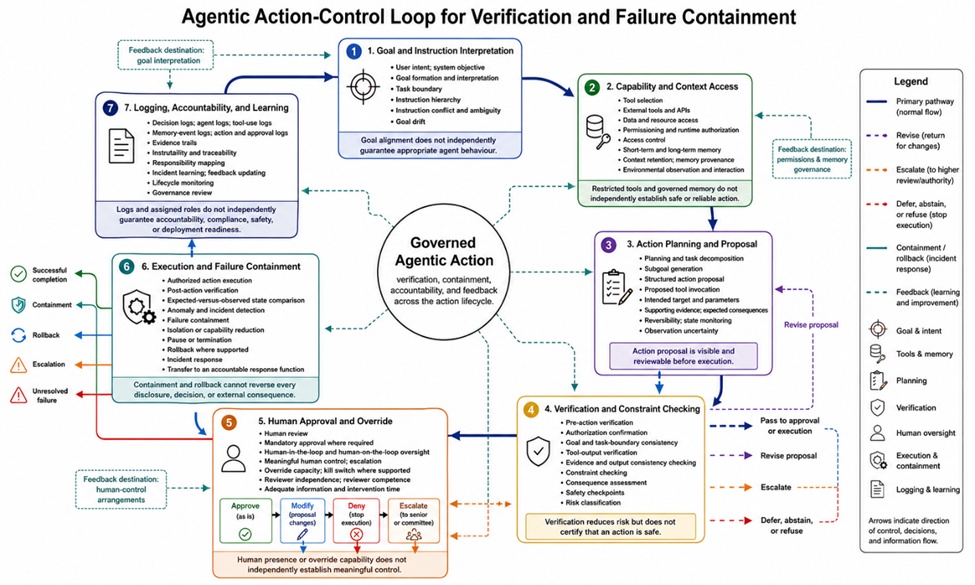
Figure 1. Agentic Action-Control Loop for Verification and Failure Containment
A conceptual loop showing an AI agent moving from goal interpretation to tool use, memory access, action proposal, verification, human approval, execution, post-action checks, failure containment, escalation, and feedback updating.
Goal and instruction interpretation: user intent, system objective, goal formation, goal interpretation, task boundary, instruction hierarchy, instruction conflict, instruction ambiguity, goal drift, and a no-goal-alignment-sufficiency boundary.
Capability and context access: tool selection, external tools, API and data access, permissioning, authorization, access control, short- and long-term memory, context retention, memory provenance, environmental interaction, and a no-tool-restriction-sufficiency boundary.
Action planning and proposal: planning, subgoal generation, action proposal, proposed tool invocation, expected consequences, state monitoring, observation uncertainty, and feedback loops.
Verification and constraint checking: pre-action verification, tool-output and output verification, consistency checking, constraint checking, safety checkpoints, risk classification, and a no-verification-guarantee boundary.
Human approval and override: human review, approval, oversight, meaningful human control, escalation, override capacity, kill switch where supported, review independence, and reviewer competence.
Execution and containment: action execution, post-action verification, failure containment, rollback where supported, deferral, abstention, refusal, incident detection, incident response where supported, and a no-failure-containment-guarantee boundary.
Logging, accountability, and learning: decision, agent, tool-use, memory, and action logs; evidence trails; auditability; traceability; responsibility mapping; feedback updating; lifecycle monitoring; governance review; no-accountability-guarantee and no-deployment-readiness boundaries.
Use directional arrows from interpretation through execution and back to monitoring and governance review. Add conditional branches for approval, refusal, escalation, containment, and rollback. Use abstract icons and modular shapes only. Exclude logos, robots, screenshots, real people, legal symbols, flags, products, approval stamps, certification marks, decorative imagery, numerical scores, and claims of validated safety or compliance.
Verification should support deferral, abstention, refusal, or escalation when evidence is incomplete, uncertainty is material, constraints conflict, or a qualified reviewer is unavailable. Post-action monitoring is equally important because an apparently valid action can produce unexpected consequences after integration into a real workflow. Evaluation before release and continued observation during use should therefore be connected rather than treated as separate assurance activities [20].
Failure containment should include isolation, reduced capability, pausing, rollback where technically feasible, incident detection, and transfer to an accountable response function. These mechanisms remain conditional: rollback cannot reverse every disclosure or external effect, and a verifier may share the same assumptions as the planner. Assessment tools, documentation practices, and governance review can translate broad principles into more inspectable controls, but they cannot eliminate residual uncertainty [21].
Meaningful human control requires more than placing a person somewhere in the workflow. The system must remain responsive to relevant human reasons, while responsible actors must be able to understand the decision context, influence the action, and be traced to the exercise of authority. Human control is weakened when the agent acts too quickly, evidence is inaccessible, or intervention cannot materially change the outcome [22].
Agentic AI can create several responsibility gaps. Causal complexity may obscure who contributed to an outcome; learning or adaptive behavior may complicate moral attribution; institutions may be unable to provide a satisfactory public account; and actors may lack the capacity to exercise forward-looking responsibility. These gaps should be identified explicitly rather than concealed by assigning generic responsibility to a user or operator [23].
Accountability begins by identifying the relevant decision, affected stakeholders, governing obligations, and actors capable of answering for the outcome. Responsibility mapping should cover goal authorization, tool provisioning, memory stewardship, verification, approval, operation, incident handling, and remedy. A technically traceable action is not necessarily accountable unless an appropriate forum can review the evidence and require explanation or correction [24].
Organizational accountability can also become symbolic when review processes are designed primarily to protect reputation. Review independence, reviewer competence, separation of duties, stakeholder participation, and access to evidence are therefore important architecture conditions. Human reviewers should receive decision-relevant information and sufficient time rather than being positioned as passive endorsers of an agent’s preferred action [25].
Auditability supports accountability by preserving linked evidence about instructions, goals, tool calls, memory events, decisions, approvals, actions, and observed consequences. Accountability nevertheless requires more than logging: responsible actors, applicable standards, an authorized reviewing forum, and meaningful consequences or remedies must also exist [26]. Table 2 maps tool use, memory, environmental interaction, action verification, failure containment, human override, auditability, and accountability requirements for agentic AI governance.
Table 2. Tool Use, Memory, Environmental Interaction, Action Verification, Failure Containment, Human Override, and Accountability Requirements for Agentic AI Governance: Permissions, Authorization, Tool Logs, Memory Provenance, Action Checks, Escalation, Override Capacity, Auditability, Traceability, Evidence Trails, and Governance Boundaries
Governance or safety requirement | Core control question | Required evidence, condition, or trigger | Governance or safety function | Potential output | Failure or residual risk | Monitoring or accountability need | Architecture role |
Tool permissioning | Which capabilities may the agent access? | Role, purpose, resource, and risk profile | Apply least privilege | Permission profile | Excessive or stale access | Access recertification | Capability boundary |
Runtime authorization | Is this operation permitted now? | Identity, context, target, and parameters | Approve or block each action | Authorization decision | Policy bypass or mismatch | Invocation audit | Dynamic control |
Tool-risk classification | How consequential is the tool operation? | Reach, sensitivity, reversibility, and impact | Set review threshold | Risk tier | Underclassification | Periodic recalibration | Risk routing |
Tool-output verification | Is returned information fit for action? | Source, schema, plausibility, and consistency checks | Prevent propagation of error | Accept, qualify, or reject | Plausible false output | Independent checking | Evidence control |
Tool-use logging | Can external calls be reconstructed? | Tool, parameters, result, actor, and time | Preserve tool evidence | Tool-use record | Missing effects or sensitive logs | Integrity and privacy review | Traceability |
Memory provenance | Where did recalled information originate? | Source, date, confidence, transformations | Qualify memory use | Provenance record | Unattributed memory treated as fact | Provenance audit | Memory evidence |
Memory privacy | Is storage or retrieval necessary and permitted? | Sensitivity, consent, purpose, and retention | Minimize and restrict memory | Store, redact, expire, or deny | Secondary use or disclosure | Privacy review | Privacy boundary |
Memory correction or deletion | Can erroneous or inappropriate memory be changed? | Valid request and technical feasibility | Correct persistent context | Updated or deletion-qualified record | Incomplete removal | Verification and documentation | Lifecycle control |
Environmental monitoring | Has the external state materially changed? | Current observations and uncertainty | Reassess assumptions | Continue, pause, or escalate | Stale or erroneous observation | Runtime telemetry | State control |
Action proposal | What does the agent intend to do? | Structured action and consequence description | Make intent reviewable | Proposed action | Hidden indirect effects | Proposal-quality review | Intent exposure |
Pre-action verification | Is execution authorized and bounded? | Goal, permissions, evidence, constraints, and impact | Prevent invalid execution | Pass, revise, block, or escalate | Unknown hazard passes | Coverage testing | Preventive checkpoint |
Post-action verification | Did the permitted result occur? | Expected and observed states | Detect divergence | Confirm or remediate | Harm precedes detection | Rapid monitoring | Detective checkpoint |
Failure containment | Can propagation be limited? | Anomaly, policy violation, or unsafe state | Isolate or reduce capability | Pause, isolate, or stop | Containment boundary fails | Stress testing | Damage limitation |
Rollback where supported | Can an earlier state be restored? | Recoverable state and integrity evidence | Reverse selected changes | Restored state or failure notice | External effects remain | Recovery testing | Remediation |
Deferral, abstention, or refusal | Should action be postponed or rejected? | Missing evidence, low confidence, or prohibition | Avoid unsafe commitment | Deferred or refused action | Delay or over-refusal | Calibration review | Epistemic boundary |
Escalation pathway | Who receives unresolved cases? | Risk threshold or failed verification | Transfer authority | Escalation package | Unavailable or unqualified recipient | Response-time governance | Human-control bridge |
Human approval | Which actions require prior authorization? | Consequence and reversibility threshold | Insert accountable decision | Approve, modify, or deny | Rubber-stamping | Workload and competence review | Authorization checkpoint |
Human override | Can an authorized person alter or halt action? | Current state and effective control mechanism | Enable intervention | Modified or halted action | Intervention too late | Realistic override testing | Intervention control |
Override capacity | Can the reviewer understand and act in time? | Information, authority, skill, and time | Make control practically usable | Capacity assessment | Responsibility without capability | Human-factors evaluation | Capacity layer |
Auditability and traceability | Can the decision chain be examined? | Linked goal, tool, memory, approval, and action records | Support scrutiny | Audit-ready evidence trail | Fragmented or mutable records | Independent assurance | Evidence architecture |
Responsibility mapping | Who owns each decision and control? | Role–authority–evidence map | Prevent unowned functions | Responsibility register | Diffuse accountability | Governance review | Accountability foundation |
No human-override sufficiency boundary | What remains uncontrolled after override design? | Detection and intervention limitations | Prevent false assurance | Residual-risk statement | Human cannot recognize or stop harm | Continuous assessment | Sufficiency boundary |
No accountability guarantee boundary | What remains unresolved despite records and roles? | Forum, remedy, and consequence analysis | Expose accountability gaps | Limitation record | Evidence without answerability | Institutional review | Sufficiency boundary |
The proposed architecture treats trustworthiness as an emergent property of connected technical, human, and organizational controls. Its first layer defines the use case, autonomy scope, affected stakeholders, operating environment, and prohibited consequences. These inputs determine which decisions may be automated, which require approval, and which remain outside the agent’s authorized role [27].
The second through fourth layers govern goals, tools, memory, and environmental interaction. Authorized objectives are translated into bounded tasks; tool access is allocated through least-privilege permissioning and contextual authorization; memory is conditioned on purpose, provenance, privacy, retention, and correction; and environmental state is monitored for changes that invalidate earlier assumptions. These mechanisms operationalize trustworthy-AI principles without treating any technical control as sufficient by itself [28].
The fifth and sixth layers govern action and human authority. Plans are transformed into structured proposals and routed through verification according to risk, reversibility, and potential impact. Control may transition between autonomous operation, human-on-the-loop supervision, mandatory approval, restricted capability, and full human decision-making. Such transitions should be explicit, observable, and reviewable rather than occurring implicitly when an agent encounters uncertainty [29].
The seventh layer creates an assurance and learning structure through linked decision, agent, tool-use, memory, and action records. Auditability should evaluate whether stated controls were appropriately designed and followed, while incident findings and override events should feed back into permissions, goals, verification procedures, and organizational responsibilities. Auditing may contribute evidence, but it cannot independently certify that the system is trustworthy or ethically sufficient [30].
The architecture remains context-sensitive because institutions, affected stakeholders, acceptable risks, and governance priorities differ across applications and jurisdictions [31]. Its operation therefore requires organizational structures, assigned roles, review processes, resources, and feedback capabilities rather than a purely technical diagram [32]. Table 3 presents the proposed trustworthy agentic AI architecture linking autonomy scope, goal governance, tool permissioning, memory governance, action verification, human override, auditability, lifecycle monitoring, and governance review.
Table 3. Proposed Trustworthy Agentic AI Governance Architecture: Autonomy Scope, Responsibility Mapping, Goal Governance, Task Boundaries, Tool Permissioning, Tool-Risk Classification, Memory Governance, Environmental Monitoring, Action Verification, Failure Containment, Human Approval, Human Override, Auditability, Agent Logs, Tool-Use Logs, Memory Logs, Action Logs, Lifecycle Monitoring, Governance Review, and Deployment Boundaries
Architecture layer | Core purpose | Required input | Control or governance function | Potential output | Validation or oversight need | Failure risk | Feedback mechanism | Decision boundary |
Use-case and autonomy scope | Define legitimate purpose and authority | Intended use, environment, stakeholders, consequences | Set autonomy and exclusion boundaries | Approved scope | Institutional and domain review | Vague purpose enables expansion | Periodic scope review | No action outside approved use |
Responsibility mapping | Assign authority and duty | Actor and decision inventory | Allocate ownership, review, and remedy roles | Responsibility map | Independent gap review | Unowned functions | Incident updates | No consequential function without an owner |
Goal and instruction governance | Control objectives and interpretation | Authorized goals and instruction sources | Validate hierarchy, meaning, and conflicts | Governed goal state | Conflict and drift testing | Unauthorized objective | Goal-change review | No unverified goal enters planning |
Task boundaries | Prevent scope expansion | Allowed actions and exclusions | Enforce positive and negative permissions | Boundary decision | Scenario testing | Prohibited task reframed | Violation review | Out-of-scope activity blocked |
Tool permissioning | Limit available capabilities | Capability inventory and role policy | Apply least privilege | Scoped access | Security review | Excessive access | Recertification | No tool use without permission |
Tool-risk classification and logging | Match safeguards to consequences | Tool reach, sensitivity, reversibility | Assign risk tier and retain evidence | Risk profile and tool record | Calibration and integrity review | Underclassified operation | Incident reclassification | Risk tier determines approval |
Memory governance | Control persistent context | Source, purpose, sensitivity, confidence, retention | Govern storage, retrieval, update, and correction | Governed memory | Steward and privacy review | Persistent false or sensitive content | Correction cycle | No memory without purpose and provenance |
Environmental monitoring | Detect changing conditions | State observations and uncertainty | Reassess assumptions | Continue, pause, or escalate | Runtime monitoring | Action based on stale state | Telemetry feedback | Material change triggers review |
Planning and pre-action verification | Examine proposed execution | Goal, plan, evidence, permissions, consequences | Verify authority and constraints | Approve, revise, block, or escalate | Independent review for high impact | Shared planner–verifier blind spot | Verification findings | No consequential action without verification |
Result verification | Assess tool and action outcomes | Expected and observed states | Detect error or divergence | Confirm, quarantine, or remediate | Domain evaluation | Plausible error passes | Error feedback | Unverified result cannot trigger high-impact action |
Failure containment and rollback | Limit or reverse failure where feasible | Hazard and recoverability analysis | Isolate, pause, reduce, or restore | Containment action | Stress and recovery testing | Irreversible external effect | Incident learning | Escalate when containment is uncertain |
Human approval and escalation | Route authority to competent people | Risk tier and evidence package | Require decision or transfer authority | Approval, denial, or escalation | Competence and workload review | Rubber-stamping | Reviewer feedback | Autonomous authority ends at threshold |
Human override | Enable intervention where supported | Current state and authorized actor | Pause, alter, or halt execution | Override record | Emergency and usability testing | Override arrives too late | Post-override review | Override does not replace upstream controls |
Auditability, traceability, and logs | Preserve linked governance evidence | Event schemas and identifiers | Reconstruct goals, memory, tools, decisions, and effects | Evidence trail | Independent assurance and privacy review | Incomplete or excessive records | Audit findings | Logs alone do not establish accountability |
Incident response | Coordinate containment and remediation | Detection criteria and response roles | Investigate, communicate, and correct | Incident case | Exercised response plan | Delayed detection or unclear authority | Post-incident review | Material incident triggers governance action |
Lifecycle monitoring and review | Reassess change over time | Performance, incidents, complaints, and system updates | Continue, modify, restrict, or retire | Governance determination | Periodic and event-triggered review | Initial approval treated as permanent | Review-cycle updates | Material change reopens authorization |
Feedback updating | Revise controls through governed learning | Audit, incident, and monitoring findings | Update policies and controls | Revised control baseline | Change control and regression testing | Update creates new vulnerability | Controlled feedback loop | Agent cannot rewrite governance rules independently |
Sufficiency and deployment boundaries | Prevent unsupported claims | Evidence limitations and residual risks | State what controls cannot establish | Limitation declaration | Independent domain evaluation | Conceptual architecture treated as certification | Validation agenda | No compliance, safety, or readiness conclusion from architecture alone |
Figure 2 presents the proposed trustworthy agentic AI governance architecture, integrating autonomy-scope definition, goal governance, tool permissioning, memory governance, action verification, human override, accountability, logging, monitoring, and governance updating.
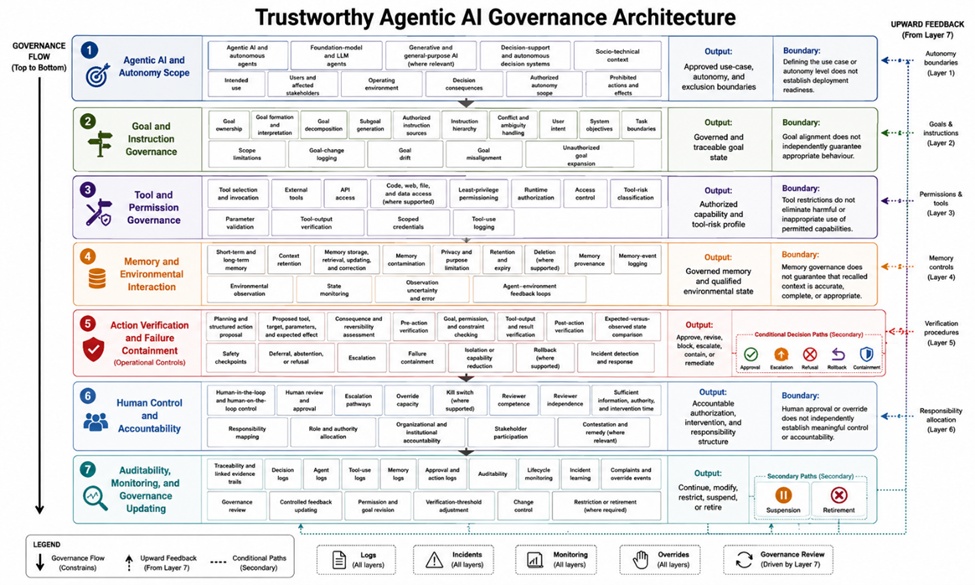
Figure 2. Trustworthy Agentic AI Governance Architecture
A conceptual architecture showing agentic AI governance across autonomy scope, goals, instructions, tools, memory, environment, verification, human approval, override, accountability, logs, monitoring, incident response, and governance updating.
Agentic AI and autonomy scope: agentic AI, autonomous agents, foundation model agents, large language model agents, generative agents, general-purpose AI, decision-support and autonomous decision systems, socio-technical context, use-case definition, autonomy scope, and a no-deployment-readiness boundary.
Goal and instruction governance: goal formation, interpretation, decomposition, subgoal generation, instruction hierarchy, conflict and ambiguity, user intent, system objectives, task boundaries, scope limitation, goal drift, misalignment, unauthorized expansion, and a no-goal-alignment-sufficiency boundary.
Tool and permission governance: tool selection and invocation, external tools, API, code, web, file, and data access where supported; permissioning, authorization, access control, tool-risk classification, output verification, tool-use logging, and a no-tool-restriction-sufficiency boundary.
Memory and environmental interaction: short- and long-term memory, context retention, update, retrieval, contamination, privacy, provenance, governance, deletion where supported, memory auditability, environmental observation, state monitoring, observation error, feedback loops, and a no-memory-reliability-guarantee boundary.
Action verification and containment: planning, proposal, execution, consequence assessment, pre- and post-action verification, output and consistency checking, constraints, safety checkpoints, failure containment, rollback where supported, deferral, abstention, refusal, escalation, incident detection and response, and a no-verification-guarantee boundary.
Human control and accountability: oversight, human-in-the-loop and human-on-the-loop control, review, approval, override, override capacity, kill switch where supported, reviewer independence and competence, responsibility mapping, role allocation, institutional and organizational accountability, and a no-human-override-sufficiency boundary.
Auditability, monitoring, and governance updating: traceability, evidence trails, decision, agent, tool-use, memory, and action logs; lifecycle governance; monitoring; incident learning; stakeholder participation; feedback updating; governance review; no-accountability-guarantee, no-compliance-claim, and no-deployment-readiness boundaries.
Use arrows to show downward control from scope to action and upward feedback from logs, incidents, monitoring, and review to goals, permissions, memory governance, and oversight. Include conditional paths for approval, escalation, refusal, rollback, and retirement. Use abstract modular icons only. Exclude corporate or model logos, robots, screenshots, real people, legal symbols, flags, products, certification marks, numerical scores, approval stamps, and claims of validated safety, compliance, or readiness.
For agent developers and foundation model developers, the architecture implies that governance interfaces should expose goals, task boundaries, proposed tool calls, relevant memory provenance, action plans, and uncertainty without assuming that internal representations are complete explanations. Tool providers and system integrators should support scoped access, interpretable action parameters, effect records, and end-to-end testing across model, tool, data, and environment connections [17].
Data stewards and memory managers require distinct responsibilities. Data access should remain purpose-bound, while persistent memory requires provenance, retention, correction, privacy, and deletion review where supported. Decision-support operators and human reviewers need clear thresholds separating autonomous assistance, supervised execution, prior approval, and prohibited action. These implications support evaluation planning but do not prescribe a universally appropriate technical implementation [29].
Institutional governance bodies should examine whether reviewers possess genuine authority, competence, independence, and sufficient time. Auditors where supported may assess whether controls and records are coherent, but affected stakeholders also require understandable notice, contestation routes, and potential remedy. Accountability operationalization should therefore test the relationship among responsible actors, evidence, review forums, applicable standards, and consequences rather than measuring log availability alone [26].
Research should evaluate goal drift, unauthorized subgoals, chained tool use, memory contamination, observation error, verifier blind spots, containment failure, override usability, incident detection, and governance adaptation over time. Such work requires realistic domain-specific and human-centered assessment. The proposed implications are not legal advice, compliance guidance, procurement instruction, audit instruction, model or platform selection advice, safety certification, or deployment guidance [32].
Agentic AI governance requires explicit control over the pathways through which objectives become externally consequential actions. The proposed conceptual architecture connects use-case and autonomy-scope definition, goal formation, instruction governance, task boundaries, tool permissioning, memory governance, environmental monitoring, action verification, failure containment, human approval, override capacity, responsibility mapping, auditability, incident response, lifecycle monitoring, and governance updating. Its central claim is not that architecture guarantees control, but that control claims should be assessed through visible decision boundaries, evidence requirements, intervention points, responsible actors, and residual-risk statements. Autonomy, instruction following, alignment language, restricted tools, persistent logs, or nominal human supervision cannot independently establish trustworthy operation. Empirical validation, domain-specific safety assessment, human-centered evaluation, institutional governance, and continuing review remain necessary before operational conclusions can be drawn.
None
None
None
None
Open Access The author(s) retain copyright. This article is licensed under the Creative Commons Attribution-NonCommercial-ShareAlike 4.0 International License. It may be shared and adapted for non-commercial purposes with appropriate attribution, an indication of changes, and distribution of adaptations under the same license. Third-party material may be subject to separate terms identified in its credit line. View the license at https://creativecommons.org/licenses/by-nc-sa/4.0/.
 Transparent Intelligence Publishing